

"Sharing the Greatest Gift" - Amy Lawrence
Whether we grew up in the church or came into the fold later in life, every Christian has a story of the where, when, why, and how they were taught the gospel.
Evangelism
Sharing the Greatest Gift
Whether we grew up in the church or came into the fold later in life, every Christian has a story of the where, when, why, and how they were taught the gospel. I live in an area where there is a sound congregation of the Lord’s church around every corner. We are in what is known as the Bible Belt of the United States. If Tennessee is a belt, then Warren County is the buckle, with over 40 congregations of the church of Christ. Americans have the advantage of an amazing amount of resources when we need to know more about God…but this isn’t the case everywhere. In Communist China, Bible distribution is regulated by the China Christian Council/Three-Self Patriotic Movement (CCC/TSPM). Only one company is authorized to print Bibles, the Amity Printer company, and only 3-3.5 million copies are distributed annually. (The Scripture Distribution Statistics report for Bibles distributed in the United States in 2022 was around 35.5 million copies.) A Bible in China can only be purchased in places approved by the CCC/TSPM, and in-house churches are reluctant to go to CCC/TSMP churches to purchase Bibles for fear of surveillance. Only one translation is available for purchase: the Chinese Union Version. We often take for granted the availability of scripture here in the US; over 3,100 versions of scripture in over 750 languages are accessible through the World Wide Web. (For the sake of accuracy, I would recommend using ASV, KJV, or NKJV.) For the most part, we as American citizens are blessed with religious freedom. This is a blessing that allows us to share the gospel in any of the 50 states, and elsewhere if possible. No one is beyond reach if we are brave enough to share what we’ve found with others. Let’s talk about how to do that.
The first step to doing anything worthwhile is having the desire to do so. God wants us to love Him - and each other - as much as He loves us, 1 Jn. 4:9; 5:3, and only a heart that has a love toward God and a desire to do His will can be pleasing to Him, Heb. 13:6, 1 Jn. 2:3-6. We as females are given responsibilities in the church. Although we cannot take on the leadership roles that are allotted to men, we can still do our part in evangelism. Being a God-fearing mother is one of the most influential of those responsibilities. Teaching the gospel should begin at home, Deut. 6:1-9. The influence is found in living what we teach. Children that see God in their parents are most likely to become Christians that continue sharing this gift. We also have the benefit of everyday living among others that may not know Christ. In the workplace, at home, at the sports court/field, even from grocery store conversations to bumper stickers and t-shirts, we can glow Christ. We have so many opportunities that we unfortunately often overlook. We can be billboards for Christ! Let’s look at all the opportunities we as women have by looking at the endeavors of the Proverbs 31 woman: She…
1.) …is trusted by her husband and blessed by her children, making her first and foremost an evangelist at home by shining Christ, Mt. 5:16.
2.) …“seeks wool and flax” and “brings food from afar”, most likely at a local market.
Both vendors and customers are potential audiences for the gospel, Acts 16:13-14.
3.) …“provides food for her household and a portion for her maidservants”, and in this is the opportunity to give both physical and spiritual sustenance to her family and employees.
4.) …uses her good work to be a beacon toward God, leading others to appreciate her work ethic and ask what makes her so dedicated, Acts 9:36,39.
5.) …“extends her hand to the poor”, another opportunity to give both physical and spiritual sustenance to anyone in need, Lk. 4:18.
6.) …”opens her mouth with wisdom and upon her tongue is the law of kindness”. We can teach children and other women in the church, we can aid in the work that goes into preparing for evangelical work, and we can be supportive to any missionary endeavor.
There are so many opportunities we as women have to aid in spreading the gospel. Don’t fall prey to the idea that any job toward evangelism is menial. Even if it’s something as simple as mailing Bible Correspondence Courses to someone interested in learning God’s Word, dedicate yourself to it. Mt. 6:4 - God sees! Don’t be afraid to strike up a conversation about Jesus if the opportunity arises, never let an open door close because you think you are too busy, and be a billboard for Christ every chance that you get to do so! We are His ambassadors, and that in itself is phenomenal. We are given the responsibility of showing the world the message of salvation, the blessing of sharing with others the grace and mercy we ourselves have received, and the honor of serving the One who gave all for us. Let us do so with joy, Acts 20:24!

If I Only Had This, I Would Be Happy—Wrong! - Ben Bailey
“My life would be happier if…”? If I had more money, if I had a better job, if I had a better education, I would be happier.
WRONG
If I Only Had This, I Would Be Happy—Wrong!
Have you ever said to yourself, “My life would be happier if…”? If I had more money, if I had a better job, if I had a better education, I would be happier. We have all had thoughts along those lines at one time or another in our life. Would these things really make your life happier? More money might make you worry more about losing it. A better job might mean more responsibility and more stress. A better education may not be the answer to the problem either. The real problem is we look to the wrong places for happiness. C. S. Lewis put it so simply when he said, “Human history is the long terrible story of man trying to find something other than God which will make him happy.”
Think back to the first time this failed venture arises in Scripture. Adam and Eve had everything they needed to live the best life provided by God in the Garden. They did not have to worry about the stresses of life that often bring us unhappiness. They truly were in Paradise! Despite living in Paradise already, the Devil was able to convince them something was missing. He tempted them with the forbidden fruit, and they thought they were missing something. Was it how good the fruit looked (Lust of the Eyes) that tempted them? Maybe It was how the fruit would improve their knowledge and power that appealed to them (Pride of Life). Or was it a desire to taste that new fruit they had never eaten (Lust of the Flesh)? Adam and Eve failed to realize that true happiness does not come from the pursuits of this earthly life but from God himself. God was the source of their happiness; they were just deceived into believing something was missing (Gen. 3:1-15).
Another clear picture of someone who had it all but could not be satisfied is Solomon. God blessed Solomon with wisdom, wealth, and power beyond our wildest imaginations (1 Kings 3:5-15). Even more important than the physical blessings Solomon had was His close relationship with God (1 Kings 3-5). Solomon truly had it all. Surprisingly, things change very quickly for Solomon and his happiness. He begins to add more stuff, and more wives and more earthly pursuits in his life. This man who was blessed supernaturally by God finally reaches a point in his life where he is so despondent and depressed that his conclusion on life is this: “Then I looked on all the works that my hands had done and on the labor in which I had toiled: And indeed, all was vanity and grasping for the wind. There was no profit under the sun” (Eccl. 3:11). How could Solomon reach such a low point in his life? He failed to learn that our happiness is not based on earthly pursuits, but rather our happiness is in God.
What about us today? Are we any different? Do we still try to base our happiness on the successes and attainments of earthly pursuits? Have you been where Adam and Eve, and Solomon were? Do you feel like if you could just taste something new or if you could just have more it would make you happy? Are you ready to learn an important but hard lesson? None of that stuff will really make you happy. Why not? Because true happiness is only in God not in earthly pursuits! Listen to the words of Psalm 1: “How happy is the one who does not walk in the advice of the wicked or stand in the pathway with sinners or sit in the company of mockers! Instead, his delight is in the Lord’s instruction, and he meditates on it day and night. He is like a tree planted beside flowing streams that bears its fruit in its season, and its leaf does not wither. Whatever he does prospers” (Psalm 1:1-3). May we learn the wonderful lesson that wherever we are at and whatever state we are in we can be happy because of God (Phil. 4:11). –Ben Bailey

"A Helper Comparable" - Amy Lawrence
(on Amazon) we as consumers can just type in a description of the item we seek, and hundreds if not thousands of possibilities present themselves at our fingertips.
A Helper Comparable
Seeking and Finding a Spouse
When browsing on Amazon, we as consumers can just type in a description of the item we seek, and hundreds if not thousands of possibilities present themselves at our fingertips. Pictures, videos, and customer reviews allow us to see the items in a more personal way. We can modify our search to limit it to a specific range - color, size, price, rating, even the name of a particular brand - and it will show us our heart’s desire. Seeking a spouse is not so simple. Many would suggest any number of dating websites that use this idea to find a compatible significant other, but there is a personal element missing from such tools. Given that this is an article that is geared toward a study for Christian women, one must ask: how does one find a godly husband in an ungodly world? As He is God, our Lord has answered any question that any Christian will ever have through the written documents we all know as scripture. Before we can glean from it, though, there is a certain foundation a Christian must have before God’s answer can be understood. God expects a student of scripture to have eyes and ears that are capable of seeing and hearing and a heart that is ready to receive, Mt. 13:13-17. If your eyes, ears, and heart are ready, let’s begin a study from God’s Word on the subject of finding a godly spouse.
We’ll first begin with the basics:
1.) A woman should be seeking a man and a man should be seeking a woman, Gen. 1:27, Mt. 19:4-5. Seeking the same gender is not an option, Lev. 18:22; 20:13, Rom.
1:18-32, Heb. 13:4. Enough said.
2.) A divorced man/woman is not always allowed to remarry, Lk. 16:18, 1 Cor.
7:10-11. If you are a woman that has divorced for reasons that are not authorized by
God, then you are still married in the eyes of God Almighty and are ineligible to date. If dating a divorcee, make sure you know whether or not their divorce was scripturally authorized. One should always be in possession of the facts before considering marriage to a divorcee.
3.) Although marrying a Christian is recommended, it is not a requirement, 1 Cor. 7:12-13. There are some in the brotherhood that attempt to bind where God has not bound in this matter. Scripture does not support the notion that marrying a nonChristian is disallowed. Having said that, I will also say that a wise Christian that considers not just their own future but also the future of their children, will seek out another Christian to marry.
Now, to the meat of the matter.
When seeking the person with whom you plan to spend the remainder of your life, do so more with intelligence than emotion. Anyone that allows emotion to steer the helm of their ship is one that is without the anchor of reason to keep them from crashing into the rocky shore. USE. YOUR. BRAIN. FIRST. When making decisions now, consider the impact today’s decisions will have on your future. There’s a word for this concept: prudence. Scripture has a lot to say about prudence, Prov. 8:12; 12:16, 23; 13:16; 14:8, 15, 18; 15:5; 16:21; 18:15; 19:14; 22:3; 27:12, Hosea 14:9. It is always coupled with wisdom. One who lacks wisdom suffers, Prov. 10:13. A lot. A wise person uses patience and observation skills to learn the person they are considering marrying. No, I’m not suggesting fingerprinting, a background check, and an application process for every date. I am suggesting an attention to detail that is not clouded by emotional judgement. People will tell you everything you need to know about them if you just pay attention.
Another element of prudence is being able to let them go if they are not the right person for you. Being “in love” with someone does not make marriage to that person mandatory nor does it mean the love is reciprocated. One of the biggest mistakes made by people that are dating is that of confusing lust for love. Sexual attraction alone is a terrible way to decide if that person will make a good spouse/parent. With marriage, you are creating a team of two people that become one entity, Eph. 5:31. These two people must work in tandem to build a successful household. The health of a household depends directly on the health of the marriage that is the first building block of that household. If the foundation is God and His will, every block that is laid on that foundation will hold up against any storm.
Make sure love is the tie that binds, and make sure you know how to define “love”. The definition of true love can be found in 1 Cor. 13:4-8. This is the only love that has the power to withstand anything this life can throw at you as a couple. Be prudent when seeking this love, recognizing this love, and being this love. I know you’re thinking, “Well, Amy, you told us earlier not to think with our emotions.” Read 1 Cor. 13 again. Every term that Paul uses to define “love”, ἀγάπη (agapé), is a verb. It’s an action. A person can say “I love you” all day long, but it’s nothing but hot air - until it is shown through their actions. (If actions do not match words, then that’s a red flag, ladies.) The actions listed in 1 Cor. 13 are those of a care for another’s wellbeing ahead of your own. Seek someone whose needs you can put ahead of your own, but also can do the same in return for you.
Let’s be honest; what we seek most when considering marriage is attraction. As I will agree that beautiful people have a much easier time gaining attention, one must be careful that their beauty is not only skin-deep. Absalom was an incredibly handsome man, but his character was appalling, 2 Sam. 13:30; 14:25.. A Christian seeking true beauty will seek spiritual beauty, not just physical. David had such beauty, 1 Sam. 16:6-13; 17:42, Ps. 34:18. We should also consider, though, that outward attractiveness is not a necessity. Jesus Himself was recorded as being average in His outward appearance, Is. 53:2. He is still beautiful to the spiritually focused mind that knows Him and is eager to see Him, 2 Tim. 4:8. Don’t overestimate (or underestimate) what you see, Jn. 7:24. A person can look like a 10 on the outside, but if their character is a 3, then they’re a 3. The opposite is true, as well; a 3 on the outside that is a 10 on the inside is a 10. Kindness is beautiful. Joy is beautiful. Meekness, self-control, gentleness, patience, intelligence, selflessness are all beautiful. Outward beauty will fade. Only inward integrity can stand the test of time. Be more attracted to that beauty.
When it comes to finding someone that you will share space with indefinitely, there’s not really a checklist. That’s not how it works. Everyone is attracted to varying combinations of attributes. You can set your own standard, though. It is important to find a person with whom you can coexist well. Common likes and dislikes are essential to the success of any relationship. You will never find that success if you don’t know what you stand for - and won’t stand for - in the relationship. Set boundaries for yourself. Respect boundaries of anyone you date. Learn habits! Whether they are your own or those of anyone you date, LEARN HABITS! If it’s a bad habit, change! Part of setting boundaries is asking your significant other to change bad habits as well, and if they refuse to change, that’s another red flag! Never assume that a person cannot change. (It takes time, so be patient.) We are all a fluid concept. It’s the willingness to change what needs to be changed and keep what needs to be kept that is the determining factor of maturity. (Don’t sell yourself short by assuming they will change after marriage, either. I know many women that have made that mistake. If they won’t change while you’re dating, they won’t change while you’re married, Luke 16:10-11.) A couple that desires a successful marriage has to be two people that can communicate within a balance of being accountable to one another. They also, above all, must be forgiving. Mistakes will be made. A successful marriage is that of two good forgivers, Eph. 4:31-32.
When God placed Adam in the Garden of Eden, He said, “It is not good that man should be alone. I will make him a helper comparable to him.” (Gen. 2:18) The word used for “comparable” here is the Hebrew word נָגַַד (nagad). This word is used elsewhere in scripture to describe proximity, the space and time shared in the relationships of people. There is more detail given to this relationship between husband and wife, though. Gen. 2:21-22 describes the very first Father that led His daughter to her waiting bridegroom. Adam describes Eve as being “bone of my bone and flesh of my flesh”, vs. 23. Husband and wife do not just share time and space. They share flesh, vs. 24-25. Before I go on, I need to make one thing inescapably clear; boyfriends do not get husband privileges. Period. There is no such thing as a “test drive” when it comes to physical relations between a man and a woman. Purity is a requirement in every aspect of God’s law, and marriage is no exception, Heb. 13:4. This is where it is most vital that we USE OUR BRAIN and not our emotions. If you are susceptible to losing your good sense in situations where there is the temptation to go too far with a date, then don’t put yourself into those situations. Paul dealt with a problem the Corinthians were suffering when it came to physical relations. The city itself was rife with sexual immorality. One of the questions the Corinthian Christians asked Paul was answered in 1 Cor. 7:1-2: “to avoid sexual immorality, let each man have his own wife and each woman have her own husband.” This is the only relationship in which the sharing of flesh is allowed. If a date refuses to respect this boundary, that’s not just a red flag - that’s shark-infested waters. Find a man that is as obsessed with purity as you should be.
God set a pattern for all households. In order to enjoy the success God’s law provides, one must adhere to the organization God’s law commands, Gen. 18:19. As Christian women, we are commanded to submit to our husbands, Eph. 5:22. Once you are married, you don’t get to decide at that point that you cannot submit to the man you chose. Find a man to whom you can submit BEFORE you marry. This is the only time you get to decide. Understand also the wording of Eph. 5:22. It doesn’t say, “husbands, make your wives submit”. That is not his job, so don’t make it his job. He has a heavy enough responsibility already. Submission is our responsibility. I have found, however, that it is easy to submit when I love the one to whom I submit. My husband takes care of me, the care that is described in Eph. 5:25, sometimes even to the sacrifice of himself. THAT’S love, Phil. 2:3-5. It’s only fair that I reciprocate, Prov. 31:27-28. Does this mean I don’t have to reciprocate if my husband doesn’t take care of me? No. I’m not just submitting to my husband. I’m also submitting to God, 1 Pet. 2:18-25, and He has commanded that I submit to my husband - no matter how easy or difficult that becomes. Even if it does become difficult, don’t underestimate the influence of good character. If I do what I should do, even if my husband does not, my conduct could one day convince my husband to behave as God would have him, 1 Pet. 3:1-2. This works both ways. Good husbands can also influence wives to be more godly.
Most women get this idea in their heads that “submission” is a bad word that carries undesirable connotations. This is usually because all they have ever known was a misrepresentation of submission. I clean my husband’s dirty socks and underwear, but I’m not his maid. I wash my husband’s used dishes, but I’m not his waitress. I know this because of the appreciation he shows for the things that I do for him. He earns the money that enables him to mow a lawn he barely gets to enjoy, maintain the structural integrity of a house and its utilities he spends less than a quarter of his time using, and ensure the wellbeing and happiness of the people that get to reap the benefits of these things more than he does - but that doesn’t make him my personal ATM. He knows this because I show appreciation for the things he does for me. Communication and selflessness are two very principal keys to a working relationship between husband and wife. He doesn’t treat me as chattel and lord over me, either. Husbands should love their wives as they do their own flesh, Eph. 5:28-29.
Submission is not a baser, degrading position to hold. It is simply that of a follower. Any good leader is aware of the needs of anyone under their leadership but also takes into account the desires and opinions of those in their care. Such respect makes submitting to such a leader an easy choice. This, of course, doesn’t mean that they do not have the final authority. My husband frequently asks my opinion on important decisions, but ultimately the decision is his and his alone. There have been (and I’m sure will be) times that I have not agreed with the decision my husband has made. This does not give me the right to overstep the boundaries God has set. Sometimes my husband was right and I didn’t see until after the fact. Sometimes, he was wrong. I would love to tell you that I have always handled the “I told you so” conversation with patience, understanding, and forgiveness…but that would be a lie. I will say this; any time the conversation WAS handled with patience, understanding, and forgiveness, that’s where growth happened. Such communication gave him the wherewithal to admit his mistake and also to more freely forgive my mistakes in the future. God’s way works best, every time, Ps. 1:1-3, Nahum 1:7.
I have been blessed with a wonderful husband. He wasn’t dropped into my lap nor I into his. He wasn’t miraculously instructed to find me and woo me, nor was I divinely struck upon the back of the head and told to locate and marry this man. We were blessed through the providence of God with sense, circumstance, and opportunity. God still left the decision up to us. I have now been happily married for almost 21 years. “Happy” doesn’t mean there wasn’t trouble. We’ve had more good days than bad, but the bad days have made the good all the more pleasant. We are a team as we raise our daughter, we are a force to be reckoned with when battling those problems that come along, and we owe all of this to God because it is Him we follow.
His word is our shield and buckler, Ps. 91:4.
If you are a woman in search of a good husband, God’s word describes how such a man can be recognized. It makes them so much easier to find when you know what you’re looking for and doing so in the right place - the church. Just don’t ignore the probability that those good men are seeking good women. If you want a good husband, you have to be a good wife. The woman in Proverbs 31 is the kind that doesn’t ignore chapters 1-30. I hope this study has given you a starting point to a bountiful harvest from the will of God in how to find a good husband and be a good wife. I pray that every wife finds herself as blessed as this one is.

My Most Contrary Convert - Ben Bailey
Who is the one person you must work on most with the Gospel? Who would you, more than anybody else, like to see conform to the image of Christ? If your answer is anyone other than self, you are not looking in the right direction.
My Most Contrary Convert
Who is the one person you must work on most with the Gospel? Who would you, more than anybody else, like to see conform to the image of Christ? If your answer is anyone other than self, you are not looking in the right direction. Jerry Bridges expressed it correctly when he said, “Preach the gospel to yourself every day.” We all believe in preaching the Gospel. Reaching our friends and neighbors with the good news is a high priority. But like Mr. Bridges said, I need to preach the Gospel to myself first every day. I am my most contrary convert! Yet, it is encouraging to know I am not the only one who felt this way.
The Apostle Paul said, “But I discipline my body and bring it into subjection, lest, when I have preached to others, I myself should become disqualified” (1 Cor. 9:27). Paul knew it was a challenge every day to crucify self and live for the Master (Gal. 2:20; 1 Cor. 15:31). Like us, his struggle was real. Paul said, “Wretched man that I am! Who will deliver me from this body of death? Thanks be to God through Jesus Christ our Lord! So then, I myself serve the law of God with my mind, but with my flesh I serve the law of sin” (Rom. 7:24-25). Like the Apostle Paul we must never stop preaching the Gospel to ourselves and striving to live faithful to Jesus every day. Do you remember what Paul said about the struggle? He said, “Not that I have already obtained this or am already perfect, but I press on to make it my own, because Christ Jesus has made me his own. Brothers, I do not consider that I have made it my own. But one thing I do: forgetting what lies behind and straining forward to what lies ahead, I press on toward the goal for the prize of the upward call of God in Christ Jesus” (Phil. 3:12-14).
While it is indeed a wrestling match with the flesh every day, do not give up. Keep fighting the good fight of faith (1 Tim. 6:12). Keep dying to self and crucifying self every day (Gal. 2:20; 1 Cor. 15:31)! If our mindset is that we are not going to give up and we are going to keep working on self and walking in the light, then we have the right mindset to win the battle (Luke 9:23; 1 John 1:7). Keep working on your most contrary convert—Yourself! He is worth it! —Ben Bailey

Everything Makes Sense with God - Ben Bailey
How do we make sense of this short, temporary existence on this terrestrial ball? What does it all matter anyway? We are only going to be here a while, and in a few years it will all be over, right?
Everything Makes Sense with God
In his book Desiring God, John Piper said, “The proper understanding of everything in life begins with God.” How do we make sense of this short, temporary existence on this terrestrial ball? What does it all matter anyway? We are only going to be here a while, and in a few years it will all be over, right? It only makes sense if everything in life begins with God! Notice two ways this impacts my everyday life.
God is My Life. In a dark and dreary book, the wise sage tried everything to find the proper understanding. He focused on building projects. He fulfilled every pleasure he desired. He planted gardens and flower beds. He acquired treasure and had many servants at his beckon command. He put his attention on music and the arts, as well as the lust of the flesh. How do you think all that worked out for him? Listen to his own words: “And whatever my eyes desired I did not keep from them. I kept my heart from no pleasure, for my heart found pleasure in all my toil, and this was my reward for all my toil. Then I considered all that my hands had done and the toil I had expended in doing it, and behold, all was vanity and a striving after wind, and there was nothing to be gained under the sun” (Eccl. 2:10-11). That is a little bit shocking and so counter to what the world would have us believe today. Imagine all the money, time and effort Solomon put into these ventures! And his final analysis of it all was it was a worthless waste of time. Why? Because Solomon had not yet learned that life only makes sense with God. He would later realize this and say, “Let us hear the conclusion of the whole matter: Fear God and keep His commandments, for this is man’s all” (Eccl. 12:13).
God is My Glory. If life only makes sense when we put God in the proper place, what does that change about my life. It causes us to recalibrate around a different and selfless purpose in life. Through the prophet Isaiah, God said “Everyone who is called by My name, Whom I have created for My glory; I have formed him, yes, I have made him” (Isa. 43:7). Everything I do now, I do it to God’s glory and not my own selfish interest. My Job—an opportunity to Glorify God. My recreation—I am looking for opportunities to magnify the name of God. My home life—It is one of my greatest ways to glorify and magnify the name of God. What we really need to learn is everything in life, even the trivial things, are about glorifying God. That is why I am here! Paul said this to the Corinthians in these words, “Therefore, whether you eat or drink, or whatever you do, do all to the glory of God” (1 Cor. 10:31).
Does your life have the meaning and purpose you so desperately long for it to have? The real question we need to ask is, “Is God my purpose and my glory?” May each of us be encouraged to think about why were here and make sure we realize that everything begins with and only makes sense when God is the center of our life
Evangelism or Benevolence? Both! - Joey Ferrell
Sometimes the church may get encumbered by the “works” of the church and maybe at time lose balance and even sometimes the focus of the work of the church.
Sometimes the church may get encumbered by the “works” of the church and maybe at time lose balance and even sometimes the focus of the work of the church.
One “three-legged stool” thought of the work of the church is at times described as 1. Benevolence, 2. Evangelism, and 3. Edification. Certainly, all three of these can be supported in scripture with passages such as Ephesians 4:11-12, Colossians 3:17, James 1:27, Galatians 6:10, Matthew 28:18-20 and many other passages that show compassion, edification, and benevolence.
But, why do we sometimes try to separate these things…when truly, they should all be in conjunction with one another? Yes, evangelism is hard work. Yes, benevolence can be costly with money and time. Of course, edification is necessary for the saints to grow! Balancing these things can be much more than just an obligation. It can sometimes be quite rewarding to not only those receiving the benefits of the three, but also the church and each individual Christian as these works “collide.”
Please allow me to share one illustration of this “three-legged stool” being strengthened and the glory of our Lord being shown quite evident through such a collision.
At the end of September, many will remember that our Southeastern area of the United States became victim to not just one, but two back to back hurricanes. The first, and most powerful of these was Helene. Not only did Helene pack a huge punch, but it also was preceded in some areas by not only inches, but feet of rain - in turn causing flooding, mud slides, lingering wind and tornadic damage and just pure utter chaos to some areas that had never seen these kinds of events happening all at one time in areas that were previously unthought of to be in the paths of such storms and devastation. It was (and still is) a widespread MESS!
Many Christians began trying to figure out what to do as many prepared for the “known” storm that was heading toward the Florida gulf coast - including me as we have a strong personal attachment to the area that was in the eye of the storm. I had been on the phone with Mark Weaver with Crisis Evangelism (https://crisisevangelism.org/) whom I have become very acquainted with and count Mark and Dawn as great Christian servants and friends. We were trying to “get ahead” of the needs that were about to show themselves evident. We had put together some “game plans” on where to go based on the areas that were in the “target.” Overnight, the storms shifted, but Mark went ahead to the area close by where we had talked about might be hit.
The storm hit…and then it hit again…and then it kept pounding…all the way up the eastern coast. But, what was not expected was that a frontal system was already dropping rain in the mountainous areas of North Carolina and Northeast Tennessee. The aftermath would soon be seen. While the good folks in the Big Bend of Florida and Southern Georgia were feeling the direct effect of the hurricane, these other areas were starting to wake up to water…more water…and even more water. Reports were coming in that lives were lost, homes were gone, and roads were caving in. The devastation was unfathomable.
I wanted to help. After some contact with different people in North Carolina, Virginia, and NE Tennessee, there was a place I could go. The destination was Mountain City, TN. This area is on the fringe of the major damages, but, with the mountain ranges around them, they were also victims of no power, major flooding in areas, wind damages, no internet (for contact and using payment methods outside of cash), roads impassable, and more. After talking with one of the members - my good friend Dean Jones, and getting all set up with the elders, I started my journey with a borrowed trailer in tow, meeting with one of the deacons at Lenoir City church of Christ after coordinating with Kelly Warren who wanted to try to help get involved as the church there. And we were off to Mountain City.
By the time that Rick and I arrived with as much supplies and food as we could bring, after staying the night at Kelly’s house because there were no suitable hotels closer, the church was already in action. I had shared with them experiences from former storms I had seen and relief efforts I had been a part of as well as advice from Mark Weaver. They had set up a feeding line and started organizing supplies to be given out. Souls were starting to show up for essential needs. Food…water…cleaning supplies…baby supplies…and of course, some sort of comfort from those who could offer an ear and a heart.
These Christians that had assembled there at the church building, who had brought their own food to cook, had brought extra supplies from their own homes, who wanted to “be the church” in every way, showed up and they showed up shining the glory of God through His church with His people!
These great elders that are there - Tom Reece, Tim Winters and Don Kerley along with their preacher Chuck Stewart and Dean had already been working on how to take this opportunity of service in benevolence into evangelism, but what they may not have realized is the amount of edification that this also afforded for not only their own congregation, other Christians who were able to come, bring thousands of dollars in supplies and assist for days on end like Dennis and Rachel Smith (Dennis is a preaching student at the TCSOP about an hour or so away), members of the Mountain City congregation, and even Christians from as far as Mississippi, Pennsylvania, Vermont, Tennessee, Arkansas, Georgia, Alabama and probably more than can be listed. Certainly, I would not want to leave anyone out but there are way too many to name. You see, this work of benevolence that would turn into an evangelistic opportunity, also strengthened the ones who were able to take part… not only in the physical realm…also through prayer and through financial support.
You see, I want to give thanks where thanks is due. Working with The Gospel of Christ, I had opportunity to do what I was able to do in going to help for a few days, but the story did not end,and certainly did not begin or evolve around my extremely small part of being there with a few supplies and some moral support. Calls began coming from all over the country from those that support The Gospel of Christ as congregations and individuals found out about the needs. They wanted to help too! And they did, and continue! Each call I would get, I would hand off or refer to Tom as the treasurer and elder. Many of those calls came within days, but some are still coming. And every single call…even if nothing more than an encouragement to the church there, was so uplifting and comforting and recorded on Tom’s little book.
Fast forward to today…the church there has plans of using the contacts (over 250) that were made in the initial days after in an opportunity to evangelize. So…benevolence was provided. And evangelism is ongoing. But what about that edification part? Well, it is said often that when you are struggling, serve someone…and so many did just that…and growth has been seen! Without naming names, I witnessed first-hand at least three babes in Christ (in a generation of people that is pointed at as being in the dwindling religious realm) getting their hands, heart, and feet involved in this work. What did that do? The ones I saw grew. But it did not stop with them. I grew. I believe many in the church there grew. But, that is not all. In the past few weeks, I have been to multiple congregations that were among those first phone calls that wanted to help…any way they could. And the help continues as many of these same people stepped up just a week ago when some in North Carolina needed propane tanks for heaters and through a concentrated - very quick effort in raising funds to use through some members and a congregation, our good brother Darren Clayton was able to purchase and deliver 30 tanks as well as 30 hoses were shipped directly to the site where people are living in tents! Back to those congregations…I have seen members at these congregations that are very involved in these efforts that may not have known what they could do before. I have spoken with Darren several times as he is also helping with clean up in some of the area…and he is growing!
After all, we all have room to grow, right? That is edification!
As we grow as The Gospel of Christ, a very special thank you is due to all of our supporting congregations and individuals as well as those who watch, pray, and encourage this work. It has been said several times, and it is worth repeating - The Gospel of Christ is not just a television program…and we have you to thank for that! If your congregation or as an individual you helped in any way with these efforts - THANK YOU! You do not know how much good has been done by your sacrifice. Your prayers have been encouraging, your financial support has been helpful. Your love for others and for Christ that is shown is incredibly edifying to us at The Gospel of Christ and to many…but it would seem especially to our God and His church!
Benevolence, Evangelism, Edification….it all matters and souls will be saved because of these efforts!
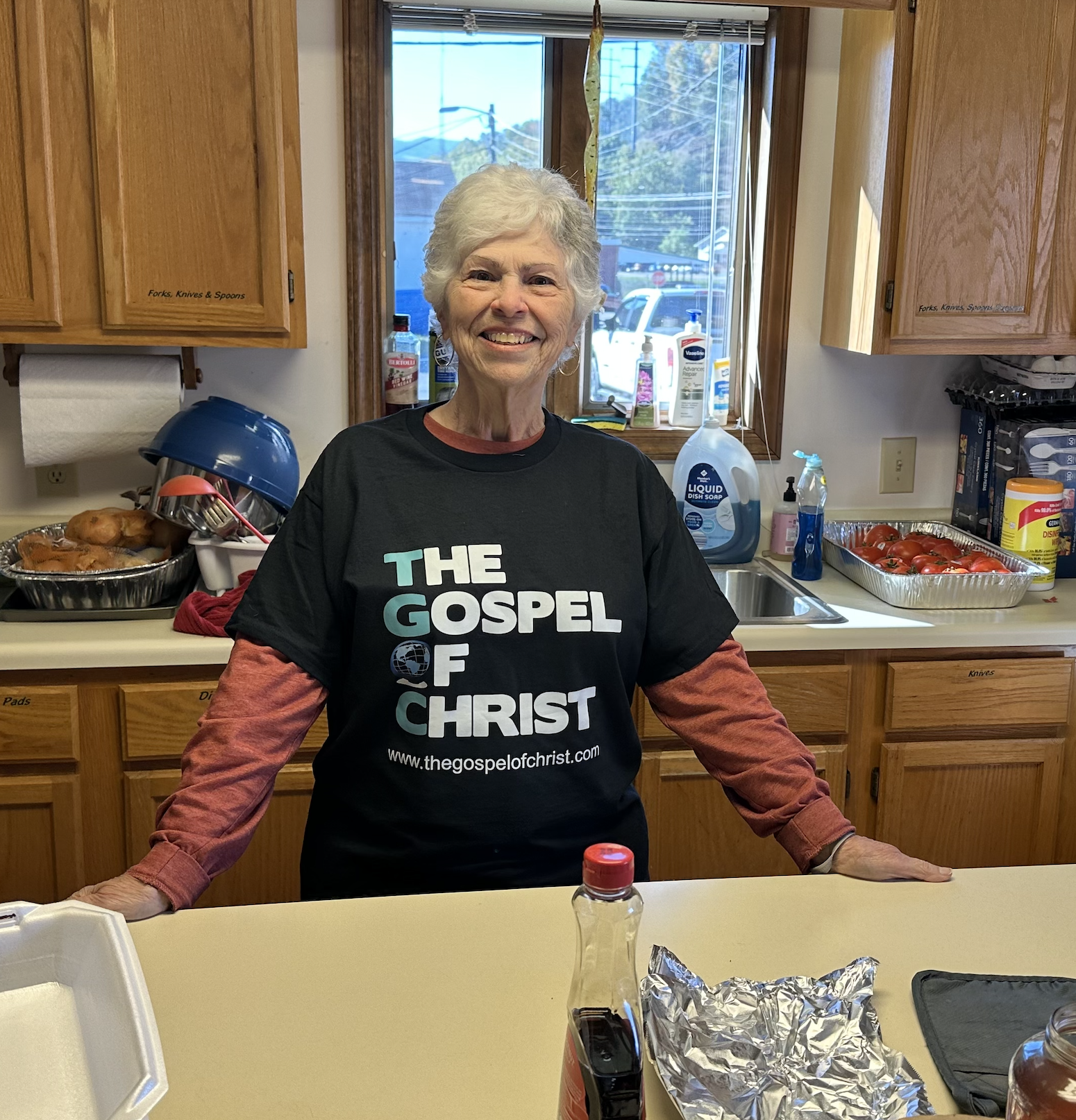
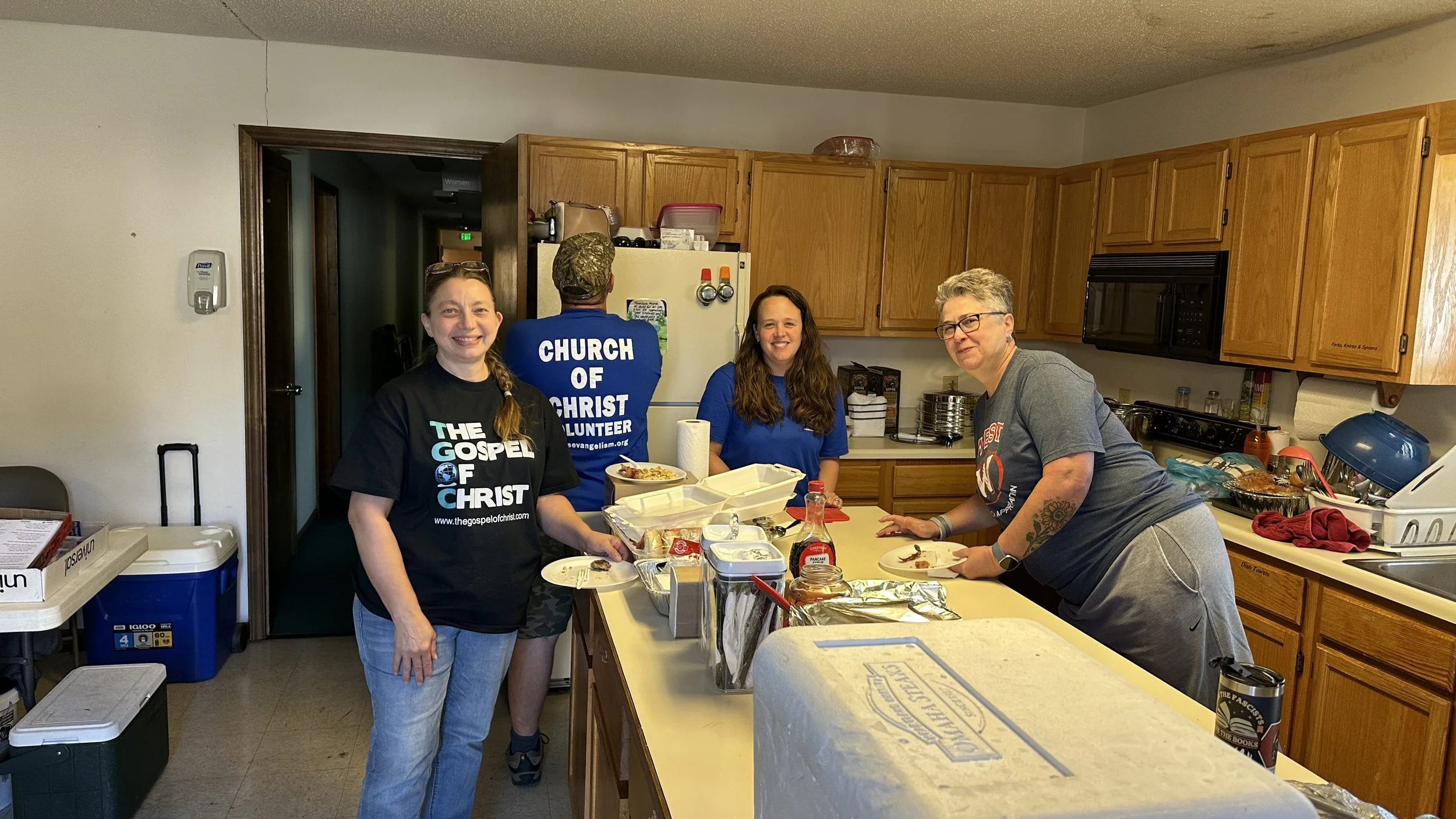
Here are a few pictures of the efforts.








Christian Relativity - A study on Time - Amy Lawrence
We can spend it, waste it, manage it, or measure it, but what we can never do is change its speed.
Time stands still for no one.
Time speeds up for no one.
Christian Relativity
A Study on Time in Scripture
Time. In reading the first three words of scripture, we learn that the first thing created was time. It is indeed a marvel. We can spend it, waste it, manage it, or measure it, but what we can never do is change its speed.
Time stands still for no one.
Time speeds up for no one.
Let’s discuss this unstoppable force and what we as Christians are expected to do with it.
Albert Einstein possessed a mind that had a knack for thinking ahead of his time. HIs theory of general relativity is a description of how gravity works and how mass affects time and space. Einstein postulated that time and space are intertwined, and what affects one also affects the other. He theorized that if one could “fold” space, time would “fold” with it…and one could travel from point A to point B millions of miles away in a matter of seconds. He also theorized that anything that generates enough gravity will “bend” this space/time fabric. Using Einstein’s theory is how astronomers find stars, black holes, planetary bodies, galaxies millions of light years away. Most do not understand Einstein’s theory because most people see space and time as two separate entities. Your phone understands, though. The GPS on your phone relies on Einstein’s theories for accuracy. Satellites in outer space experience time slightly faster than we do here on Earth (by nanoseconds, nothing significant). This means that the technology inside your phone has to use the theories postulated by Einstein in order for your GPS to get you where you need to go. Einstein’s ideas were theorized decades before we even had the technology to confirm his theories, but many of them are now proven fact.
It’s a lot to wrap one’s head around. And that’s the point.
When God responded to Job in Job 38, he challenged Job to explain the “ordinances of heaven”, 38:33. God was presenting Job with a picture of how awesome He is and how puny we are when we stand before God. As long as it has taken the human race to discover what God has known all along is a testament to our limited ability and access to knowledge. God tells us, “For as the heavens are higher than the earth, so are my ways higher than your ways, and my thoughts than your thoughts.” (Is. 55:9) Just because we have learned how time and space work doesn’t mean we’ve suddenly been given the ability to manipulate either. Understanding the relationship between time and space does not change the fact that we are still human. God created Einstein. Even knowing what he knew, Albert Einstein could not bend space. He could not alter time. Only God can. That fact has never changed. In this, we see God. Paul wrote to the Romans, “For the invisible things of him from the creation of the world are clearly seen, being understood by the things that are made, even his eternal power and Godhead…” (Rom. 1:29) God is proven, time and time again, by His creation. Our limits are proven, time and time again, by HIs creation.
But why show us how limited we are?
I’ll get into that in a moment. First, let’s see what the Bible has to say about time.
Scripture talks A LOT about time and the relationship it has with Creation. Everyone can probably quote Ecclesiastes 3:1-8: “To everything there is a season, and a time to every purpose under heaven…” We are the prisoners of time. Solomon also wrote, “I returned, and saw under the sun, that the race is not to the swift, nor the battle to the strong, nor bread to the wise, nor riches to men of understanding, nor favor to men of skill; but time and chance happens to them all. For man also knows not his time: as the fish that are taken in a cruel net, and as the birds that are caught in the snare; so are the sons of men snared in a cruel time, when it falls suddenly upon them.” (Ecc. 9:11-12) Time is a determinate of our existence, and we cannot escape it. There is nothing quite like watching the hands of a clock move and knowing that we are at the mercy of the time that clock represents. Imagine, if you will, going through an entire day without knowing what time it is! Would that day feel slower? Faster? Would the sun seem to stand still? (That really happened, once, Josh. 10:12-13.) No matter how we perceive or how much we know about the temporal, it still does not change the fact that our physical bodies have been created with a time-limit. Everything in Creation is temporary, 2 Pet. 3:10, which makes God separate from Creation, from time and space. God is spirit, John 4:24. God existed before time began, 1 Pet. 1:20. God inhabits eternity, Is. 57:15. There is no limit to the space God can take up at any given time, Is. 52:12, and there is no escaping God, Prov. 15:3. His eternal existence in both time and space is depicted in His name, Ex. 3:13-15, Jn. 8:58.
This is part of what makes God awesome.
Scripture measures time in human terms by hours, Mt. 20:3-5, days, Gen. 1:5, weeks (Sabbaths), Ex. 26:26, months, Ex. 12:2, years, Ex. 12:5, feasts/holy days, Ex. 23:14, Is. 30:29, moons, Ps. 81:3; 104:19, Is. 66:23, and watches, Lk. 12:38. (The Hebrew Calendar is a lunisolar calendar, using both the sun and moon for times and dates. Not all scripture was recorded using the Hebrew references of time, though. Matthew, Mark, and Luke used Hebrew references - but John did not. John used Roman time, which is why it may seem that scripture contradicts itself when in fact it does not, Mt. 27:45, Mk. 15:33, Lk. 23:44, Jn. 19:14). No measure of time, however, is relevant to God, 2 Pet. 3:8, because God is eternal, Is. 43:11-13.
Okay. We’ve covered the physical. Let’s get into our spiritual view of time. I asked a question earlier; why does God show us how limited we are? Being finite, we often are forced to consider the brevity of this life. Eternity is so appealing to us as humans because we know how fleeting this life is, Is. 40:6-8. We’ve seen the truth of death. The other side of suffering shows us how fragile we are. In this, we have the tendency to seek things that make us feel safe and secure. Scripture gives us the answer. Only in scripture can we can find the promise God gives that we do not have to be afraid. God told Joshua, “Be strong and of good courage; do not be afraid, nor be dismayed, for the LORD your God is with you wherever you go.” (Josh. 1:9) When we understand our own weakness, we seek a safe haven. Anyone that has a deep knowledge of and appreciation for God’s power finds that safe haven in Him. Our limits should draw us closer to God, Ps. 57:1. He never leaves, Heb. 13:5.
Our weaknesses are also a billboard for God’s power, our imprisonment by time a flashing sign that points to the Almighty. Paul understood this, 2 Cor. 12:7-1. Isaiah 43:1-13 showcases how God’s might is necessary throughout all of Creation and our interaction with it. Mankind’s limitations broadcast the difference between God Almighty and man. This also brings to the forefront the love that God has for us. He has the ability to destroy us…but instead lifts us up, James 4:10.
We may not be able to manipulate time, but we can certainly use what we have been given wisely. The Ephesians were advised by Paul to “walk circumspectly… redeeming the time, because the days are evil.” (Eph. 5:15-16) All things are given to us by God, including our time, James 1:17. In this, we are made stewards for Christ…and a steward must be found faithful, 1 Cor. 4:1-2. We can be efficient with the time and talents given to us by God (Mt. 25:14-23)…or we can squander them (Mt. 25:24-30).
Either way, we will answer for it, 2 Cor. 5:9-11.
I’ll ask some questions in conclusion:
1.)How much of your day did you dedicate to God?
2.)How much of God’s day did He dedicate to you?
3.) How much of your time would you invest into eternity?
Every moment we invest into God’s Kingdom is an investment into eternity, because it is the only Kingdom that will cross over into eternity, 1 Cor. 15:24. Give your time to God, and what He will give in return is timeless.

Heaven, Our Forever Home - Ben Bailey
“There remains therefore a rest for the people of God” (Heb. 4:9). With these words the Hebrews writer reminds us of our forever home—Heaven. Unlike the Israelites who were heading toward the physical home of Canaan, Christians are journeying toward our final destination of Heaven. As we think about that forever home each of us are probably made to ask, “What will Heaven really be like?” Notice how the Bible describes the beauty of Heaven.
Heaven, Our Forever Home
“There remains therefore a rest for the people of God” (Heb. 4:9). With these words the Hebrews writer reminds us of our forever home—Heaven. Unlike the Israelites who were heading toward the physical home of Canaan, Christians are journeying toward our final destination of Heaven. As we think about that forever home each of us are probably made to ask, “What will Heaven really be like?” Notice how the Bible describes the beauty of Heaven.
Our forever home will be a wonderful place of rest after the struggles of this life have ended. Each one of us gets tired after a long hard day of work. We enjoy putting up our feet at the end of a long day and relaxing. While earthly rest will not begin to compare to heavenly rest, what a joy it is to know that Heaven is a place of rest. There will be no more labor, toil, and striving against sin. The writer of Hebrews describes it in this way. “There remains a rest for the people of God” (Heb. 4:9). This rest contrasted with and was greater than the promise rest Joshua had given the people of Israel in Canaan (Heb. 4:1ff).
Our forever home will be great because it will be a place where we can worship God fully. Someone has said, “If you don’t enjoy worship here on earth, you probably won’t enjoy Heaven either.” Why? Because much of what we see going on in Heaven is worship to Almighty God. For example, in Revelation 4&5 those in Heaven are throwing down their crowns and worshipping God in song. This gives us insight as to what will happen in Heaven (Rev. 4:9-10).
Our forever home will be amazing because it is described as a place of endless joy. One of the great things about Heaven will be the absolute joy that God’s people possess. All of us will admit that one of the worst things about this life is sadness. Isn’t it wonderful to know that Heaven is a place of infinite joy? To the servant who used his talents to the glory of God Jesus said, “…enter into the joy of your Lord” (Matt. 25:21).
How wonderful it is to know that when the toils and struggles of this life are over and we hear the Words, “Well done, good and faithful servant enter into the joys of your Lord” that we can partake in all the wonder and beauty of our Heavenly Home. May God help each of us to life in such a way that Heaven will be our forever home! --Ben Bailey

What Does the Lord Teach About Our Speech? - Ben Bailey
How should a Christian talk? What kind of things should or should not come out of a Christian’s mouth?
What Does the Lord Teach About Our Speech?
How should a Christian talk? What kind of things should or should not come out of a Christian’s mouth? Hopefully these are questions you have thought about and or maybe are thinking about. The good news is God teaches us the way we should talk and the things we should avoid saying. Notice what the Bible teaches about our speech.
Let your speech be gracious. The Word of God says, “Let your speech always be with grace, seasoned with salt, that you may know how to answer each one” (Col. 4:2). No one enjoys talking to or listening to someone whose speech is abrasive or harmful. A Christians speech should be gracious and preserving. The idea here is that our speech should be kind, considerate of others and we should say things in a way that should open doors rather than close them.
Speak the Truth in Love. Someone once told me a truth about speech that I have never forgot…You are never someone’s enemy when you tell them the truth (Gal. 4:16). It may be uncomfortable. It may feel like you are becoming their enemy, but if truth sets people free you are not their enemy (John 8:32). However, our approach with the truth also needs to be considered. When I tell someone the truth it must be done in love. With a kind an loving heart and with the motivation of love is how I should always approach others.
Avoid evil speech. The Word of God says, “Let no corrupt word proceed out of your mouth” (Eph. 4:29). Paul also reminded Christians to put off “filthy language out of your mouth” (Col. 3:8). Maybe you used to use foul language or say coarse words before you became a Christian. As a child of God, you must work on breaking that habit and removing those words from your vocabulary. Remember, the Lord said for every idle word men speak they will give an account of in the judgment (Mt. 12:36-37).
May every Christian have the mindset and the attitude of the Psalmist when he said, “Set a guard over my mouth, O LORD; keep watch over the door of my lips” (Ps. 141:3). Let’s use our speech to encourage, build up and praise God not for evil purposes! --Ben Bailey