
Peace that Passes All Understanding - Ben Bailey
Peace is one of the most treasured commodities for any society. For many, many years’ people have prayed, died and lived for peace. Jesus often spoke of the idea of peace. Yet, it was a little different than how we think of peace today. Today, we think of peace as military safety. Or, we think of it as financial security. Sometimes, we even feel like we have peace when the home security alarm is working well and the stock market is soaring.
Peace that Passes All Understanding
Peace is one of the most treasured commodities for any society. For many, many years’ people have prayed, died and lived for peace. Jesus often spoke of the idea of peace. Yet, it was a little different than how we think of peace today. Today, we think of peace as military safety. Or, we think of it as financial security. Sometimes, we even feel like we have peace when the home security alarm is working well and the stock market is soaring. This was not the kind of peace Jesus spoke of. Jesus spoke of a peace that transcends the physical. He spoke of a kind of tranquility that regardless of whether or not we were at war, financially broke, or even our lives were at stake would allow us to overcome and be victorious. To His disciples Jesus said, “Peace I leave with you, My peace I give to you; not as the world gives do I give to you. Let not your heart be troubled, neither let it be afraid” (John 14:27). How does one have this kind of peace?
Christian peace comes through a right relationship with God. Paul said, “Therefore, having been justified by faith, we have peace with God through our Lord Jesus Christ” (Rom. 5:1). When sinners have the faith to obey God’s commands, then we can truly have the peace that passes all understanding (Rom. 1:5). You see, dear friend, you can only have spiritual tranquility when you can say to yourself, “The Bible says I’m right with God.” Nothing else can give you greater satisfaction and joy than this.
Christian peace comes through living a spiritual minded life. The Apostle Paul said, “For to be carnally minded is death, but to be spiritually minded is life and peace” (Rom. 8:6). This idea find exact accord with what Paul said later to the church in Philippi (Phil. 4:6-8). The only way to maintain Christian peace is to know that you are living according to the commands and wishes of God found in the Bible.
To sum up the idea of Christian peace we could say, the only way to get it is to get right with God and the only way to keep it is to stay right with God. When I do both of these, then truly I can say, “The LORD is my helper; I will not fear. What can man do to me” (Heb. 13:6). Do you really possess this kind of peace in your life? Are you sure you have done what the Bible says and not what some other person told you to do? If so, are you living the Christian life every day? If so, then you know the joy of Christian peace. If not, it’s not too late to know the Christian peace. We would love to help you have a right relationship with God and learn how to live the Christian life. Please contact us and we would be glad to help you. May the peace of God rule in your hearts through Jesus Christ (Col. 3:15).
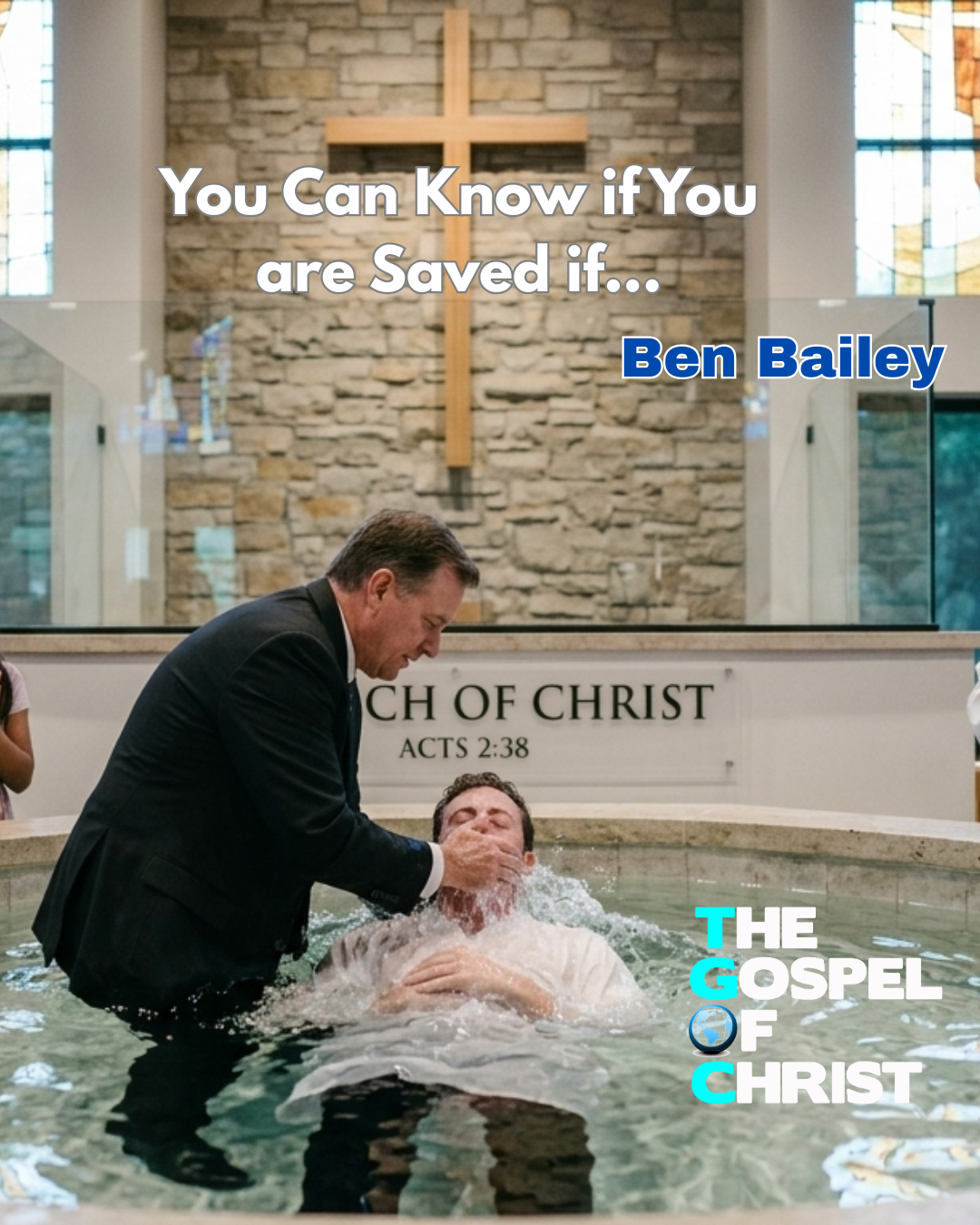
You Can Know You Are Saved if... - Ben Bailey
We live in a world that is full of doubt and worry. What will the stock market do tomorrow? Will the gas prices rise again? How will our country stay safe in these times of terror? Many of these questions are really unknown to us. Yet, when it comes to a person’s eternal salvation, he can know beyond a shadow of a doubt that he is saved.
You Can Know You Are Saved If…
We live in a world that is full of doubt and worry. What will the stock market do tomorrow? Will the gas prices rise again? How will our country stay safe in these times of terror? Many of these questions are really unknown to us. Yet, when it comes to a person’s eternal salvation, he can know beyond a shadow of a doubt that he is saved. The Apostle John said, “These things I have written to you who believe in the name of the Son of God, that you may know that you have eternal life, and that you may continue to believe in the name of the Son of God” (1 John 5:13). He can know he is saved if he does the following things.
1. Keep God’s Commandments. While we do not at all advocate salvation by works (Eph. 2:8-10), God does make it clear to be saved we must do exactly what he says. Jesus said, “If you love me keep My commandments” (John 14:15). The Apostle John said, “Now by this we know that we know Him, if we keep His commandments” (1 John 2:3). In fact, John makes it crystal clear when he says, “He who says, "I know Him," and does not keep His commandments, is a liar, and the truth is not in him” (1 John 2:4). This principle especially applies to the initial steps in the plan of salvation. For example, many in our religious world do not teach the full truth on baptism. Many will say that while baptism is a good thing to do, it is not essential to salvation. Notice what Jesus and His followers said. Jesus said, “He who believes and is baptized will be saved, he who does not believe shall be condemned” (Mark 16:16). Peter said, “Repent and be baptized every one of you for the remission of your sins and you shall receive the gift of the Holy Spirit” (Acts 2:38). Ananias told Saul, “Arise and be baptized and wash away your sins calling on the Lord’s name” (Acts 22:16). From these passages and others it is clear that baptism is essential to having one’s sins washed away. If a person is going to keep all of God’s commandments he must obey what the Bible says on baptism also.
2. Love your Fellow Christians. It seems odd that we would have to remind ourselves to love our Christian family, but it is at times necessary. For example, the church is a family (Eph. 2:10). Just like a physical family, there are also problems that arise in a spiritual family. Tempers flare at times and people say things they shouldn’t. It is at times like these that we must let our love for Christ and one another outweigh our own emotional impulses. Jesus said, “A new commandment I give to you, that you love one another; as I have loved you, that you also love one another. By this all will know that you are My disciples, if you have love for one another” (John 13:34-35). Jesus summed up the essence of knowing we are saved when He said, “And you shall love the LORD your God with all your heart, with all your soul, with all your mind, and with all your strength.' This is the first commandment. 31 And the second, like it, is this: 'You shall love your neighbor as yourself.' There is no other commandment greater than these” (Mark 12:30-31).
Dear friend, if we truly love God and do what He says in the Bible and love our neighbors and friends as our selves it will be impossible for us not to go to Heaven. The imperative question we each must ask is, “Have I really obeyed what the Bible says?”
Our Elders Are Dying! What Do We Do Now? - Joey Ferrell
I grew up hearing the story of Chicken Little (you know “the sky is falling, the sky is falling") and I know this title sounds a little like that, but there is some reality in what the title means….
Let’s take a few minutes to look at what is becoming a major problem within the church of today, and what the biblical idea can help us to determine “what do we do now?"
I grew up hearing the story of Chicken Little (you know “the sky is falling, the sky is falling") and I know this title sounds a little like that, but there is some reality in what the title means….
Let’s take a few minutes to look at what is becoming a major problem within the church of today, and what the biblical idea is that can help us to determine “what do we do now?"
(Disclaimer: I do not serve as an elder. I have not served as an elder. In my current role in ministry working with The Gospel of Christ, I do not feel that even if all of the “boxes” are checked (which I indeed struggle with at times), serving as an elder would not be practical in my opinion, whatever that is worth, to serve the kingdom in the local church in that capacity being that I travel many Sundays to preach and to events across the country. I have served in capacity in the past as a deacon for a congregation, and have studied the roles of leadership in depth; however, I do not claim to be the authority, nor infallible in my thoughts.)
The bible has a clear idea on biblical leadership in the church as given in several passages. The overarching picture given is the idea of “shepherding” a flock as can be seen in 1 Peter 5 where Peter, himself being an elder, encourages and instructs his fellow elders using the three classifications that we might label as “elder (pastor), bishop, and shepherd.”
In the United States, the church faces a challenge and has for many years. Many good men have stepped into the role of an elder and served in that capacity until they were unable for various reasons…or they die. Unfortunately, when this happens, it can be very devastating not only to the point at hand in the congregation, but it also may include a dissolve of leadership completely as is established through the words of scripture in having a plurality of elders. One man cannot serve as a “pastor” even though the common language of our day misuses the term to identify those who preach often that may never be qualified to serve in the biblical practicality of qualifications in 1 Timothy 3 and Titus 1. We won’t take this post to go over all of those qualifications, but we will touch on the idea of how one gets to that point.
So, with our elders “dying” with age or ability to serve, what do we do? Should we be concerned that the church may not have elders in the future or even in present? What is God’s prescription for elders in the church? Well, Paul told Titus to stay in Crete until there were elders and he told both Titus and Timothy what would be required, so there is definitely a biblical narrative that we need elders…in every congregation…when it is at all possible…so what do we do?
First off, we need to pray. Every congregation that does not have elders needs to pray about the future. Every congregation that has elders needs to pray about the future. Every congregation that has “issues” within the eldership of unqualified men, or sin in the camp or…needs to pray about the future.
Secondly, elders don’t just show up one day. As a matter of fact and expediency, it is probably unwise for a fairly new member (even if not a novice - which would disqualify one anyway) to serve as an elder. Why? Well, the principal of shepherding….a shepherd MUST know his sheep, and the sheep MUST know their shepherd. This takes time. This takes encouragement. This takes an open mind to both the man who may serve and the sheep who need him to serve to not be an impulse decision to “fill a spot” in absence.
Thirdly, elders need to be qualified. The church is NOT a business, a corporation or a social club where leaders are hired, appointed, or voted in because of their popularity or accomplishments…even though sometimes those lines are blurred because of the characteristics of good leadership in these latter mentioned organizations. Putting a man into a position that is not qualified is as equal to not having elders at all as they are in name only and not fulfilling the will of God.
Fourth, stop making it too difficult for men to become elders….hold on, read this again. For years, I have heard a lot of negative stories of how bad elders were treated…and it is even far greater to hear how preachers are treated at times! Why would any man want to serve (or his wife want him to serve) in a role that would constantly be torn down, mocked, challenged, scolded for decisions, and so on? Some state that a man is not qualified if he does not desire the work of a bishop (as we see in 1 Timothy 3); however, please pay closer attention to that context. The desire is a characteristic of the man, not a qualification. No man should serve that does not desire, but at the same time, qualified men should want to and work to have the desire….and that takes ALL of us to help encourage that desire, not just his own attitude. While it is true that some may desire the position in order to advance themselves, or to be in control (See 3 John about Diotrophese), or because they want to show their leadership talent, most elders I have ever met start with the true desire to serve God’s church and in turn His desires from a good place in their own heart. Stop questioning their motives, but also, men, please never ever think that this position is something that will change your status in the church or the community to elevate your importance.
Fifth, plant the tree now! It has been said in many an illustration that the best time to plant a tree you want to use for shade was many years ago….but the next best time is yesterday or today. You cannot expect a man that is living a worldly life one day to be converted tomorrow and be qualified to serve as an elder in two years. It just does not happen like that. Many times when a man is considered a reasonable age to become an elder, he has lived an entire life. Sometimes that life has things that have happened that would disqualify him…as early as he became an accountable age and knowledge of sin was known, even if before becoming a Christian (i.e., unscriptural marriages). The time for us to be seeking elders is always now, but it is not always the typical candidates that we seek. We need to be training our young me (and women) to keep their lives on track to become “elder” or “elder’s wife” material (deacon can also be substituted as the qualifications are very similar). Our young boys need to know what an elder is and how they can become one one day. They need to see the joy in desire of the office. The teenagers need to know that the role of elder is one that they can look up to and strive to be. The young adults that recently were married need to know that God has a purpose for their lives in the kingdom. The middle-aged couple that has been faithful in their Christian walk needs to be encouraged to consider working toward that goal of desire and qualifications. We need to plant the tree today!
I was asked recently, and this is not a new question, why do we not have “elder training” schools sort of like we do preaching schools. Well, there would probably be a half dozen answers to that and all would be possibly correct, or incorrect. But, we do have elder training in the form of studying the qualifications together as a church family, preaching from the pulpit as a preacher, going to classes that are offered by various congregations and other lectureship events, and as we started off - praying for open hearts to the idea and the right path for congregations and members alike to find and grow qualified men to lead and shepherd the church of God!
Bible Class Curricula - The Book of Revelation - Lesson 13 - Revelation 21 & 22
A study on the book of Revelation
Interpretation: Revelation 21:1–27
Final judgment had been passed on the harlot, the beast, the false prophet, and the dragon. This is the last vision of the apostle John - the city of God. It is important to understand the “already, but not yet” phases of inaugurated/consummated eschatology. The big eschatological picture is that Christians have entered the inaugurated phase of the holy city (Galatians 4:25,26; Hebrews 12:22–24), yet have not entered the consummative phase of the holy city (Hebrews 13:14).
For example, if Revelation 21-22 means the consummative phase only, then if Christians subtract or add from the Scriptures, they will be thrown out of heaven. But if Christians are living in the new creation, there is no possibility of sin. Therefore, this must be talking about both phases.
The word “new” is kainos. It means in some contexts the idea of quality, not time. For example, you might buy a new car. It is much better than your old car. The first dwelling place was temporary and running down. The new one is enduring and will never run down. It may also be the case that John is writing in an inaugurated phase in that Judaism was the “first heavens and first earth” that has passed away. The law of Moses was nailed to the cross (Colossians 2:14-17). The temple was destroyed in A.D. 70.
Christianity, the “new heavens and the new earth,” has arrived as the new world order. The old creation has been cursed by God (Romans 8:18-25). Sin has dominion over a lost humanity. Jesus has inaugurated the new creation in His death, burial, and resurrection. Jesus has come to translate humanity out of the old creation in its inaugurated phase. The sinner who dies to sin in repentance (Acts 17:30; 1 John 2:15-17), buried with Christ via water into death (Romans 6:3,4), and raised to walk in newness of life (2 Corinthians 5:17). Those who have identified with Christ are a part of the inauguration of the new creation.
Why is the sea singled out as no longer existing? It was known previously as the origin of cosmic evil (Revelation 12:18; 13:1; Isaiah 57:20,21). It is also where unbelieving, rebellious nations who persecuted God’s people dwell (Revelation 12:18; 13:1; 17:2,6). In the old creation, there was discord and division. In the new creation, there is harmony and peace (Luke 2:14; Romans 5:1).
John had been discussing the old Jerusalem for most of Revelation. The old Jerusalem was no longer the people of God. The new Jerusalem, the church, is God’s new people. People would have to acknowledge who the true people of God were, especially after the fall of Jerusalem. She was prepared to meet her husband, Christ, by remaining faithful to Him.
The whole Bible can be summarized in the fact that God wants to come dwell in fellowship with His people. He did this in various ways over the centuries (Genesis 3:8; Exodus 40:34,35; 1 Kings 8:10,11; John 1:14; 2:18,19; Isaiah 2:2-4). Those who have identified with Christ are a part of the inauguration of the new temple (1 Corinthians 3:16,17; 2 Corinthians 6:16-18).
The faithful church would triumph over their persecutors. When old Jerusalem was destroyed, there would be: (1) no more death, (2) no more sorrow, (3) no more crying, and (4) no more pain. This has both an inaugurated and consummative sense. In a sense, there would be no more persecutions from the Jews. In another sense, this is fulfilled in the ultimate sense in that physical death will be destroyed at the end when Christ returns and we will be in new, glorified resurrected bodies (1 Corinthians 15:24-28).
In verse 5, Jesus has made everything new. He has made it better in an escalated manner. Jesus brought forth a new covenant (Hebrews 8), a new song of redemption to be praised (Revelation 5:9), a new sacrifice that could take away sins (Hebrews 10), a new temple (1 Corinthians 3:16,17), a new priesthood (1 Peter 2:9), a new life (Romans 6:3,4), a new nation (1 Peter 2:9), a new Jerusalem (Revelation 21:1,2), a new name (Isaiah 62:2), and a new creation (Revelation 21:1,2).
Alpha is the first Greek letter of its alphabet. Omega is the last Greek letter of its alphabet. Jesus stated He was the Beginning and the End. Jesus is the author and finisher of the faith. He brings everything to pass (Hebrews 12:1,2). Jesus offers the invitation to come partake of the blessings (John 4:9-14; 7:37-39; Zechariah 13:1).
There is the encouragement to overcome because Jesus will give the everlasting inheritance to that faithful child of God (Revelation 2:10).
Next, John mentions a list of sins in verse 8 that will lead to eternal death. The first on the list is the cowardly. It could be a reference to those who gave into the persecution or gave up being a Christian. There are the unbelieving. Many of the Jews did not believe Jesus was the true Messiah (John 3:36; Hebrews 11:6). There are the abominable, which are sins that God detests and abhors (Proverbs 6:16-19). There are those who intentionally kill those made in the image of God. It is a probable reference to putting to death innocent Christians. Fornication can be both used in a literal and figurative way to unlawful sexual intercourse (Matthew 19:9), yet in a figurative sense to idolatry (Revelation 2). The sorcerers are those who use drugs in the practice of their black arts associated with idolatry. There are the idolators (Matthew 6:33; Colossians 3:5-8) who associated with the beast, the false prophet, or the harlot. There are the liars (Ephesians 4:25) who unfortunately gave up the truth by denying Christ and turned their back on Christianity.
John is carried away by the Spirit again and sees something that pales beyond the imagination. When John saw the harlot (the old Jerusalem), he saw spiritual ugliness. She was destroyed by God in A.D. 70. The church (the new Jerusalem), to whom Jesus was married, was shown in all of her spiritual beauty.
These visions are reminiscent of Ezekiel’s vision of the temple (Ezekiel 40;1,2; 43:1-5). The same temple that Ezekiel saw is the same temple that John sees in his vision. The details in each vision are different. Why the difference? It probably has to do with Ezekiel having to write to his audience in terms of “old covenant” language so that they would understand. Here is a helpful illustration.
Beale states: “A father promises in 1900 to give his son a horse and buggy when he grows up and marries. During the early years of expectation, the son reflects on the particular size of the buggy he would like, its contours and style, its beautiful red-leather seat, and also the size and breed of horse that would draw the buggy. Perhaps the father even had knowledge from early experimentation elsewhere that the invention of the “horseless carriage” was on the horizon, but he coined the promise to his son in familiar terms that the son could readily understand. Years later, say in 1925, when the son marries, the father gives the couple an automobile, which has since been invented and mass-produced. Is the son disappointed in receiving an automobile instead of a horse and buggy? In fact, the essence of the father’s word has remained the same: a convenient mode of transportation. What has changed is the precise form of transportation promised. The progress of technology has escalated the fulfillment of the pledge in a way that earlier could not have been conceived of fully by the son when he was young. Nevertheless, in the light of the later development of technology, the promise is viewed as “literally” and faithfully carried out in a greater way than could have earlier been apprehended.” (G.K. Beale, A New Testament Biblical Theology: The Unfolding of the Old Testament In The New, (Grand Rapids, MI: Baker Academic, 2011), Kindle edition, ch. 19: “The Story of the Eden Sanctuary, Israel’s Temple, and Christ and the Church as the Ongoing Transformed Eschatological Temple of the Spirit in the New- Creational Kingdom.”)
Ezekiel was living in the “horse and buggy” times. Ezekiel saw glimpses of the glories of this new temple. John was living in the “automobile” era - the realization of the temple that Christ had made. They both were gloriously made because this is where God dwells.
The city had a great light like a precious stone. When you think about how dark this world is now, do you have a greater appreciation for the city of light? (Philippians 2:14,15) The city of light can help overcome the darkness of this world. The only way that can happen is if every Christian is personally involved.
The city had a great and high wall for its perfect fortification and protection. Christians are to be watchmen guarding the walls of Zion in its inaugurated stage (Revelation 20:9). There are twelve angels who are stationed at the gates. They remain opened, not closed. In the old Jerusalem, sometimes the city gates were closed (Matthew 24:20). But the gates of the new Jerusalem are open because they give the opportunity for anyone wanting to obey the gospel and enter into the inaugurated state of the city (Revelation 22:14,17).
There are names written on these gates, which are the names of the twelve tribes of the children of Israel. This could be a reference back to Rev 7 and 14 that is speaking of the spiritual and faithful remnant (Galatians 6:16). The city has as its foundations the twelve apostles of the Lamb. This could be a reference to the fact that we are built on the doctrine of the apostles (Acts 2:42; Ephesians 2:20-22). They were guided into all truth by the Holy Spirit (Acts 2:42; Ephesians 2:20-22).
It is laid out as a square because it is the Holy of Holies par excellence. The same precious stones were displayed on the breastplate of the high priest (Exodus 28:17-21). It is the true dwelling place of God. From every nation, there have been Christians and they have brought everything into it if they are faithful into it (Isaiah 60:1-5). There is a street that reminds of Isaiah 35:8.
Interpretation: Revelation 22:1–21
John then sees a river that is flowing out of the throne. It is a reminder of Ezekiel 47:1–10. It brings renewal and refreshment. It also contains trees that bear different types of fruit for the healing of the nations.
There was also found no more curse. The curse had been lifted from Genesis 3:14–19. The servants of God will continue to serve Him. The glory of God will overwhelm it so much that it has no need of sun, moon, or stars.
In verse 6, there can be full confidence and assurance that the words of God are trustworthy because He cannot lie (Titus 1:2). It is also a reminder back to Rev 1:1–3. After John wrote the letter, the events in it would start to come to pass. The reason that John is not to seal the book is because it was going to immediately start to unfold. In contrast, the book of Daniel’s prophecies would not occur in the immediate future (Daniel 12:9). The destruction of Jerusalem was looming near. There was no time for repentance and true obedience. It was important to be true to God in these difficult times. This is not in reference to the second coming of Jesus. It is in reference to His representative comings of judgment on these wicked nations such as the harlot and the beast. Because of Christ’s resurrection, He brought about a new age. He will bring everything to pass that He said He would. People who remain outside of the holy city will be cast into the lake of fire (Revelation 21:8). Jesus is reminding us that He is the ruler that was promised in David’s covenant (2 Samuel 7:12-15). An invitation is offered to come into the city of God. We have a responsibility to hear and handle the words of God carefully.
When Jesus states, “Surely I am coming quickly,” this is not a reference to the second coming of Jesus. There is an application that we are to be ready to meet the Lord though in His second coming. Do you have the fervor and joy that John had?
Applications
First, is sin my master? (Romans 6:12) Was the old man of sin truly buried? (Colossians 3:9,10) Am I walking in the newness of life? (Galatians 5:22,23) In other words, am I really living as if I am a part of the inaugurated new creation?
Second, Christians do not have to be a part of this chaotic, turbulent sea of worldliness. If Christians stand fast, they can arrive on the bright and peaceful shore in the new creation.
Third, in the old creation, there was divorce for any reason, polygamy, homosexuality, adultery, spousal abuse and neglect. If a person becomes a part of the inaugurated new creation, then he ought to value faithfulness, commitment, oneness, sacrificial love, and respect. We must have the types of marriages that point ultimately to Christ and the church (Ephesians 5:22-33).
28. Fourth, everyone wants to go to heaven, but not very many want to put forth the effort to go there (Matthew 7:13,14).
Fifth, it will be an everlasting joy to know that in the new creation there is no more sorrow, pain, death, or crying. Everything that had to do with sin and the curse will be gone.
Sixth, can you not see that trusting and obeying God is what you have been searching for all this time? For example, think about the Samaritan woman. She was in need of the spiritual, everlasting water that could quench her soul.
Seventh, this imagery of the lake of fire and brimstone that is the second death ought to make a lasting impression on us that we do not want to go there. We do not want this eternal separation from God forever.
Eighth, there are several things that should be mentioned about Christ and the church. First, she is His lover because Christ shows His love to the church. Second, Christ is her Redeemer because Christ redeemed the church with His own blood. Third, Christ is her Husband because Christ meets the needs of the church. Fourth, Christ is her sanctifier because Christ is able to sanctify His bride.
Ninth, are you in the “glorious church”? (Ephesians 5:27) Only those in the glorious church and remain faithful are those who will be in eternal glory.
Tenth, will you choose to enter into the city or stay outside of the city? Do we have apostles in the Lord’s church today?
Eleventh, there are far too many who are not preaching the apostles’ doctrine. They are standing on an unstable and sandy foundation. Question: “Does baptism save us?” Example: “What saves you according to 1 Pet. 3:21?”
36. Twelfth, what kind of water are you drinking? Is it the pure word of God that can quench your thirst? Is it the dirty potholes of man’s teachings and doctrines? Is it the dirty sinful habits that can never satisfy your soul? (Zechariah 14:8; John 4:7-14; Jeremiah 2:13)
Thirteenth, do you have the desire to be healed of your disease called sin? The great Physician now is near, the sympathizing Jesus, who can change that matter.
Fourteenth, there was paradise lost and now there is paradise regained. There are three gardens in the Bible that are important: (1) The garden of Eden, (2) the garden of Gethsemane, and (3) the garden of heaven. Jesus was able to reverse the curse.
Fifteenth, do you have the heart of a servant? (Philippians 2:5-11) Those who are willing to serve are those who will be entering the everlasting kingdom of God (Matthew 18:1-4).
Sixteenth, time is still here. The second coming of Jesus is coming. There is still time and opportunity. It is so important to make our lives right with God while we still can. We ought to come to Jesus and partake of the true river of life!
Seventeenth, we are to be looking forward to the second coming (1 Thessalonians 4:13-18). Do you look forward to the second coming? Would you be trembling or joyful?
Eighteenth, you have the choice to choose whether or not you want to be saved. God will not force you to choose His will.
Nineteenth, some people are very haphazard with the word of God. There are many people who add to the word of God (Proverbs 30:6). Do you want the plagues to be added to you? There are many people who take away the word of God such as king Jehoiakim (Jeremiah 36:20-32).
BIBLIOGRAPHY
Aune, David E. Revelation 1–5. Word Biblical Commentary 52A. Accordance electronic ed. Grand Rapids: Zondervan, 1997.
Beale, G.K. A New Testament Biblical Theology: The Unfolding of the Old Testament In The New. Grand Rapids, MI: Baker Academic, 2011. Kindle edition.
Blomberg, Craig L. From Pentecost To Patmos: An Introduction To Acts Through Revelation. Nashville, TN: B&H Publishing Group, 2006.
Carson, D.A. and Douglas J. Moo. An Introduction to the New Testament, 2nd. Accordance electronic ed. Grand Rapids: Zondervan, 2005.
Clarke, B.J. “By Approaching With Right Attitudes.” How Can We Understand The Bible Alike? ed. B.J. Clarke. Southaven, MS: POWER Publications, 2006.
Hailey, Homer. Revelation: An Introduction and Commentary. Grand Rapids, Michigan: Baker Book House, 1979.
Houwelingen, P.H.R. van. “Fleeing Forward: The Departure of Christians From Jerusalem To Pella.” Westminister Theological Journal 65 (2003): 181–200.
Josephus. Translated by H. St. J. Thackeray et al. 10 vols. LCL. Cambridge: Harvard University Press, 1926-1965.
Keener, Craig. Revelation. The New International Version Application Commentary. Grand Rapids, Michigan: Zondervan, 1999.
Koester, Craig. “The Origin and Significance of the Flight to Pella Tradition.” Catholic Biblical Quarterly 51 (1989): 90–106.
Mounce, Robert H. The Book of Revelation. New International Commentary on the New Testament. Grand Rapids, Michigan: William B. Eerdmans Publishing Company, 1997.
Osburne, Grant R. Revelation. Baker Exegetical Commentary On The New Testament. Grand Rapids, Michigan: Baker Academic, 2002.
Phillips, John. Exploring Revelation. John Phillips Commentary Series. Accordance electronic ed. Grand Rapids: Kregel Publications, 2004.
Roper, David L. Revelation 1–11. Truth For Today Commentary. Searcy, Arkansas: Resource Publications, 2002.
Taylor, Donald. The Apocalypse: A Revelation of Jesus Christ. Memphis, Tennessee: WriteWay Publishing, 1996.
West, D. Gene. Avenging His Holy Saints, Apostles and Prophets. Pulaski, TN: Sain Publications, 2003.
West, Jr. W.B. Revelation Through First-Century Glasses. Nashville, TN: Gospel Advocate, 1997.

The Gospel of Christ
This material is copyrighted by The Gospel of Christ and its authors. This information is free to use in its entirety without further consent, however, modifications should not be made without contacting mail@thegospelofchrist.com for permission. Any and all images contained herein are believed to be free for all distribution and content.
Bible Class Curricula - The Book of Revelation - Lesson 12 - Revelation 19 & 20
Lesson 12 - Revelation 19 & 20
Interpretation: Revelation 19:1–21
In chapter 18, there were three great lamentations from three groups of people over the loss of Babylon the great.
In chapter 19, there are three great scenes of rejoicing over her fall.
There is a great scene of the multitude of praise in verses 1–3, the second scene is the elders and four living creatures giving praise in verse 4, and the obedience to the command to give praise in verses 5–7. In verses 8–10, there is a blessing brought about to those who come to the supper of the Lamb.
The first and second scene is to give us a reminder that God is the perfect and righteous Judge.
The third scene gives us a reminder that we are to fear God and respect Him greatly.
There are two contrasts John gives: (1) an unfaithful harlot who committed spiritual fornication represented by the old Jerusalem and (2) a pure and faithful wife represented by the new Jerusalem - the church.
The unfaithful wife had been divorced by God for her spiritual fornication. God has brought Himself into relationship in a new covenant with a new bride - the bride of Christ. There is an “already-not yet” tension being stated here in that the consummation of the marriage supper has not occurred yet (Isaiah 25:6-8), but has in its inaugurated stage.
In a Jewish wedding, there were two stages: (1) a betrothal and (2) the actual wedding. It must be the case that the church is still in its betrothal status because we are awaiting the actual wedding supper, and the servants are still inviting guests to the wedding (Matthew 22:1-14).
The way that the bride makes herself ready is to work out her salvation with fear and trembling and living in the light of the grand reality that is to come in the future (Philippians 2:12,13; Ephesians 2:8-10). The invitation is still being extended to come obey the gospel (Revelation 22:17,18). John is so overwhelmed by this vision that he worships the angel and receives a rebuke. There is the command to worship God because Jesus is the essence and heart of prophecy.
10. John sees a new vision where heaven opened and he sees Jesus on a white horse. In Matt 22:1–14, the parable of the marriage feast is given. The Jews were invited, but they rejected it. As a result, God destroyed them in A.D. 70. After that destruction, the inaugurated marriage feast is introduced. God had married OT Israel at Mt. Sinai (Exodus 24:1-8; Ezekiel 16:1-8). God divorced OT Israel for spiritual fornication (idolatry). God had the right to remarry someone who would remain faithful to Him, which would be the church of Christ (Romans 7:1-4; 2 Corinthians 11:2). Paul spoke of the fact that there was a present spiritual marriage (Ephesians 5:20-33). After the harlot fell, the bride (the church) would be recognized as the bride of Christ because the harlot was destroyed and Christ was free to present His new bride to the world.
11.Jesus is on a white horse, which is a metaphor for His victory as a conqueror of His enemies and His perfect and righteous judgment to judge them. Jesus does not possess the attitude of past bloodthirsty conquerors. He is faithful and true because His character is perfect. The description of His eyes reminds us that He knows and sees everything. The imagery of His many crowns is to denote that He is the supreme King of everything and is above every other king. His clothes were immersed in blood because it is picture of the bloodshed of His enemies (Isaiah 63:1-6). He is known as the Word of God because He is God’s message to man (John 1:14). The sword that comes out of His mouth is the word of God (Hebrews 4:12).
12.He treads out the winepress, which is imagery of judgment upon Babylon (OT Jerusalem) reminiscent of Revelation 14.
14. There is also a reversal occurring with the enemies of God.
15.Notice how God is dealing with His enemies. First, He deals with the harlot in Rev 17 and 18. Second, he deals with the beast and the false prophet in Rev 19:19–21. Jesus will deal with the ultimate enemy, Satan, in Revelation 20.
Applications
16. First, whose side are we on? Are we on the victorious or the losing side? Can we sing honestly that we are on the Lord’s side?
17. Second, God showed His love, mercy, and grace through the cross of Christ to those who are willing to obey Him. But God also shows His justice and wrath to those who are wicked and will not obey Him.
18. Third, we belong exclusively to Jesus if we are in the church. He is faithful and true to us. Should we not do the same? (James 4:4)
19. Fourth, it is reassuring to know that we can conquer the enemy while we are marching under the cross.
20. Fifth, which supper do we wish to be apart? Do we wish to attend the supper of the judgment of enemies on the final day of judgment or the blessed marriage supper of the Lamb?
Interpretation: Revelation 20:1–14
21. There needs to be some preliminary remarks made concerning this chapter. This is a highly symbolic and figurative text as we have seen elsewhere in the book (Revelation 1:1). It has been greatly disputed and differed by those who hold to the views that are known as premillennialism, millennialism, post-millennialism, and other views.
22. Although the book does contain prophecies that would soon come to pass as it states at the beginning of the book (Revelation 1:3), Jesus wants us to recognize that an exception is made that there are some sections of this chapter that will not shortly come to pass due to the highly symbolic number known as a 1,000 years, which gives us a hint that it means a long and indefinite period of time.
23. In Revelation 20:1, John now sees a vision of an angel come down out of heaven who had the key to the bottomless pit and a great chain in his hand.
24. The angel represents the authority of God to execute His will upon the earth. This angel had a key and a great chain.
25. A key symbolizes the power to open or to close. A chain was used to bind captives when taken into captivity (Jeremiah 52:8-11).
26. This vision John had represented a prison for Satan. He had been bound showing he had some restraint and limitation of his power. Notice though that Satan still holds some type of influence. He is like a dog tied to a leash. He has the power to roam his territory, but he only has some limitation within that territory. Notice in this text that the great enemy is called “the dragon,” “the serpent of old”, “the devil”, and “Satan.” John is referring back to Revelation 12 where he uses the same order of names for the devil. John is reminding us that the devil was defeated by the work of Christ through His personal ministry, death, burial, resurrection, and ascension. The gospel accounts refer to Christ and His victory over the evil works of the devil. During the personal ministry of Jesus, he was binding Satan's power (Matthew 12:29-30; Luke 10:17,18; John 12:31,32).
27. Demons, the allies of Satan, had been physically binding the bodies of Jews during that time. Jesus and His disciples were performing exorcisms upon the demons and they were cast out. Jesus made it explicit that he was triumphing over Satan in Jn 12:31,32. In Hebrews 2:14, it records that the work of Jesus Christ was triumphing over Satan. Jesus, in some sense, has defeated him, but there is some activities that he is still doing. He is still tempting man to sin. Satan still held some power over the world (1 Peter 5:8,9; 1 John 5:18). Although Satan had suffered a great blow, he still could roam about like a lion trying to destroy souls.
28. In what sense had Satan deceived the nations? This pictures for us Satan as the serpent of old in the garden of Eden in Genesis 3 who had deceived Eve, an image bearer of God. In Romans 1 and 2, Paul reports how the nations were greatly deceived because they had given themselves over to idolatry and immorality. Even Israel, who was to be a light to the nations, was given over to the same deception by adhering to idolatry and immorality. That is the sense in which Satan had been deceiving the nations. When the gospel was spreading, many people in the Gentile nations were influenced by the gospel and obeyed it. They were turning away from their idolatry and immoral lifestyles to a life of righteousness. They are coming to know the one true God. We see this being shown to us in the book of Acts. Many of the places that the apostles traveled were places where the Gentiles lived. Many of the Gentiles sought to be under the reign of God rather than under the reign of Satan.
29. In Revelation 20:3c, there is at some point after this symbolic thousand year period that Satan will be released from the prison. God, in His sovereignty, allows this to take place.
30. Whenever thrones are mentioned, they are located in heaven always. Notice that these thrones are currently occupied. They are occupied by “souls.” These souls are the same souls we saw earlier who were found under the altar because they had given themselves as a sacrifice (Revelation 6:9-11). Notice that judgment is given to these souls. This should remind us of Dan. 7 when judgment was given to the saints. Notice that these Christians were willing to lay down their lives for Jesus. They would not deny their Lord now in the midst of persecution. Notice these Christians have a disembodied existence. Their souls are separated from their bodies. This teaches the reunification that Christians desire to have their souls connected to their newly transformed bodies that will be raised from the grave (1 Corinthians 15:1-58). The plea in their prayer has been granted and they were thus vindicated. These martyred saints were being translated from the altar of sacrifice to the thrones of victory. This is based on God's mighty work of deliverance and judgment.
31. In Revelation 2:25, Jesus had encouraged the church that they could reign with Him if they remained faithful to Him. In Revelation 2:10, notice that Jesus states that some of the saints were to be cast into prison by the devil for ten days. This is a symbolic number. It is probably taken from the book of Daniel when Daniel and his friends were tested for ten days. These Christians were going to go through a rough, yet short period of persecution. Notice the number 1000 is 10 times 10 times 10. This teaches that although there will be a long period of persecution and tribulation, according to 2 Corinthians 4:16-18, this period of persecution is only temporary compared to eternity where all things will be made well. This “first resurrection” takes place at physical death for the faithful Christian during this time of persecution because he is going from the altar of sacrifice to heaven itself where Christ is reigning in heaven. We have to remember though that this is a symbolic picture. This was to encourage the saints at that time to remain faithful to Jesus. We have to remember that this does not contradict what we learn elsewhere. We learn that the faithful saint will go into the compartment of Hades known as Paradise. Paul still sees Paradise as where Jesus can be found when he writes in 2 Cor 5:8: “We are confident, yes, well pleased rather to be absent from the body and to be present with the Lord.”
32. In Revelation 20:6, Christians are urged at this time to remain faithful by taking part in the first resurrection. We learn the words “first” and “second” are used in pairs in Revelation and have different meanings. We learn that this “first resurrection” is the soul rising from the altar of sacrifice to a throne of victory. The “second resurrection” will be a physical, bodily resurrection in which the body will be raised from the grave to live upon the “new heavens and new earth in which righteousness dwells.” (John 5:28,29; Revelation 21:1,2; 2 Peter 3:10-13) We learn that the “first death” is temporary, yet the “second death” is eternal because a person who is wicked will have their soul and resurrected body (Matthew 10:28; 25:46) cast into hell fire and darkness. The first heavens and earth is temporary because it has only been here a few thousand years. It will be destroyed by fire (2 Peter 3:10). God will create a second or new heavens and new earth that will last for the righteous for all eternity (Revelation 21:1,2). It states that the martyred saints shall be priests of God and Christ and shall reign with Christ for a thousand years. This shows this is what God desired all along. Adam was the first priestly king to have dominion over the earth in the first temple, the garden of Eden. He was to expand the glory of God across the earth. Adam failed due to his sin. Israel was given the commission just as Adam was (Exodus 19:6). They were to be a kingdom of priests who were to establish God's holy abode upon a mountain in the land of Canaan to bring glory to the nations, but they failed to be the kingdom of priests. It is these martyred saints, the church of Christ, who are fulfilling Adam's commission. They have become a part of the true temple of God, Jesus Christ (John 2:18-22; 1 Corinthians 3:16,17) and they are a holy priesthood (1 Peter 2:9,10). When they die, God will grant them to be priests (as they were already priests upon the first earth) who will reign upon the new heavens and new earth in which righteousness dwells. Paradise will be restored.
33. In Revelation 20:7–10, the text states that after this indefinite, symbolic long period of time expires Satan will be released from his prison. His mission will be: (1) to deceive the nations and (2) gather them together to battle. Satan is bringing together a wicked coalition to destroy the church of Christ. He gathers this wicked coalition from everywhere. This wicked coalition is called Gog and Magog, which is reminiscent of Ezekiel 38. We will turn there soon to find out why God named this wicked army these names.
34. Notice the vast number of this great army. It is counted like the sand in the sea. Several enemies of God's people in the OT were described like the sand in the sea (Joshua 11:4; Judges 7:12; 1 Samuel 13:5). This seems to give a grim and intimidating picture of defeat because of the overwhelming odds against the church and it seems to be outmatched in every way in that there is no way of possible victory. Just as the OT Israelites faced some overwhelming odds, so it would be the case for the true, spiritual Israel (the church). They will have to fight against these overwhelming odds. We need to see with the eye of faith that this is how the Lord works. We have seen the OT pattern where God did not use some clever human strategy to overcome His enemies. God is eager to demonstrate His deliverance in the power of the paradox of the weakest circumstances.
35. For example, in Exodus 14, Moses had brought the children of Israel near the shore of the Red Sea. Pharaoh's army is on its way to subdue them and the people of Israel are afraid and complain to Moses as to why they have been brought out here to die. Moses responded: “Stand still and see the salvation of the Lord!” By the power of God in those dire circumstances, we see a way of escape is opened up for the children of Israel to cross through the waters of the Red Sea while we see the end of Pharaoh's army drown in it. God demonstrates His deliverance and salvation unto His people!
36. In Joshua 6, the children of Israel are to walk by faith and obedience by obeying the exact instructions of the Lord in conquering the city of Jericho by walking around it, shouting, and blowing the trumpets. The faith to take that city was indeed a paradox because it seemed so strange compared to an ordinary siege of military conquest against the city. The Lord showed that He was in charge of delivering the wicked city of Jericho into the hands of His people. In 1 Samuel 16, small David came up against a great Philistine giant named Goliath. From a human point of view, it would seem that Goliath has the odds in his favor. It was through God's power that David was able to slay the great giant. John is likely deriving the imagery of the fire coming down from heaven in 2 Kings 1:9-14. We have the soldiers of the wicked king, Ahaziah, coming to seize Elijah because Elijah had stated that the king was going to die. Ahaziah dispatches soldiers to go seize Elijah. When the soldiers arrive at the hill where Elijah is, it would seem to be the case from a human point of view that Elijah is going to be captured because there is no way he is going to be able to get away from these soldiers. Ahaziah sends fifty soldiers up the hill, but the prophet calls down fire upon those soldiers. Another batch of fifty soldiers is sent up the hill and they are consumed by fire. God does work through what seems to be the weakest circumstances. He will also do that for His precious people, the church, who are surrounded, outnumbered, and outmatched by enemies of God's people.
37. The focus will turn to the names of Gog and Magog, which are found in Ezekiel 38 and 39. These are enemies of God's people and are unidentifiable. We clearly just do not have enough information to know who they were. Gog and Magog are found to be descendants of Noah (Genesis 10:2; 1 Chronicles 5:4), but that is all we can clearly say. That is the point though. God wants us to know that these are unidentifiable foes. They are not meant to be specific, but generic to us. Notice in Ezekiel 38 and 39, God has set judgment against others besides Gog and Magog (Ezekiel 38:1; 39:1,2). Tubal and Magog had already been identified earlier along with Egypt as being found in the pit under the judgment of God in Ezekiel 32. The point that God is making through Ezekiel is that we have this unknown, unidentifiable army that opposes God's people, but it stands under God's judgment. This big wicked army is not going to get away with wiping out God's people. God is going to save His remnant of people while rendering righteous judgment upon the wicked. This grand wicked army of Gog and Magog that serves as an evil ally to Satan in Rev 20 is surrounding the camp of the saints and the beloved city. The identity of the camp of the saints and the beloved city is referring to the same entity – the new Jerusalem – the church of Christ.
38. Why is it being called the camp of the saints? This is a symbol that is rooted in the OT to show that just as Israel was camping with the tabernacle in the wilderness wanderings and heading to their promised land of Canaan, so it is with the church who are camping in this world and are exiles heading toward the new heavens and the new earth in which righteousness dwells (1 Peter 1:1; 2:11,12; 2 Pet 3:10–13). Just as Israel faced some dire threats in the wilderness with enemies of God's people, so it would also be the case that the new Israel – the church – would face enemies while they are traveling through the wilderness.
39. Why is it being called the beloved city? We have identified earlier that the “great city” that is a harlot is referring to physical Jerusalem that was persecuting the true people of God. It was a wicked city that would be destroyed by Rome. But there is another city that has the apple of God's eye – the new Jerusalem. God has His eyes set on that city because it is a city that is righteous and holy. This city will be further described in Rev 21 and 22. We are in the city of the new Jerusalem right now in its inaugurated state, but we have not been established in its consummated state in the new heavens and new earth. God has always designed it to be that there would be a (1) people and a (2) place. In the beginning of creation, God placed people – Adam and Eve into a place – the garden of Eden. In Egypt, God formed a people – the nation of Israel and set them to go toward a place – Canaan. God has set forth a new people in Christ (2 Corinthians 5:17) – the church of Christ – and they are heading toward a new place that has not been fully consummated – “the new heavens and new earth.” (Revelation 21:1,2) Suffering, persecution, and defeat will not be the last words for the Christian. God will destroy those who oppose the church. This is good news for the people of God.
40. In Revelation 20:10, earlier in book the devil is the “main boss” behind the beast, the false prophet, and the harlot. We have seen how the beast, the false prophet, and the harlot were defeated (Revelation 18; 19:20). God goes after the arch nemesis – the devil – the one who is behind it all. God is going to condemn the devil to hell. His judgment will not be temporary. It will be forever and ever. Those who ally with Satan will likewise suffer the same type of eternal punishment as the devil. They will be tormented day and night forever and ever (Matthew 25:41-46). The reason hell was created was that it was prepared originally for the devil and his angels who rebelled against the Lord. This ought to create a legitimate motivation of fear for those who have not obeyed the gospel (2 Corinthians 5:10,11). God's ultimate wrath over evil will finally be accomplished. There will be no more evil, no more sorrow, or pain. God's people will no longer have to endure suffering. It will finally all be over. What a great comfort to those who are faithful servants of God. We should not oppose God and make sure that we are living lives for God. We are living worthy of the gospel of Christ (Philippians 1:26,27). There is a reality worse than physical death and that is eternal punishment.
41. In Revelation 20:11–15, John sees a vision of a great white throne and the One who occupies it before him. It denotes vastness. It is not insignificant. If you want to picture the sovereignty, authority, and great power of God, then to picture this great white throne. The color of white represents purity, righteousness, and holiness because the One who occupies the throne is pure, righteous, and holy. God will judge righteously. Whatever he does, he is not wrong to sentence the final judgment of unbelievers. He will do all things well. There is no one that can accuse God of wrongdoing. John also saw the “earth and heaven flee away.” This is not referring to the destruction of heaven and earth as is taught elsewhere (2 Peter 3:10-13). This is a personification of the earth and the heavens fleeing away in terror. In Psalm 114, it shows the geographical features trembling at the presence of God. It is communicating the majesty and glory of God. Nothing is able to come into His presence that is truly like Him.
42. John is here intertwining the implication of the “second resurrection” because it was implied by the “first resurrection” of Revelation 20:6. The “second resurrection” is referring to the general bodily resurrection of both the righteous and the wicked that will be raised from their graves (Daniel 12:2; John 5:28,29; Acts 24:15). Physical death, the ruling power that was reigning over the human race, the final enemy of God (1 Corinthians 15:26) is destroyed. Since its power has depleted, it is now giving up the bodies and God is bringing them back to resurrected life. There is a connection between the resurrection of the dead and the day of judgment. In Matthew 12:41,42, the men of Nineveh and the queen of Sheba will rise up (a strong connection to the general resurrection of the dead) against the contemporary generation of Jesus' day because they will rise up “with” them and will condemn them because the men of Nineveh repented while most of the Jews did not believe on Jesus and thus did not turn away from their sins. After everyone is resurrected from the dead, there will be a great judgment that takes place of those who were dead and those who are now living (2 Timothy 4:1,2; Acts 17:30,31). God will decree those who are righteous to live upon the new heavens and the new earth (2 Peter 3:13). Those who are wicked will be cast into hell fire (Revelation 21:8; 2 Thessalonians 1:7-9).
43. John sees the “great and small.” This encompasses everybody. Nobody is too great to be exempted from the day of judgment, even those who are in high government positions. It does not matter if you are a king, teacher, professor, lawyer, doctor, or preacher. You will be judged by God. In Matthew 25:31–46, we see another picture of the day of judgment.
44. The risen Christ has been given the right to judge all men. There are books that are opened. We do not know what those books are. They could represent the omniscience of God since God knows everything we have ever done whether it be past, present, or future. We are told though about the Lamb's Book of Life. It is called the Lamb’s Book of Life because Jesus was slain to make redemption available through His shedding blood (Revelation 1:5,6; 5:8–13; 7:10; 13:8). It is the Book of eternal Life because only people whose names are written in it will enter into eternal life in the heavenly city (Revelation 7:17; 21:10,27; 22:3–5). Those whose names are not written in God’s Book will be cast into the lake of fire (Revelation 20:14,15). Therefore, only the names of God’s children are written in the Book. But even a child of God can have his name taken out of the Lamb’s Book and, hence, forfeit his eternal salvation. For instance, children of God of the OT were taken out of God’s book because of their impenitent sin and because they turned their hearts away from God (Exodus 32:31-33; Deuteronomy 29:14,15,18-20). Children of God of the NT are taken out of it because they do not overcome/remain faithful and/or they take away from God’s words (Revelation 2:10; 3:5; 22:19). Other names not found in the Book of Life are those who worshiped the sea beast and those who defile, cause an abomination or lie (Revelation 13:1,8,17; 17:8; 21:27).
45. It is very hard to know whether “the sea” here is talking about the literal oceans or is it being a symbol. In the OT, the sea is rooted in meaning that its origin represents sinister evil, chaos, and death that needs to be defeated and is destroyed. In Daniel 7, it speaks of the four beasts (that represented Babylon, Medo-Persia, Macedonia, and Rome) that arose from the sea. John speaks of Rev 21:1 that the sea will be no more. It will finally have vanquished because it was an evil entity. Death was a sinister enemy because it was an intrusion into God's good creation. Hades was the “partner in crime” because it held those who were dead by separating the souls from the physical bodies. Since the general physical resurrection has taken place, death will have been conquered because God's power overcame Death, and Hades will no longer be able to hold the souls captive and therefore it is destroyed in hell.
Applications
46. First, there is a story about a boy who wanted to help his father with plowing the field. The father said to his son, “Now son, keep your eyes focused on something ahead of you and you will always plow a straight line.” The son started to plow and was doing a very fine job. The dad decided to leave for a little bit, but when he came back he was shocked at the horrible scene of so many “zig-zags” across the field. He said to his son, “Son, what did you do? I told you to stare at an object in front of you and you would never go wrong.” The son replied, “I did what you told me to do dad, but I kept on staring at that dog who kept moving around everywhere!” We have to give the boy credit for setting his eyes on the object of his goal. We as Christian runners need to focus our eyes on the Lord Jesus Christ. He is our perfect example. We need to always be looking at Jesus just like the little boy did with the dog. Don’t ever take your eyes off Him.
47. Second, God allows hardships, suffering, and difficult events to happen in order to teach us, reprove us, discipline us, and conform us to the image of His Son (Romans 8:29).
48. Third, remember that these times of suffering are only temporary compared to eternity (2 Corinthians 6:14-18). If you want to be in the Book of Life (and stay in it), you must be a faithful Christian worker who endures to the end (Philippians 4:3; Revelation 3:4,5; Malachi 3:16,17). Is your name in the Book of Life? Has it been taken out? Examine yourself whether you are in the faith (2 Corinthians 13:5).
49. Fourth, works are examined by God (Matthew 16:27; 2 Corinthians 5:10; Ecclesiastes 12:13,14). Why does God look and examine our deeds? Because they will testify for or against you. Faith always entails action. If you were a faithful Christian, then you are going to show works that are worthy of repentance and show that you devoted your life to Jesus Christ throughout your life. But if you have lived an evil life, then it shows that you have been living a heart of unbelief and did not conform to a life of obedience.
50. Fifth, John speaks of the second death – separation from God forever and ever. He states that those who are not in Christ will not be found written in the Book of Life. In Christ, faithful Christians are not condemned because they continually have access to the blood of Jesus Christ (1 John 1:7-9). Believers will not experience what will happen to death, Hades, and the devil if they will remain faithful to the end.
51. Sixth, people sometimes say: “God does not send people to hell. People send themselves there.” That is false. The casting was done by God himself. This is where people must go if they do not want to live a righteous and holy life that is pleasing to God. God does not take any pleasure in the death of the wicked and He certainly wants all to come to repentance before it is too late (2 Peter 3:9).
The Gospel of Christ
This material is copyrighted by The Gospel of Christ and its authors. This information is free to use in its entirety without further consent, however, modifications should not be made without contacting mail@thegospelofchrist.com for permission. Any and all images contained herein are believed to be free for all distribution and content.
Feminism - Equality vs Equity - Amy Lawrence
Feminism has gradually become less a fight for rights and more a push for privilege. Women in the mid to late 20th century were certainly mistreated and abused by society at large. I’m not dismissing that fact. Many women today still suffer from gender prejudices.
Feminism
Equality Versus Equity
In July of 1848, at the Wesleyan Chapel in Seneca Falls, NY, a convention of women signed a document titled “Declaration of Sentiments”. This document highlighted women’s rights to legal, social, and political equality that were currently being denied them. Very little ground was gained through this particular convention, but women still persevered. Time marched on. The 15th amendment to the Constitution of the United States of America was ratified on February 3, 1870; however, women wouldn’t gain the right to vote until 50 years later - when the 19th amendment was ratified. History recorded how women fought for equal work opportunities, equal pay, and equal ability to be elected to government positions. The fight for women’s rights was going in a positive direction, until…
Margaret Sanger came into the picture. For those that are unfamiliar with this name, Margaret Sanger was the founder of the organization Planned Parenthood. She was a profound activist for women’s “reproductive rights” (e.g. birth control and abortion), but what many do not know is that she was very vocal about why. She felt it was necessary to “breed out” mental and physical handicaps in order to build a “stronger, healthier, more intelligent human race.” She went about doing this through eugenics. By influencing women to prevent or abort conception of a child instead of advocating abstinence, such a movement opened certain doors that should have remained closed. The allowance to murder innocent unborn children has become a megaphone for the feminist movement. Females of such a mind see pregnancy as an inconvenience that they should have the right to eliminate. A child in the womb slowly became nothing more than a “fetus” to society. This and more has brought to light a dangerous mindset many women hold today. And it doesn’t stop here.
Feminism has gradually become less a fight for rights and more a push for privilege. Women in the mid to late 20th century were certainly mistreated and abused by society at large. I’m not dismissing that fact. Many women today still suffer from gender prejudices. There will always be those that see women as inferior, but there are laws in place that make it easier for us to feel safe and fairly treated. The rights that were gained through efforts such as the Women’s Suffrage movement have brought about the establishment of those laws. Now, however, there are certain feminists whose sole aim is to utterly eradicate anything masculine. This brings me to my original study topic: equality versus equity.
The two are not synonymous. It would be prudent to our study to first define exactly what is equality and equity. Cambridge Dictionary defines equality as, “the right of different groups of people to have a similar social position and receive the same treatment." Equity is defined as, “the situation in which everyone is treated fairly according to their needs and no group of people is given special treatment." I once saw a drawing that illustrated the difference between these two concepts. Equality was depicted as a tall fence blocking the view of three people with varying heights. Each was given the same sized box to stand on (equality), but the shortest person still couldn’t see over the fence. The next frame showed the same fence and same people, but each was given a different but appropriately-sized box that lifted everyone to the same height to see over the same fence (equity). To ask a woman to equally give and receive the same things as a man is to not understand why they are asking the impossible. Most women need a taller box to see over that fence. Being given the same sized box as a man will keep us on the blind side.
I feel I should also point out that feminism is inconsistent. Let me explain. Did you know that between 1968 and 2024, there has been little to no change in the percentage of men in construction work, installation/maintenance/repair, transportation and shipping, production, farming/fisheries/forestry, and computer science? Feminists argue that men unfairly dominate the workforce…so why aren’t more women after the jobs I just listed? Discussions concerning an imbalance in occupations rarely acknowledge where the men are largely absent - mental health, education, nursing, and social work. These women are not fighting for fairness. They are fighting for dominance in the workforce. Many (not all) are misandrists that allow their prejudice against men to cloud their judgement.
Men and women are not equal. We never will be. Why? Because these two genders are different in ways that cannot be changed, both physically and emotionally. More than this, though, we don’t HAVE to be. There are things men can do better than women and women can do better than men. There are things men cannot do that women can, and vice versa. Does that make either less useful or important than the other? No. Placing our value in an ability to do all the things men can do is preposterous. What makes our differences wonderful, however, is that, when we work together, our talents become complimentary to one another.
Sadly, there are women that view men in such a manner that they carry their prejudice over into the religious arena. Many denominations allow women to hold an office of leadership over men. God’s word is very clear about a woman’s place in the church. “I desire therefore that the men pray everywhere, lifting up holy hands, without wrath and doubting; in like manner also, that the women adorn themselves in modest apparel, with propriety and moderation, not with braided hair or gold or pearls or costly clothing, but, which is proper for women professing godliness, with good works. Let a woman learn in silence with all submission. And I do not permit a woman to teach or to have authority over a man, but to be in silence. For Adam was formed first, then Eve. And Adam was not deceived, but the woman being deceived, fell into transgression. Nevertheless she will be saved in childbearing if they continue in faith, love, and holiness, with self-control.” (1 Timothy 2:8-15 NKJV)
Does this diminish our value in the church? Absolutely not. We have such a powerful influence - that begins in our homes. The Christian home is of such importance that God has made it the beginning of an education in godliness, Eph. 6:1-4. We are to be managers of the home and the children, 1 Tim. 5:14, Prov. 31:10-31. We can also influence our husbands in good, godly ways, 1 Pet. 3:1-6.
Feminists tend to feel they shouldn’t have to submit to anyone. Pride is a dangerous thing, Prov. 16:18, 1 Tim. 3:6. We should remember; the only Person that has ever had the right to rule over mankind instead became a servant to mankind, Mk. 10:45. We are encouraged to be like Christ, 1 Cor. 11:1, and I can’t think of a better example. “Let this mind be in you, which was also in Christ Jesus…” Phil. 2:1-11. We, as Christian women, have the profound ability and responsibility to influence Christ-like behavior. The best way to teach this is to BE this. Whether we like it or not, God has commanded that women submit to men in the church, 1 Cor. 14:34. Have you ever been asked to do something you really didn’t want to do, but you later discovered that it was the best thing you could have done? Were you glad in the end that you submitted to the request? We don’t always like or understand what God asks of us, but we can always rest assured that He knows what is best. He is God. He has already seen the outcome. History is replete with stories of lives that were changed by the influence of a good woman. The best leaders have been those that have stood in the shadows with no desire for the spotlight. We don’t have to be in the lead to be a leader.
Yes, women are often stereotyped and underestimated. So was Jesus. He still obeyed God, Phil. 2:8. We need to be careful how we respond to prejudices and not forget our place. We are the handiwork of God, and as our Creator, He knows where we do our best work, Prov. 3:5-6. Consider women in scripture that were where God needed them to be: Ruth - Ruth 1:16, Esther - Est. 4:13-14, Mary - Lk. 1:38, Elizabeth - Lk. 1:5-6, Dorcas - Acts 9:36, 39, Priscilla - 1 Cor. 16:19, and Mary Magdalene - John 20:11-18. He has put us all in a place to influence, guide, and cultivate for good those that are around us. A meek, hard-working, godly woman is a force to be reckoned with on any day. We must use our position, always, to give glory to God.
The Marvelous Mercy of God
“Blessed be the God and Father of our Lord Jesus Christ, who according to His abundant mercy has begotten us again to a living hope through the resurrection of Jesus Christ from the dead” (1 Peter 1:3). One of the great themes of the Bible is God’s loving mercy toward sinful man. As the Apostle Peter noted, if it were not for God’s mercy we would have no hope in this life. Notice some of the great statements about God’s mercy found in the Bible.
“Blessed be the God and Father of our Lord Jesus Christ, who according to His abundant mercy has begotten us again to a living hope through the resurrection of Jesus Christ from the dead” (1 Peter 1:3). One of the great themes of the Bible is God’s loving mercy toward sinful man. As the Apostle Peter noted, if it were not for God’s mercy we would have no hope in this life. Notice some of the great statements about God’s mercy found in the Bible.
“God, who is rich in mercy, because of His great love with which He loved us, even when we were dead in trespasses, made us alive together with Christ…” (Eph. 2:4-5). Isn’t it wonderful to know that the King we serve is abundantly wealthy? What is even greater is his wealth is not a monetary passing pleasure but in eternal mercy with is realized with each Christian. As Paul reminded Titus, “trough the Lord’s mercy we are saved” (Titus 3:5).
“The LORD is gracious and full of compassion, Slow to anger and great in mercy” (Ps. 145:8). What makes God’s nature so wonderful is that he is not a capricious and vindictive God. While God does get angry with the wicked (Ps. 7:11), his mercy toward those who love and obey Him far outweighs His anger. In reality, if each one of us got what we deserved we would be lost in Hell for all eternity. As the Psalmist pondered this he said, “He has not dealt with us according to our sins, Nor punished us according to our iniquities. For as the heavens are high above the earth, So great is His mercy toward those who fear Him; As far as the east is from the west, So far has He removed our transgressions from us” (Ps. 103:10-12).
The Christian owes a great debt of gratitude to Almighty God for his marvelous mercy. May we show our appreciation for God’s mercy by humbly submitting to His will. Friend, have you received the mercy of God? Have you obeyed the gospel? If not, you can obey God’s will today by hearing God’s word (Rom. 10:17), believing in Jesus as the Son of God (Jn. 8:24), repenting of past sins (Luke 13:3), confessing Jesus as Son of God and Lord of your life (Rom. 10:10), and being baptized in water for the forgiveness of sins (Acts 2:38). May each of us constantly be reminded of the marvelous mercy of Almighty God!

Lemons! - Amy Lawrence
I am a firm believer that life doesn’t hand out lemons. It fires them, rapidly, from a lemon cannon. Experience should teach us how to catch some and how to dodge some, but we won’t always succeed.
Lemons
A Study on Compassion
I am a firm believer that life doesn’t hand out lemons. It fires them, rapidly, from a lemon cannon. Experience should teach us how to catch some and how to dodge some, but we won’t always succeed. We forget sometimes that everyone is getting through this life looking like they took a swim in a lemonade pond. As equal sufferers, we should all be compassionate toward one another as we survive this thing called life.
Compassion is a learned behavior, Mt. 18:21-35. The high priest would first offer sacrifices for himself so that he would be cleansed in order to offer the sacrifices for the people, but also so that “he can have compassion on those who are ignorant and going astray, since he himself is also subject to weakness,” Heb. 5:1-3. Jesus is our High Priest and has suffered in all points as we have, Heb. 4:15. He knows - and He cares. We often forget that sin is “common to man”, 1 Cor. 10:13, and that we all need compassion. But do we all practice compassion? We are certainly commanded to do so, Zech. 7:9.
What is compassion? Google’s handy-dandy AI defines it as “a deep awareness of another’s suffering combined with a strong desire to alleviate it. It is an emotional response that includes recognizing suffering, empathizing, and taking action to help, often referred to as "suffering together". Compassion goes beyond sympathy or empathy by motivating proactive, kind, and supportive actions.” From this definition, it is obvious that selflessness is a prerequisite. One cannot emotionally engage with another when they have no love for anyone but themselves. The ultimate example of compassion is found in our Lord and Savior, Jesus the Christ, Mk. 6:34, because He didn’t just give up something for us. He gave up EVERYTHING for us - and we are commanded to be like Him, Phil. 2:5-8. We can do it. He showed us how.
One of the many benefits of being members of the church of Christ is that we are all part of the same body. When one part of that body hurts, we all hurt. When one rejoices, we all rejoice, 1 Cor. 12:20-26. Sorrow is halved, joy is doubled. In order to accomplish this, we must have a relationship with one another. It is paramount that we, as brothers and sisters in Christ, recognize that the only way to know when another is suffering or rejoicing is by being emotionally invested in our relationships with fellow Christians. God knows this and has commanded that we fellowship with one another, but it is not just a command. It’s an investment in the only establishment that can promise 100% success rate - because Christ is its Head, and our fellowship is through Him, 1 John 1:3-7. That is a guarantee of benefits for those that are invested in Christ. Compassion is also a megaphone for the church. When we have love and compassion for one another, the world sees, John 13:34-35. Our relationship with fellow Christians should portray the characteristics of Christ - because we want the world looking at Him, Heb. 12:1-2, 1 Pet. 3:8-13.
Christian compassion is not limited to those within the church. We can have compassion for all men, Mt. 5:7. As a matter of fact, this is what should compel us to share, especially the gospel. Every person is a soul that will spend eternity somewhere. There are so many feet still pointed toward Hell. Jesus came to save the lost, Lk. 19:10, and every one of us were once lost in the darkness. Fortunately, there’s plenty of Light to go around, John 8:12. Let’s share it. The best way to share the gospel is to live the gospel by sharing in physical needs as much as spiritual needs, 2 Cor. 9:12-15.
Tolerance is often confused as compassion. Satan gets his foot in the door by influencing people to allow sinful behavior, and sin is tolerated under the guise of compassion. Know that sin grows. It starts out as an innocent-looking cub, and by the time it is noticed that those claws have become sharp, we are in its grip. It is much more difficult to fight off a monster that is fully grown, James 1:14-15, and Satan knows this, 1 Pet. 5:8. Sin has a way of taking us where we don’t want to go, getting us there faster than we want to travel, and keeping us there longer than we want to stay. When one understands the difference between tolerance and compassion, one sees that boundaries are not uncompassionate. They are necessary to protect our hearts, Prov. 4:23. The Christian armor in Ephesians 6:10-18 shows us that healthy boundaries in the form of shield and helmet protect the vital areas that Satan is trying to pierce. Sometimes distance is the boundary, 1 Cor. 15:33. Not everyone helps or wants to be helped. Be careful that you don’t allow your compassion to enable sin, Mt. 7:6, 2 Thess. 3:10. and that you do recognize counterfeit kindness, Mt. 7:21-23. There is a vast difference between being a compassionate Christian and being a doormat.
Let’s get into the practical. What are some ways we can be compassionate as individuals? As the church? Jesus said, “…you have the poor with you always, and whenever you wish, you may do them good…”, Mk. 14:7. There will always be those in need. We should be as eager as Paul was to help the poor, Gal. 2:10, both in the needs of this life and those of the next. Poverty is not, however, a prerequisite. We can do good to all, Gal. 6:10. We can:
-aid and visit with the elderly
-donate to/participate in food drives
-do small jobs for the sick or otherwise disabled
-spend time getting to know a new member
-teach or aid in teaching a Bible class or study
-babysit kids for parents that need a break
-participate in fellowship efforts in your congregation
-engage in aid efforts in your community
-be kind to whomever you meet
There is always someone in need. Find a need - and fill it.
Marcus Tullius Cicero once said, “Gratitude is not only the greatest virtue, but the parent of all the others.” It takes gratitude to be compassionate. A thankful heart remembers what it is like to be in need and receive mercy. We are always in need of God’s mercy, Lk. 6:36, and if we all follow God’s commandments, everyone will be taken care of - just as God said, Mt. 6:33. “Blessed are the merciful, for they shall obtain mercy,” Mt. 5:7. Our gratitude should begin with the fact that nothing we have is our own…not even our soul, Is. 18:4. Everything belongs to God, Ps. 50:7-12, and it MATTERS what we do with it. God has made us stewards of what is His, 1 Pet. 4:10, 1 Cor. 4:1-2. If we do not use what is God’s for the purpose God has placed upon it and us, imagine what He will say when it’s time for the accounts to be called in, Mt. 25:14-30. Let us be faithful stewards.
Every Christian should want what God wants. That is the only way to be pleasing to Him. We must be holy as He is holy, 1 Pet. 1:13-16, and full of compassion, Ps. 86:15. In a world that expects everyone to be cruel, be the mirror that reflects Christ in the darkness, shining forth gratitude and compassion.

Defeating the Devil is Possible! - Ben Bailey
The Bible clearly teaches that the Devil is a serious adversary who desires to devour our soul. The Apostle Peter said, “Be sober, be vigilant; because your adversary the devil walks about like a roaring lion, seeking whom he may devour” (1 Peter 5:8). While the devil is a fearful foe, the good news is we can and must defeat the Devil. Here are three ways we can defeat Satan.
The Bible clearly teaches that the Devil is a serious adversary who desires to devour our soul. The Apostle Peter said, “Be sober, be vigilant; because your adversary the devil walks about like a roaring lion, seeking whom he may devour” (1 Peter 5:8). While the devil is a fearful foe, the good news is we can and must defeat the Devil. Here are three ways we can defeat Satan.
Resist the Devil. “Resist him, steadfast in the faith, knowing that the same sufferings are experienced by your brotherhood in the world” (1 Peter 5:9). The encouragement Peter gives to suffering Christians is that they can resist the adversary. Although the devil is a fearful foe, you can defeat him!
Realize his Tactics. The devil has many tricks up his sleeve to use against the Christian. Satan is characterized as a wiley and conniving creature (1 Tim. 3:7, Eph. 6:10-11). Satan has a large arsenal of weapons including worldliness, lust, defeat, and even self. But, if we will study the nature and tactics of Satan it will help us defeat him.
Read the Bible. At the temptation of Jesus, He overcame Satan by saying three times, “It is written” (Matt. 4). Jesus was so well versed in the Bible that it was His primary defense against the devil, and it worked. Today, if we are going to overcome Satan we must know the Word of God. The Psalmist said, “Your word I have hidden in my heart that I might not sin against You” (Psalm 119:9-11).
God has given us the ability to defeat Satan. We have to arm ourselves for battle and vehemently fight the foe every day. May God help us to truly overcome the enemy (Rev. 2:10).
Motherhood - Amy Lawrence
The sad truth is that the majority of women in this world have no intention of
becoming mothers…but still engage in the method by which children are created.
I am writing this article in response to several young ladies that have told me that
they plan to never have children. There are women that know themselves and
understand that motherhood is not for them, but for a teenager to say that they want
no children is heartbreaking - because they are not aware of how wonderful
motherhood can be. I won’t lie - it is a challenge. Bringing another human being into
this world and having them depend on you for safety and sustenance is not an easy
job. Some women may not be able to physically deliver a child, but, through adoption,
can still become as much a mother as any female. It is a serious undertaking.
Unfortunately, not all mothers take the role seriously.
The sad truth is that the majority of women in this world have no intention of
becoming mothers…but still engage in the method by which children are created.
God’s law prohibits sexual intercourse outside of marriage, 1 Cor. 7:1-2, and for good
reason. Marriage is a commitment. If one is unwilling to commit to marriage, then one
forfeits the rights of marriage. The annual 1.1 billion abortions in the U.S. alone tell a
gruesome tale; unmarried women want what they can’t have and then have what they
don’t want. (Yes, married women do have abortions, but statistically, abortions are
primarily performed on unmarried females.) There are a lot of single mothers out
1there that accepted the consequences of their mistakes and became what their child
needed them to be, but they are few and far between. Women that are unwilling to
marry before they become sexually active are women that have not counted the cost
of their choices, Gal. 6:7-8. They are not the only ones that suffer from their poor
choices, either.
It is statistically proven that the best environment in which to raise a child is
within a godly home of both a father and a mother that are committed to one another
in holy matrimony and to God Almighty, Eph. 6::1-4, Ps. 128. Intention to be a mother
should begin with intention to be a wife first. But let’s not be vague about that. The
Bible has a lot to say about both wisdom and prudence, stating that the two should
go hand in hand as a prerequisite to any decision-making, Prov. 8:12. I didn’t just
choose a husband. I also chose the father of my future child. Too many women have
discovered too late that the man they chose was not father material - another poor
choice that innocent children have to suffer. “Well, you can’t help who you fall in love
with, Amy.” Anyone that believes this is how to choose a husband doesn’t understand
love. Loving someone doesn’t obligate you to marry them, and it certainly doesn’t
mean they are loving you in return. The care they give you is the care they will also
give their children, so pay attention to that very important detail.
There is also a lot to be said about being congruent as a husband and wife.
Attempting to raise a child under two different moral standards is a recipe for
disaster. No one can serve two masters, Lk. 16:13, and yet many married couples try
and force their children to do so. The man a woman chooses should be a like-minded
half of the whole of parenthood.
2I hope I haven’t frightened anyone away from being a mother by detailing some
of the responsibilities first. It is indeed a heavy responsibility, but God did not design
it to be done alone. Yes, we as women are strong and capable of taking it on, but God
provided us with good men so we wouldn’t have to go it alone. I am proud of the
father my husband is, and he makes my job as a mother easier than it would ever have
been by myself. He is the protector, provider, and patriarch of our household, as God
has called him to be, Gen. 18:19. That’s not to say I don’t have anything to do on my
end of the parenthood, Prov. 31.
The benefits of being a mother have outweighed the hardships by tenfold, Ps.
127:3-5. I am so proud of my daughter. No relationship I have compares to the one
with my child. When I first became a mother, I had all these big ideas starting out that
never accounted for my daughter’s personality. I learned over the years what it took to
be “Mama”. I learned how to care for a person that couldn’t care for herself…yet. It was
my job to teach her how. I learned how she learns, how she processes, what sets her
off, what calms her down, what she likes and dislikes. I learned to let go of what
needed letting go and hold on to what was worthwhile. Don’t get me wrong; I made
plenty of mistakes on this road, some small and some big. I’m still making mistakes.
But after 17 years, my husband and I can proudly say that we have successfully
parented a loving, intelligent, creative Christian young lady. We could not have done
this without God and His word, Ps. 127:1.
My daughter has also taught me. Jesus said, “Let the little children come to Me,
and do not forbid them; for of such is the kingdom of God.” (Mk. 10:14) I’ve improved
in love, patience, self-discipline, humility, selflessness, and joyfulness because of my
precious offspring. I want to be all those things for God, Gal. 5:22-23, but for her, too.
3There is nothing so sobering than to see my child doing something bad that she
learned from me. I had to change myself in order to help her grow into what God
wants her to be. The first step to doing that was to admit to her that I had done
something wrong. That made me better at both confessing my faults and praying,
James 5:16. Nothing made me a prayer like motherhood. She is the very air that I
breathe, and I would step in front of a speeding bus to save her…so I can most
definitely pray for her.
Being a mother has also given me a perspective I wouldn’t have otherwise; that
of the hurt caused me when seeing my child being hurt by others. God watched us kill
His Son. He let it happen because, without His blood, we would never be able to come
back to God, Mt. 26:28, Heb. 9:22, but each drop of blood that fell wasn’t just Jesus
giving His life. It was God giving His Son. What’s more, I don’t know that my Mama
heart could endure what Mary’s endured, John 19:25. Only God could create a love
like that, and we can experience it through motherhood.
I am blessed. Every mother is blessed, Lk. 1:28,42. We are entrusted with the
souls of our children. It is our job to educate them in the word of God, 2 Tim. 1:3-5;
3:14-15. The only way to do this properly is to LIVE it, Deut. 6:1-9. Don’t just be a good
mother. Be a godly mother.
The Reasoning Power of the Gospel - Ben Bailey
“Now as he reasoned about righteousness, self-control, and the judgment to come, Felix was afraid and answered, ‘Go away for now; when I have a convenient time I will call for you’" (Acts 24:25). His mind was made up. Paul was going to Rome to appeal to Caesar. Yet, along the way Paul had a once in a lifetime opportunity to speak to such wicked men as Agrippa and Felix. If you could speak to some of the world’s most powerful leaders today about the gospel, what would you say? Let us consider Paul’s three major points to Felix.
“Now as he reasoned about righteousness, self-control, and the judgment to come, Felix was afraid and answered, ‘Go away for now; when I have a convenient time I will call for you’" (Acts 24:25). His mind was made up. Paul was going to Rome to appeal to Caesar. Yet, along the way Paul had a once in a lifetime opportunity to speak to such wicked men as Agrippa and Felix. If you could speak to some of the world’s most powerful leaders today about the gospel, what would you say? Let us consider Paul’s three major points to Felix.
Righteousness. Felix was not well known for his righteous nature. In fact, he was probably well known for quiet the opposite. Yet, Paul was able to bring the great Felix to his knees in fear by preaching righteousness. Oh, how we need more teaching on righteousness today. Jesus said, “For I say to you, that unless your righteousness exceeds the righteousness of the scribes and Pharisees, you will by no means enter the kingdom of heaven” (Matt. 5:20). We need more preaching on righteousness in marriage. God set marriage up to be one man and one wife for a lifetime, the only exception is for fornication (Gen. 2:18-24; Matt. 19:9). We need more teaching on righteous living today. Paul encourage some in Corinth to awake to righteousness and stop sinning (1 Cor. 15:34). John reminds us that everyone who is born of God works righteousness in his life (1 John 2:29). In a world that mocks at sin and revels in the unrighteous lifestyle, we as Christian must be a light by living righteously.
Self-Control. Paul now turns to the second problem in Felix’s life. Felix, and much of the Roman world, lacked any self control. The motto of the day could have been “If it feels good do it.” Felix is especially known for his lack of self-control in the fleshly and sexual realm. Today, we still have a lot of Felix’s kinfolks around who have absolutely no restrain when it comes to sexual desires. Christians, must not give in to many of the fleshly pleasures of the world, but rather abstain from them. Peter encouraged us to, “abstain from fleshly lusts which war against the soul” (1 Peter 2:11). To help control our lusts, we must access a power greater than ourselves. The Bible says, we can do all things through Jesus Christ who is our strength (Phil. 4:13). When we are tempted to give in to our lust, we need to turn to God in prayer and ask Him for help (1 Peter 5:7).
Judgment to Come. Everything Paul had previously said, would have had no effect on Felix were it not for the Judgment Day of God. Why should people live righteous lives today? What motive is there for controlling our lusts and passions? The greatest motive of all is that one day we will stand before God and be judged for all that we have done in this life (Eccl. 12:14). Concerning the Judgment, Paul reminds us that God will bring every work in to judgment including every secret thing we have said or done (2 Cor. 5:10). The Judgment of God will be according to His Word (John 12:48). As we read the words of Revelation 20:12-15, we have to see Felix and ourselves at the Judgment. “And I saw the dead, small and great, stand before God; and the books were opened: and another book was opened, which is the book of life: and the dead were judged out of those things which were written in the books, according to their works. And the sea gave up the dead which were in it; and death and hell delivered up the dead which were in them: and they were judged every man according to their works. And death and hell were cast into the lake of fire. This is the second death. And whosoever was not found written in the book of life was cast into the lake of fire.”
The Bible has the ability to satisfy our greatest spiritual needs. Are we really living righteous lives that practice self-control in view of the Judgment of God? May we never have the attitude of Felix who sadly said, “Go away for now, when I have a more convenient season I will call upon you.” We are never told that Felix obeyed the gospel. Don’t wait too late. May we be encouraged to live for God every day of our lives!
When the Truth Speaks - Russ Vickers
It was a very tense moment. You have Jesus of Nazareth standing before the Roman governor of Judea, Pontius Pilate. We read in John’s Gospel account that after a brief recess, Pilate came back into his headquarters and began to question Jesus again…
It was a very tense moment. You have Jesus of Nazareth standing before the Roman governor of Judea, Pontius Pilate. We read in John’s Gospel account that after a brief recess, Pilate came back into his headquarters and began to question Jesus again. He starts off with a question about whether or not Jesus was indeed the king of the Jews (John 18:33). Jesus responded, “Sayest thou this thing of thyself, or did others tell it thee of me? Pilate answered, Am I a Jew? Thine own nation and the chief priests have delivered thee unto me: what hast thou done?” (John 18:34-35). Jesus responded in verse 36, “My kingdom is not of this world: if my kingdom were of this world, then would my servants fight, that I should not be delivered to the Jews: but now is my kingdom not from hence.” To this statement from our Lord, Pilate asked another question in verse 37, “Art thou a king then?” And Jesus answered him and said, “Thou sayest that I am a king. To this end was I born, and for this cause came I into the world, that I should bear witness unto the truth. Every one that is of the truth heareth my voice.” Apparently, Jesus believed that speaking the truth was of utmost importance.
Pilate of course did not seem to have much faith in the truth. He certainly did not fully know or understand what truth was. He said in the next verse, “What is truth? And when he had said this, he went out again unto the Jews, and saith unto them, I find in him no fault at all.” (John 18:38). Was speaking the truth a crime? In the eyes of the Sanhedrin and the unbelieving Jews, that was one thing that Jesus was certainly guilty of. But understand this; that the kingdom of Christ is not of this world. So then, what is the kingdom? It is a kingdom founded on truth. It is a truth that many are not willing to listen to and accept in this day and time, but there is the challenge for people to do just that.
The kingdom of Christ is the church we read about in the New Testament (Matt. 16:18; Eph. 1:22; 2:19; 5:23-25; Col. 1:18-24; 1 Tim. 3:15). What is part of the mission of the church? To direct people to the truth that is Jesus Christ. He is the way, the truth, and the life (John 14:6). In His earthly ministry, Jesus never lied about God nor about Himself. He never lied about what to do to enter the kingdom. Jesus said, “Everyone who is of the truth listens to my voice.” If this is indeed the case, then it is reasonable to say those who listen to the Lord love the truth. Furthermore, they are willing to obey the truth. These are people who understand who Jesus Christ is: He is King over HIS kingdom and no other!
Jesus’ kingdom was a spiritual one. The kingdom is founded upon Christ and the truth of His Word. Many were likely disappointed that the kingdom was not an earthly kingdom where Christ would reign in Jerusalem and overthrow the Roman Empire by military might. That is not what the kingdom of Christ is all about. Pilate was challenged to listen to what Jesus said and also believe it. We are challenged today to listen when the truth speaks. God and His holy Word are indeed the truth!
For the Challenge of the Cross,
Russ Vickers
The Soul's Health - Technology - Amy Lawrence
We all have access to a lot of what is going on in our world today due to technology. We may get a text at work: “Did you hear about Sharon’s son’s girlfriend’s brother’s wife’s mother?” …
The Soul’s Health
How We Use Technology
We all have access to a lot of what is going on in our world today due to technology. We may get a text at work: “Did you hear about Sharon’s son’s girlfriend’s brother’s wife’s mother?” We have access to a regular stream of news: “Our US hockey teams broke a 45-year losing streak by winning gold medal at the Olympics. The Artemis II mission has been postponed due to a helium issue. The Trump administration is making waves (as usual) by putting into effect sensible laws and regulations concerning voting registration. More people are offended by the assassination of a Mexican drug lord than they are by the murder of millions of unborn babies annually.” We see on social media: “An AI-generated video of an emaciated polar bear is shared on social media and goes viral, even though the illustration is entirely fake.” This is the world in which we live, and every time we see something that sparks our interest, our emotions tend to take the driver’s seat before the rest of our brains have a chance to respond. I won’t get into addressing specific politics in this article. I’d rather stay away from opinionated rants and undiagnosed problems. We have enough of that on social media already. I want to get into the meat and potatoes of what we as Christian women can do to remain focused on God in a world that seems to do nothing but produce chaos - and now gives everyone such easy access to that chaos.
I am married to a very brilliant man. He works daily in the field of internet technology management. It is amazing what he can do with that technology, the amount of knowledge his brain can process on any given day. (Yes, I have told him this. I have also used this in arguments.) Although I don’t always understand the acronyms he uses in conversation, I can usually keep up with the complexities of networking when we talk about what he does for a living. I find it fascinating (perhaps not as fascinating as he does), but he loves to tell me about devices he has discovered that are fun, clever, and/or helpful. I love to learn how to use all those neat things so that I don’t have to annoy him every time I’ve pushed the wrong button. I say all of that to say this; I am not an expert in technology by any standard, but I am capable in understanding what it is and how it works. This is why I don’t put a lot of emotional investment into technology.
You might say, “Why would you say something like that, Amy? We are not “emotionally invested” in technology.” I just spent an entire weekend with teenagers. Our society is, most definitely, emotionally invested in technology. We are so invested, we would be in dire straits if an electromagnetic pulse (EMP) were to cripple our power grid. In an article written for the Orbis International Literary Journal on June 28, 2023, Zhanna L. Malekos Smith recommended that “…the United States Government and private sector work together to harden the electric grid from both natural and man-made EMP incidents, and establish an EMP Manhattan Project to develop national contingency plans for such scenarios.” Such scenarios on a national level could put us not only at a standstill, but also in grave danger. Yes, our phones would stop working, but so would everything electronic; medical devices such as pacemakers, all modern transportation that runs on computer chips, anything controlled by a computer network (banks, utilities, mail and delivery, stores, emergency services), EVERYTHING electronic would quit. Let that sink in. Has technology helped mankind? In many ways, absolutely. Has technology hurt mankind? In many ways, absolutely. But let’s consider the common factor between the hurt and the help: humans. Electronics are just tools. Nothing more. What matters as to what makes it good or bad is the hand in which the tool is wielded. There has always been this human driving force that screams “progress”, even when it’s nothing of the sort. I would love to say that an EMP would cure a great many of our bad habits as a nation, but it would, in truth, create more problems than it solved.
But I digress. We’re talking about the feelings that are generated by the use of the technology we have within such easy reach. I’m not talking about the medical gadgets that save lives every day. In my honest opinion, those are the God-sent technologies that are worthwhile. I’m talking about the gadgets that we use to stay connected to a world that is slowly trying to kill our souls. The emotional confusion that it causes would drown even the sanest of us - and does. Technology uses algorithms to learn our habits. What we see and hear is the product of what artificial intelligence has learned about us, and it shows only what feeds that habit. This makes it harder to break the addiction. What’s worse, this technology is targeting the largest consumer demographic: our children. Youths lack the adult mechanisms gained through maturity to battle such addictive activities and are less likely to succeed without our help as parents. We need to master ourselves before we can teach our children. Awareness is the first step.
Many struggles that we see today were just as much struggles thousands of years ago. No, I am not suggesting that Lot carried an iPhone in his sandal strap, but he did have voices much like the LGBTQ+ in his ear, Gen. 18:16-19:29. Did David allow his computer to show him pornographic pictures? No, but he did allow himself to watch a woman take a bath on a rooftop, 2 Sam. 11. Ananias and Sapphira wanted that main character status and did exactly what we do on social media today: they pretended to be something they were not, Acts 5:1-11. Scripture holds examples that serve as warnings, commands that serve as solutions to any struggle we may face. Don’t get caught up in the idea that scripture is too antiquated to understand our battles, too outdated to teach us how to win them. Remember, the word of God is still just as much alive, powerful, and sharper than a two-edged sword as it was the moment it was written, Heb. 4:12.
There are two very important things that keep me grounded in growing as a Christian and maintain my soul’s health. I’d like to share them with you and hope that these can help you to navigate through Satan’s minefield in regards to technology.
1.) Fasting
I would encourage anyone to study this concept; not just in God’s word, but also as a study of the physical benefits to the human body. It will be a deeply rewarding endeavor. There is a reason this is considered a spiritual practice. It allows one to remove distractions and hone the mental awareness required to envelop oneself in a spiritual mindset. In Matthew 17:14-21, there was a man that brought his demon-possessed child to Jesus’ disciples and they could not cast out the demon. His disciples asked why they could not. Jesus answered, “Because of your unbelief.” But then He commented, “This kind will not go out but by fasting and prayer.” Was Jesus speaking of the demon, or was He speaking of their unbelief being expelled through prayer and fasting? I believe it was the latter. Ezra wrote, “Then I proclaimed a fast there at the river of Ahava, that we might humble ourselves before our God, to seek from Him the right way for us and our little ones and all our possessions.” (Ezra 8:21) Fasting is an excellent practice for focusing on God…but most think that fasting only means abstaining from food. It is also beneficial to fast from technology.
2.) Purpose.
We have so few hours of personal time these days. I have been guilty of wasting precious personal time by doom scrolling. If you are familiar with this term, you know how shocking it can be to realize that hours have passed since watching that first video or sharing that first meme on social media. It’s a chain reaction; as soon as that one ends, another pops up, just as interesting. Before long, it’s dark outside and I didn’t even notice. What I do notice is that my emotional status is darker than when I first opened up my phone. The negativity seeped in and depression became the product of that negativity. Garbage in, garbage out. I have found that purposefully planning ahead what I will watch and when I will watch it has significantly improved my mental health. I limit my daily social media interaction, computer/phone use, and television time. I use what I save to spend quality, in-person time with people or toward doing things I enjoy (walking the dog, hiking, sewing/crocheting, etc.). I also schedule time with God, every day. No relationship can survive with so much time apart. Being with God is my favorite place to be, anyway. Jesus frequently purposed time with God, Mark 1:35. We can as well, and the benefits are innumerable, Ps. 34:15, 17.
I don’t know about every woman, but this woman has enough of her own pitfalls to keep her busy. My list is already too long. If I’m going to be addicted to something, I will let it be coffee. No one can watch the world’s negativity and sinful practices unfold and not be affected by it, Ps. 1:1.
Let God and His righteousness be our addiction, Mt. 6:33.
Five Rules For Prosperous Bible Study
Have you ever wondered how to be successful with Bible studies? While every study cannot end with the desired result, we have to start with the basics. Here are five rules for a prosperous bible study…
Study the Bible Prayerfully. Before a person ever opens his Bible, he should fall down on his knees and ask for God’s blessings. Paul reminds us of this principle as he prays for the Christians at Colossae: “For this reason we also, since the day we heard it, do not cease to pray for you, and to ask that you may be filled with the knowledge of His will in all wisdom and spiritual understanding” (Col. 1:9).
Study the Bible Carefully. One must never study the Bible with a flippant and irreverent view of God and His Word. Paul taught Timothy to, “Study to show yourself approved unto God a workman who does not need to be ashamed, rightly dividing the word of truth” (2 Tim. 2:15).
Study the Bible Practically. For the Word of God to do us any good in this life, we must apply its’ teachings to our daily life. Paul reminded the Christians in Phillipi of this when he said, “The things which you learned and received and heard and saw in me, these do and the God of peace will be with you” (Phil 4:9).
Study the Bible Impartially. To study God’s word correctly a person must put aside all prejudice, bias and preconceived notions of God and His Will. We must have the attitude of Samuel who said, “Speak Lord, for your servant hears” (1 Sam. 3:10). We must remember the words of the Proverbs writer; “There is a way that seems right to a man, but the end thereof is the way of death (Prov. 16:25).
Study the Bible Expectantly. For a person to receive the full blessings of Bible study, he must study it expecting several things. For example, we should study the Bible expecting to understand it (Eph. 3:4). We should study the Bible expecting its principles to bless us as they are applied to our life (Ps. 1:1-3). We should study the Bible expecting to learn how to be set free from sin (John 8:32). We should study the Bible expecting to learn how to be saved (Acts 2:38).
May God bless each one of us as we apply His will to our lives!
Threads - a study on Women's Role in the church - Amy Lawrence
As in any organization, every person involved has their part to do in order for the machine to run properly. Every part matters. The church is made up of many individual threads in a tapestry - a picture that should show Christ to the world. No thread is above another in worth or merit.
Threads
Women In the Church
As in any organization, every person involved has their part to do in order for the machine to run properly. Every part matters. The church is made up of many individual threads in a tapestry - a picture that should show Christ to the world. No thread is above another in worth or merit.
None of us are worthy of salvation, but salvation is still given without partiality, Rom. 3. Women are often seen as less in the church by those that do not understand the church because we are commanded to submit to men. We are to have no leading role in the services of assembly worship, 1 Tim. 2:8-15, and are expected to have a “gentle and quiet spirit”, 1 Pet. 3:1-6. To outsiders, this is seen as demeaning and unfair. I’d like to show anyone that is interested in truth why being a woman in the church is neither of those things. The women that make up their respective threads in the tapestry of the church are as important as any other thread.
I’d like to encourage anyone reading this to consider the background of the church. The general population misses what is found in the background of any image because they focus only on what stands out. Women are a vital part of the church, but our roles are primarily found beyond the obvious. We are the daughters, mothers, sisters, and wives that make up the female portion of each congregation, and we each have specific responsibilities that are attuned to our given talents. Many would label these responsibilities as unimportant, but they couldn’t be more incorrect. What makes our responsibilities within the church so important? I’m so glad you asked.
First and foremost, we can be a Christian influence. The most life-changing and significant decision any person can make in this life is becoming a child of God. Yes, that is more profound than ANY decision we will make as human beings. Such a choice allows one to be adopted into the family of God Almighty. That in itself is worthy of our gratitude, 2 Cor. 9:15. Being a part of the family of the Father of all Creation should not only be a priority, it should carry with it a desire to be pleasing to God with an attitude of service. The adoption is only the beginning of this abundant life, but I do not want anyone to be ignorant of what this physical life is, exactly; it is a life of service, Luke 9:23. If service is beneath you, then Heaven is beyond you. We’ve been given the example of service and humility to follow, John 13:1-17, but more than that…we’ve been given the recipe for happiness, vs. 17. Serving is always a fulfilling endeavor - not just for the one being served, but for the one serving also. I say this because every Christian, whether male or female, must understand that we are all here to glorify God, not ourselves, Is. 43:7. A part of serving God is serving one another in love, 1 Pet. 4:8-10.
One must also understand that organizations cannot function without structure and order. We have been given the details of the structure and order God requires of His people, the church. This is a concept that has always existed among God’s people. Rules and regulations are a necessity to maintain that ordered structure. If you do not like to be ruled and regulated and feel that you never will, then being a child of God is going to be difficult for you. Humility is a necessary element of being a servant, 1 Pet. 5:5.
Women are as much the living stones that make up the building of God as men are, 1 Pet. 2:4-10. All stones, however, are told what our place is in that building. Proud women tend to feel that they can tell God what their place should be instead of the other way around. They feel that they are too strong, capable, and intelligent to be submissive to rules of gender as found in scripture. What they don’t realize is that, without God, they are none of those things, 1 Chr. 29:12, John 19:10-11. Everything we are or hope to be we owe to God - the Omniscient, Omnipotent, Omnipresent Creator - and every human being that has ever existed was fashioned by Him for one reason and only one reason: to glorify HIM, Is. 43:7, 1 Cor. 10:31. “Humble yourselves in the sight of the Lord, and HE will lift you up.” (James 4:10)
We have several examples of women in scripture that were humble and obedient servants to God. Before I reference these, I want to point out one simple detail. These women are not lauded in secular history. Only in scripture are they even mentioned.
Hannah
We meet Hannah in the first chapter of 1 Samuel. Society has changed drastically since then, but in Hannah’s time, barrenness was seen as a blemish for women. Hannah was taunted by Peninnah for being barren, but Hannah, instead of choosing to retaliate or find means outside of God’s will to have a child, chose to pray, 1 Sam. 1:10. God blessed Hannah with a son, 1 Sam. 1:20. She dedicated her son to God, both in name (Samuel = “name of God”) and in living sacrifice, 1 Sam. 1:20-22.
Tabitha (Dorcas)
In the latter portion of Acts 9, we meet a disciple of Christ named Tabitha. She had a significant reputation in her community - so much, that the widows of the city of Joppa were in tears when Tabitha had gotten sick and died, Acts 9:36-39. Tabitha had given these widows articles of clothing she had made with her own hands.
Priscilla
Along with Aquila, this couple worked with the apostle Paul in Corinth. They were of the same occupation as Paul (tentmakers), and so they had that in common, Acts 18:3. When Paul left Corinth, they travelled with Paul to Cenchrea, Acts 18:18-19 (where something happened for which both Aquila and Priscilla protected Paul at the risk of their own lives) and then to Ephesus. This couple also allowed the church to use their home for worship, Rom. 16:3-5, 1 Cor. 16:19, which was common in the first-century church.
Mary and Martha
These were the sisters of Lazarus, and Jesus loved them all, John 11. They frequently had Jesus in their home, and we are shown that Jesus taught while He was there, Lk. 10:39. He was both fed and heard, Lk. 10:38-42.
When we address the roles of women as found in scripture, we can see that they do not measure up to the world’s standard of greatness. God’s standard, however, is the one that matters, and God’s standard has never changed, James 4:4-10.
What are the roles of women in the church? What can (and can’t) we do? Every Christian in the church is to, first and foremost, submit to one another, 1 Pet. 5:5. We are all members of the same body, and we must all be able to work together in order to accomplish the purposes of that body, 1 Cor 12. Does this mean we can rule over the men? No. The structure of the church is shown plainly in 1 Cor. 11:3. We must know our place. Anyone that has ever cooperated in carrying an extremely heavy load knows what it feels like when someone abandons their place. It doesn’t just affect the apostate. It affects every person underneath that load.
We must also understand that every little bit helps. Too many get offended because they don’t want the “little bit” jobs. They want the big jobs that put them on the tall pedestal. What they miss is the importance of the little jobs. I am reminded of the Japanese moral story of a horse losing its shoe simply because it was missing a nail. “For want of a nail, the shoe was lost. For want of a shoe, the horse was lost. For want of a horse, the message could not be carried. For want of a message, the battle was lost.” There is no role in the church that is unimportant. Even when we don’t feel seen, El Roi sees, Gen. 16:13. He sees when we feed the hungry, clothe the naked, and visit those in need. He sees when we teach our children and fellow women about Him, influence others through our conduct, and exhibit a modest, gentle, and quiet spirit through how we dress and carry ourselves. Every little bit helps. You never know who has been brought to God simply through your influence - because they were able to see God through you, Mt. 5:16.
Allow me to list some of the things we as women can do in the church and in our homes to promote care for the church and sharing of the gospel. We can:
-visit/call/send cards to the sick/shut in, Mt. 25:36
-feed anyone that wants to eat, Prov. 31:14-15
-clean the meetingplaces of the church, Prov. 31:27, Acts 16:11-15, 40
-organize fellowship events, prepare communion, Eph. 2:19, Gal. 6:10
-teach children/other women or aid other teachers, Deut. 6:7, Titus 2:4
-keep teaching material up to date and stocked, 1 Pet. 4:10
-participate in ladies’ days, Titus 2:4
-volunteer to help in any task for worship, gospel meetings, VBS, missionaries, etc., Col. 3:17
-be a good influence in the community in both service and conduct, Mt. 5:16
-maintain your home, making sure your husband and children are well cared for, Prov. 31
-be a godly daughter, wife, mother, sister, 1 Tim. 2:9-10
I could go on, but I believe the gist is understood. There are a plethora of selections when it comes to what women can do. Just because we cannot be ahead of men in worship does not mean that we cannot do our part in spreading the Word. We are still the salt of the earth and the light set upon a hill.
Our goal as Christians should be to draw all attention toward Christ. We should want Him to be seen. The only way to accomplish that is to look like Him, 1 Cor. 11:1. When we’re spiritually minded and focused, Christ is able to shine through us, 2 Cor. 4:3-7, and God is glorified, 1 Cor. 10:31. I hope that this study helps us to see that we are all threads in the beautiful tapestry of Christ, and we, as daughters of the King, have been given a place and responsibility that is profound. Godly women. May we know them, may we be them, may we raise them.

I Will Give You Rest
Some of the most beautiful words of our Lord are recorded in Matthew 11:28-30. Jesus said, “Come to Me, all you who labor and are heavy laden, and I will give you rest. Take My yoke upon you and learn from Me, for I am gentle and lowly in heart, and you will find rest for your souls. For My yoke is easy and My burden is light." This beautiful language encourages our spirits in several ways.
Some of the most beautiful words of our Lord are recorded in Matthew 11:28-30. Jesus said, “Come to Me, all you who labor and are heavy laden, and I will give you rest. Take My yoke upon you and learn from Me, for I am gentle and lowly in heart, and you will find rest for your souls. For My yoke is easy and My burden is light." This beautiful language encourages our spirits in several ways.
First, it reminds us of God’s great love for all people. Jesus simply says, “Com to me, all…”. This teaches us that God is not prejudice or biased toward anyone. God wants all men to be saved and come to a knowledge of the truth (1 Tim. 2:4). Jesus tasted death for every man (Heb. 2:9; 10:12). God sent his own Son to die for the world because He loved us so much (John 3:16).
These words also appeal to us because of the promised rest. Life sometimes wears us out. Paul said, “For to me to live is Christ and to die is gain” (Phi. 1:21). You can almost hear Paul’s desire to depart this life in that text. For those who truly labor for the Lord and are laden with many struggles in this life, the promise rest of Heaven is our hope. The words of the Hebrew writer should also encourage each one of us. He said, “There therefore remains a rest for the people of God” (Heb. 4:9).
Also, this text portrays great beauty because it expresses the gentleness and compassion of Christ. Jesus was not a militant zealot. He is a kind and compassionate Savior. This is why Jesus said, “Take My Yoke upon you and learn from Me, for I am gentle and lowly in heart.” The gentleness and compassion of Christ is exhibited best on the cross of Calvary. Jesus was led as a lamb to the slaughter or as a sheep to its sheerer He opened not His mouth (Isa. 53). Jesus had the power to call down legions of angels, yet he allowed sinful man to bind Him (Matt. 26:53.
Finally, these words strike close to our heart because of the simplicity of following Christ. Jesus assured us, “My yoke is easy and my burden is light.” This portrays to us that being a Christian is something that can and must be done. Paul reminded us, “I can do all things through Christ who strengthens me” (Phil. 4:13). It does not take a degree in rocket science or a doctorate in divinity to become a child of God. Jesus made it so simple when He said, “He that believes and is baptized will be saved, he that believes not will be condemned” (Mark 16:16). Jesus also taught us the importance of repentance (Luke 13:3) and confession (Matt. 10:32-33). If you are willing to believe in Jesus, repent of your sins, confess him before men, be baptized for the forgiveness of your sins (Acts 2:38) and live faithful to Christ you can have the promised rest Jesus assured us of. May God help us not just to realize the beauty of this text, but to apply its principles to everyday life!

"Matters of the Mind (Sins of the flesh #2)" - Amy Lawrence
As we all survive this thing we call life, our experiences and the choices we make during our experiences mold our minds and thus our characters. I think we all can agree that the mind is a powerful thing.
Matters of the Mind
Sins of the Flesh #2
As we all survive this thing we call life, our experiences and the choices we make during our experiences mold our minds and thus our characters. I think we all can agree that the mind is a powerful thing. As the human race has advanced in technology, medicine, and science, all of the above has made such an impact on the length of this existence. Unfortunately, this existence has a terminus. Death is inevitable. James wrote, “What is your life? It is but a vapor that appears for a little time, and then vanishes away.” (James 4:14) In the end, what matters?
A war is being waged as we speak; a war for our minds. Some might picture this by the old cartoon maxim, with Mephistopheles sitting on one shoulder while an angel, bedecked with wings and a halo, perches on the other; both sides are whispering in our ear trying to convince us while we make a choice. That is, of course, just an illustration of an idea, one that is often misrepresented to the populous. Despite the fiction that is varying and prominent, we who are interested in truth seek out truth. I hope that is your motivation as we study these topics.
There are two forces fighting for our minds. Satan sits at the forefront of the side of evil. He is cunning, Gen. 3:1, deceptive, 2 Cor. 11:12-15, and he has an arsenal of weapons - all aimed at us, 2 Cor. 2:11, Eph. 6:11. HIs goal is to grieve God by hurting US, Job 1:6-12. He casts his three-fold net (lust of the flesh, lust of the eyes, and the pride of life, 1 Jn. 2:16) and sees who he can snare. Satan’s goal is to accrue as much company as he can, saving a seat for everyone in eternal punishment. Yes, Satan is fighting for our minds. But so is God. He fights for us, Ex. 14:14, He fights with us, Heb. 13:5, and He provides us with both defensive and offensive tools to defeat that old serpent, Eph. 6:10-17. The battlefield is the mind, and the helmet of salvation is given to shore up our ability to withstand Satan’s fiery darts. But…will a helmet do us any good if we don’t wear it? In the Christian armor, there is only one offensive tool: the sword, Eph. 6:17. A good sword is sharp, but the word of God is sharper, and two-edged, Heb. 4:12, so it cuts both coming and going. But will a sword help us if we don’t know how to use it? Paul told Timothy to “…be diligent to present yourself approved to God, a worker who does not need to be ashamed, rightly dividing the word of truth,” 2 Tim. 2:15. We as soldiers of Christ have a responsibility to learn to use the equipment He has provided in order to withstand Satan.
As I said before, the mind - the conscience - is the battlefield. Many incorrectly assume that this war against the Devil is a physical war - but it’s not. It is spiritual, Eph. 6:12. Our conscience is ever growing, ever changing. It takes time and training for a mind to become either carnal or spiritual, Rom. 8, but the great thing is that we get to decide which it becomes. Paul would state in chapter 7 of Romans that the war within himself was that of the flesh against the spirit. We all have these two wolves fighting within us. The wolf that wins is the one we feed. We’re studying sins of the flesh (Gal. 5:19-21), and so we’ve been discussing first the junk food that the majority feed their wolves.
In my last article, we discussed the first four of the fleshly sins found in Galatians 5:19-21: adultery, fornication, uncleanness, and lewdness. In this article, I’d like to study the next two on the list: idolatry and sorcery.
What is idolatry? Colossians 3:5 tells us that idolatry is covetousness. What is covetousness? The best description scripture gives of covetousness is found in the book of Exodus. The children of Israel left Egypt following God. As one studies their journey, though, one learns that their hearts remained in Egypt, Ex. 14:11-12; 16:3; 17:3; 32:1. Covetousness is a deep-seated dedication to or longing for something that we shouldn’t desire, something that distracts our hearts from following God. Their distraction was idolatry, but idolatry can be anything from worshipping a false god to worshipping athletics, money, beauty, sexual preferences, etc. Satan will throw everything he can at us to get our minds to lose focus on God.
What is sorcery? To understand this, we have to do a bit of a history lesson of the nations that surrounded Israel…but before we get into that, let me ask some questions: did Harry Houdini really walk straight through a solid brick wall? Did David Copperfield really make the Statue of Liberty disappear? Could Derren Brown or David Berglas really control others’ minds or predict lottery numbers? We have people today that are talented with misdirection, illusion, elaborate engineering, psychology, and trickery. We call them “magicians”. They leave audiences stunned at what is seemingly unexplainable, all the while remaining within the limits of this physical existence.
I say all of this to help anyone reading to understand that illusionists are not exclusive to just the last few centuries. One can find illusionists in scripture. Words that scripture uses to illustrate this type of person are: magician, Gen. 41:8, diviner, Num. 22:7, medium, Lev. 20:27, astrologer, Is. 47:13, soothsayer, Is. 2:6, sorcerer, Acts 13:6,8, or wizard, Is. 8:19. I also mentioned before that a bit of a crash course in Israel’s history would be needed in order to understand. Before I lose your attention, what we need to know is summarized in 2 Chr. 33. Manasseh is recorded to be one of the worst kings of Judah. As you read this chapter, you learn of what Manasseh did to make him so terrible. He practiced “the abominations of the heathen”, worshipping the false gods of the surrounding nations. This worship included the use of divinations that God explicitly commanded against, Deut. 18:9-14. As we can see, sorcery has dangerous roots.
As sorcery (and any form of divination) is illusory, what could have made people in the 1st century believe what they were seeing and/or hearing, even though it was a trick? This answer can be found in the original Greek word for “sorcery” in Gal. 5:20: φαρμακεία (pharmakeia). We have an English word that is very similar to this word. Even in the culture of this day and age, we all know that a pharmacy is where we acquire drugs (legally, of course). One really must bear in mind, though, that drugs were not widely understood in the 1st century. Many that did understand them used them in harmful, selfish ways. Persons such as this were called “sorcerers”. Some of the drugs used were hallucinatory drugs from sources such as mandrake, opium, or certain mushrooms. Fermented drink would also be included. These would be used to alter the mind of a person before an audience, giving those watching a show. Drugs were also used as “cures” for varying illnesses, but the “cure” would only last so long and the ailing person would return for more. Addiction was as real then as it is now.
I feel I need to make something very clear before we move on. There are some that hold to this idea that reading fictional books such as Harry Potter, the Chronicles of Narnia, or the DaVinci Code is sinful. These written works are called fiction by their authors. They are not advertised as truth, but some try and make them so. I do not hold to the idea that it is wrong to read them nor do I entertain the notion that they are non-fiction. They are fantastical stories written to entertain. Nothing more. There are, however, minds that do believe that magic is real. They practice visiting fortune-tellers, check their horoscope daily, or allow other superstitions to guide their lives. Such beliefs are dangerous and warned against in scripture, and for good reason. Putting our faith in illusion, coincidence, and superstition takes faith away from God.
It matters what we put into our minds as much as it matters what comes out - because what we allow in determines what it will produce. A mind that receives garbage will produce garbage. A mind that receives intelligent health will produce intelligent health. One of the many things I love about the word of God is that it has an answer to every question I’ve ever asked or will ever ask God. How are we to know the ways to keep our mind healthy that are God-approved? The answer can be found in Phil. 4:4-9.
Our daily battle against the prince of this world is frequently exhausting…but Jesus promised that overcoming ends with rewards. Jesus will:
-give us fruit from the tree of life, which is in the middle of Paradise, Rev. 2:7.
-keep us from suffering the second death, Rev. 2:11.
-allow us to eat of the hidden manna and give us a name all our own, Rev. 2:17.
-give us the power over nations, just as He was given by God, Rev. 2:26-28
-clothe us in white, show us our name written in the Book of Life, and confess that He knows us before God the Father, Rev. 3:5.
-secure us a place we will never wish to leave - and never have to, Rev. 3:12.
-grant us the privilege of sitting on a throne next God the Father and His Son, Rev. 3:21. We can also trust that it can be done, because we have the perfect Example to look to when we get discouraged: Jesus, Heb. 12:1-2.
Everything we are has to be rooted in God before we can grow in God, Mk. 12:30. I can confidently attest to the fact that dedication to this will direct one’s life in a way that shows what Christ meant when He called this life “abundant”, John 10:10. I have an abundant life; not because I have money, family, health, and more, but because putting God first has blessed me with all of the above. If I can do it, so can you. Put God first. Everything you need will follow, Mt. 6:33.

Why Do People Suffer? - Ben Bailey
Look around and you will see that we live in a world plagued by suffering. The amount of people dying with such dreaded diseases as cancer, and AIDS is at an epidemic high. Many people around the world are literally starving to death right now. Others are in the midst of emotional and psychological turmoil and suffering. As we see the suffering that occurs in our world, we are naturally made to ask the question, “WHY?”. Why does human suffering occur?
Look around and you will see that we live in a world plagued by suffering. The amount of people dying with such dreaded diseases as cancer, and AIDS is at an epidemic high. Many people around the world are literally starving to death right now. Others are in the midst of emotional and psychological turmoil and suffering. As we see the suffering that occurs in our world, we are naturally made to ask the question, “WHY?”. Why does human suffering occur? Let us consider a major reason for human suffering.
One biblical reason for suffering is it helps us to realize this world that we live in is not our eternal home but is merely a temporary probationary period for eternity. The Apostle Paul reminded us of the value of suffering in 2 Cor. 4:17-18. “For our light affliction, which is but for a moment, is working for us a far more exceeding and eternal weight of glory, while we do not look at the things which are seen, but at the things which are not seen. For the things which are seen are temporary, but the things which are not seen are eternal.” Oh, how we need to let our problems focus our attention on the real issues of life, like eternity.
The Bible also teaches us that Heaven will be well worth any sufferings we might incur on this life. Paul said, “For I consider that the sufferings of this present time are not worthy to be compared to be compared with the glory which shall be revealed in us” (Rom 8:18). When life seems harsh and unkind and someone you love passes from this life all too soon, remember this old sinful world is not what life is about. Real life is about living with God in eternity (John 14:1-6). As Peter said, “…the heavens will be dissolved being on fire and the elements will melt with fervent heat…Nevertheless we, according to His promise, look for new heavens and new earth in which righteousness dwells (2 Pet. 3:12-13). May God help each of us to turn from our problems and look to Heaven itself (Col. 3:1-4).
"For God So Loved..." - Russ Vickers
“For God so loved the world, that he gave his only begotten Son, that whosoever believeth on him should not perish, but have eternal life.”
“For God So Loved”
By Russ Vickers
God’s redeeming love is seen in John’s Gospel account. We read in John 3:16-17, “For God so loved the world, that he gave his only begotten Son, that whosoever believeth on him should not perish, but have eternal life. For God sent not the Son into the world to judge the world; but that the world should be saved through him.” (John 3:16-17 - ASV).
The redeeming love of God is traceable to the garden of Eden. “And I will put enmity between thee and the woman, and between thy seed and her seed: he shall bruise thy head, and thou shalt bruise his heel” (Genesis 3:15). From Eden to Calvary, God ceased not to keep before the world His promise, and to keep awake in the hearts of His people the hope of the promised Redeemer. The sacrifices, altars, ordinances, law, and the prophets were to keep alive in the hearts of men the promise. The promise which found full fruition and expression in Christ, the gift of God’s wonderful love.
At God’s appointed time, Jesus came into the world. “But when the fulness of the time came, God sent forth his Son, born of a woman, born under the law, that he might redeem them that were under the law, that we might receive the adoption of sons. (Galatians 4:4-5). Paul, no doubt, had John 3:16 in mind when he penned these words. Many sermons had been preached from these words. This is one of the golden texts of the Bible. It’s content has never been exhausted. It’s message never grows old. What matchless love! Love stooping to redeeming a sinful world. These words reveal many things to us.
The words “for God so loved the world” show how great His love for us is. The greatness and grandeur of God’s love is in its all-inclusiveness. All of humanity has opportunity to be redeemed. His love includes the entire world. A world in hostility to Him. A world that is helpless because of sin. A world that is hopeless without Him.
Redeeming love is a great gift from Him. The words “that he gave his only begotten Son” show how great this gift truly is. The Son of the living God sent His only begotten Son to us. He was humbled with a lowly birth. He was tempted as we are. And He was crucified in a shameful death upon a Roman cross like a criminal.
Redeeming love is seen in the phrase “that whosoever believeth on him.” God’s grace is truly amazing! The hints of God’s grace had been seen in all ages. But now it has been manifested to humanity. We are assured of this grace through passages such as these. “For the law was given through Moses; grace and truth came through Jesus Christ” (John 1:17). And “Herein was the love of God manifested in us, that God hath sent his only begotten Son into the world that we might live through him. Herein is love, not that we loved God, but that he loved us, and sent his Son to be the propitiation for our sins” (1 John 4:9-10).
The grace of God’s love is seen in His provision for all men “that whosoever.” In the freeness of salvation, freely given to us without anything on man’s part. In the simple terms upon which its benefits are received. Belief is one of the steps to salvation.
God’s redeeming love is guaranteed in the phrase, “should not perish, but have eternal life.” Guaranteed security and guaranteed possession. How marvelous the redeeming love of God is! And how simple it is to obey the gospel (Hear, Believe, Repent, Confess, Baptism). How simple it is to enjoy the benefits. To reject God is to condemn the soul to everlasting punishment in hell for all eternity. We should never take the redeeming love of God for granted, nor should we reject it!

The Blessing of Being a Christian - Ben Bailey
Being a Christian is the most blessed life one could ever live! Jesus said, “I came that you may have life and that you may have it more abundantly” (John 10:10). What a true privilege it was to have been called Christians first at Antioch (Acts 11:26). Today, it is not less of a privilege and blessing to be a Christian. Notice a couple of blessings that come from being a Christian.
Being a Christian is the most blessed life one could ever live! Jesus said, “I came that you may have life and that you may have it more abundantly” (John 10:10). What a true privilege it was to have been called Christians first at Antioch (Acts 11:26). Today, it is not less of a privilege and blessing to be a Christian. Notice a couple of blessings that come from being a Christian.
One of the greatest blessing of being a Christian is the forgiveness of sins. In instituting the Lord’s Supper Jesus said, “This is my blood of the New Covenant which was shed for many for the remission of sins” (Matt. 26:28). In the New Testament, forgiveness of sins can only be found in Jesus Christ (2 Cor. 5:21; John 14:6). Our sins are washed away when we call on the Lord’s name through baptism and when we repent of our ungodly lives and are baptized into His Body (Acts 22:16, 2:38; Gal. 3:27). Ultimately, Jesus paid the great price for our sins by His own death on the cross. (Heb. 10:12; John 1:29, 1 Pet. 2:24). May each of us be extremely grateful for the blessing of the forgiveness of our sins.
Another great blessing the child of God has is a direct line of communication with God the father. Jesus taught us to never get discouraged and beat down by the world, but rather to pray to God (Lk. 18:1). The Christian can ask anything according to the Father’s will and the Bible says God will hear that prayer (1 Jn. 5:14). Jesus also taught us that whatsoever things we ask with a believing heart we will receive (Matt. 21:22). May we never forget that the effective fervent prayer of a righteous man overcomes much (James 5:16). Truly, prayer is a wonderful blessing for the child of God.
Christians should be the most thankful people in the entire world for the blessings they receive (1 Thes. 5:17-18). Yet, those who are not Christians are living the saddest life in the entire world. Are you a Christian? Don’t you want to live the blessed life if you are not a child of God? If you want to become a New Testament Christian the Bible says you must do these five things: hear God’s word (Rom. 10:17), believe in Jesus Christ (Jn. 8:24), repent of sin (Lk. 13:3), confess Jesus as Lord (Rom. 10:10), and be baptized for the remission of your sins (Mk. 16:16). May God bless each of us as we strive to do his will.