
Bible Class Curricula - First Principles - Lesson #2 - The Inspiration of the Bible
Introduction
How did we get the Bible? Correctly answering this question will help us determine how we must understand, view, and apply the Bible to our lives. If it is solely a product of the mind of God, then all people everywhere should listen to it, learn it, and obey what it teaches. But, if it is solely a product of the mind of man, then all should regard it as nothing more than a valuable old piece of literature that contains some admirable principles, but has absolutely no eternal significance or objective value for living.
There are various views regarding the origin of the Bible. Those who approach it from a liberal mindset may say that it contains at least some of the word of God, but that it is really not possible for us to know which words are His and which words are those of the Bible writers. The purpose of this lesson is to show that the Bible in its entirety is the word of God. We can know it, and we can prove it.
Biblical Claims of Inspiration
The Bible is a single volume composed of 66 books/letters written by approximately 40 authors in 3 languages (Hebrew, Aramaic, Greek), on 3 continents (Africa, Asia, Europe), in a time span of about 1,500 years. If these authors were writing the words of God, it would be reasonable to expect that they would claim to be writing them. A simple survey of both the Old and New Testament texts reveals just that: the writers of Holy Scripture both knew and claimed that they were writing the words of God (2 Timothy 3:16-17). In fact, over 2,700 times, the writers and speakers in the Bible claim inspiration.
A Few Examples of Old Testament Claims of Inspiration
- "The Spirit of the LORD spoke by me, And His word was on my tongue,"" (2 Samuel 23:2).
- "And I have put My words in your mouth," (Isaiah 51:16).
- "Then the LORD put forth His hand and touched my mouth, and the LORD said to me: Behold, I have put My words in your mouth," (Jeremiah 1:9).
- "The word that came to Jeremiah from the LORD, saying, Thus speaks the LORD God of Israel, saying: Write in a book for yourself all the words that I have spoken to you," (Jeremiah 30:1-2).
- "In the eighth month of the second year of Darius, the word of the LORD came to Zechariah," (Zechariah 1:1).
A Few Examples of New Testament Claims of Inspiration
- "For what man knows the things of a man except the spirit of the man which is in him? Even so, no one knows the things of God except the Spirit of God. Now we have received, not the spirit of the world, but the Spirit who is from God, that we might know the things that have been freely given to us by God. These things we also speak, not in words which man’s wisdom teaches but which the Holy Spirit teaches, comparing spiritual things with spiritual." (1 Corinthians 2:11-13).
- "For I received from the Lord that which I also delivered to you," (1 Corinthians 11:23).
- "For this we say to you by the word of the Lord," (1 Thessalonians 4:15).
- "knowing this first, that no prophecy of Scripture is of any private interpretation, for prophecy never came by the will of man, but holy men of God spoke as they were moved by the Holy Spirit," (2 Peter 1:20-21).
Not only did the writers of the Bible claim to be inspired, they also openly acknowledged one another’s writings as scripture (inspired writings). Matthew 22:41-46 records an exchange between Jesus and the Pharisees where Jesus quoted Psalm 110:1 to prove that He was the Messiah, and a part of David’s lineage. Had Jesus not believed that David was writing inspired scripture in Psalm 110, He would have never used it as evidence of His deity. Another example is found in 1 Timothy 5:18 where Paul wrote, "For the Scripture says, "You shall not muzzle an ox while it treads out the grain," and, "The laborer is worthy of his wages." In this passage, Paul combined an Old and a New Testament passage (Deuteronomy 25:4; Luke 10:7) and classified them both as scripture. In yet another example, the Apostle Peter referred to Paul’s writings as scripture in 2 Peter 3:15-16.
There is no doubt that the Bible claims to be the inspired word of God. The human authors and those whom they chronicled all claimed to be writing and speaking words which were not theirs, but God’s (1 Thessalonians 2:13).
Defining Inspiration: A Closer Look at 2 Timothy 3:16-17
Now that it has been established that the Bible claims inspiration, to what extent is it inspired? There are numerous thoughts and theories about how the Bible is inspired. Here are a few:
- The “General Inspiration” Theory – This refers to the type of inspiration that would be attributed to Shakespeare or Homer. The idea is that the writer displayed exceptional ability and produced a masterful work and that the words are all of human origin – not divine.
- The “Bible Contains the Word of God” Theory – This theory maintains that the Bible includes some of the word of God but that it is mixed in with myths and traditions of men.
- The “Theme and General Thoughts” Theory – This is the idea that God inspired the theme of the Bible but left the wording and explanation of the theme up to the writers. It is as if God said, "Here is the general theme which I would like for you to write about – Go!"
- The “Partial Inspiration” Theory – This theory suggests that only the moral teachings of the Bible are inspired while the statements and teachings about geography, history, etc. are not.
The true method of biblical inspiration is referred to as verbal plenary inspiration. Verbal refers to the words of the Bible; plenary means “full or complete.” So, the idea is that every word of the Bible has been fully and completely inspired by God Himself. This is taught very clearly in 2 Timothy 3:16-17 – "All Scripture is given by inspiration of God, and is profitable for doctrine, for reproof, for correction, for instruction in righteousness, that the man of God may be complete, thoroughly equipped for every good work."
Paul says that "all scripture" (plenary) is "given by inspiration of God" (verbal) which literally means that it is “God-breathed.” God used the personalities of men to write under the divine control of the Holy Spirit to pen the words that God spoke or breathed forth (2 Peter 1:19-21). Frank E. Gaebelein put it this way:
The original documents of the Bible were written by men, who, though permitted the exercise of their own personalities and literary talents, yet wrote under the control and guidance of the Spirit of God, the result being in every word of the original documents a perfect and errorless recording of the exact message which God desired to give to man.1
Evidence of Inspiration
It is one thing to make a claim of something, but another thing altogether to sustain a claim with adequate evidence. How can we prove that what the Bible claims about its inspiration is true? In this short study, we will consider two simple lines of evidence: biblical and extra-biblical.
Biblical Evidence
It may surprise you to know that we can actually use the Bible to prove that the Bible is the inspired word of God. One method of doing this is referred to as scientific foreknowledge. There are scientific truths that the Bible pointed out years before man ever confirmed them. The obvious question is if the Bible writers were not inspired, how could they have known a scientific fact hundreds and even in some cases thousands of years before it was scientifically confirmed to be accurate? Here are just a few examples.
- Isaiah 40:22 states, "It is He who sits above the circle of the earth," The Hebrew word translated circle literally means “a sphere.” But the people of Isaiah’s day taught that the earth was flat. How did Isaiah know that the earth was a sphere years before science confirmed it?
- Solomon said, "All the rivers run into the sea, Yet the sea is not full; To the place from which the rivers come, There they return again" and "If the clouds are full of rain, They empty themselves upon the earth," (Ecclesiastes 1:7; 11:3). Amos said, "He … calls for the waters of the sea, And pours them out on the face of the earth – The LORD is His name" (Amos 9:6). Both Solomon and Amos are obviously referring to what we know as the water cycle. But, the idea of the water cycle was not fully understood until the sixteenth and seventeenth centuries. How did Solomon and Amos know about the water cycle some 2,000 years before science confirmed it?
- In Leviticus 17:11, Moses said, "the life of the flesh is in the blood." He was correct. Red blood cells carry oxygen which makes life possible. But, how did Moses know that life is in the blood so many years before medical science did? Remember how George Washington died? He was bled to death!
These are just a few of the many examples of accurate, scientific foreknowledge found in the Bible. The fact is that there is no way Moses, Solomon, Amos, or any of the other Bible writers could have penned such scientifically accurate statements had they not been inspired by God to do so. Mankind was years away from acquiring that knowledge himself. God is the only possible explanation.
Extra-Biblical Evidence
Another method of proving the inspiration of the Bible is to refer to extra-biblical sources (that is, sources outside the Bible). The field of archaeology has proven to be an invaluable resource in confirming the reliability of the scriptures. There are literally hundreds of archaeological finds that have confirmed what the Bible says to be true. Here are just a few:
- King David’s Jerusalem: Between 1978 and 1985, archaeologists uncovered the buried remains of David’s city of Jerusalem. 2 Samuel and 1 Chronicles explain that David captured Jerusalem and made it the capital of Israel. Until the discovery of this city, virtually nothing was known about it outside of the Bible.
- The Moabite Stone: In 1868, a German missionary found a stone just east of the Dead Sea which was inscribed with the accomplishments of Mesha, King of Moab, around 850 B.C. The stone is one of the earliest finds that mentions Biblical people outside of the Bible. It makes reference to Omri, Ahab, and even the house of David.
- The Black Obelisk of Shalmaneser: This six-and-a-half-foot-tall pillar describes in pictures and words the conquests of Assyrian King Shalmaneser III. In one area, it depicts the Biblical King Jehu kneeling and bringing tribute to Shalmaneser. The Bible mentions Jehu in 2 Kings 9-10.
- The Pontius Pilate Inscription: For years, critics insisted that Pontius Pilate never existed. In 1961, archaeologists working in Caesarea Maritima uncovered a small stone slab bearing his name.
- The Gallio Inscription: In Delphi, Greece, a stone inscription was found that mentions a Roman governor named Gallio. This is the same governor to which Acts 18:12 refers.
- The Dead Sea Scrolls: The Dead Sea Scrolls are hundreds of scrolls and fragments found in various caves in the Qumran near the Dead Sea. Dating between 300 B.C. to A.D. 70, these scrolls contain hand-written copies of the books of the Old Testament and even commentaries and other extra-biblical evidence.
Conclusion
"All scripture is given by the inspiration of God," (2 Timothy 3:16). There can be no doubt that the Bible we hold in our hands today is the inspired word of God. About forty "holy men of God spake as they were moved by the Holy Ghost" to carefully preserve God’s word for generations with the aid of the providence of God, so that we may know His will and His precious plan of salvation which leads to our ultimate, eternal life (2 Peter 1:20-21; 1 John 5:13)!
Study Questions
- Why is it important to know if the Bible really is inspired of God?
- Does the Bible claim to be inspired?
- What is inspiration?
- What kind of inspiration do we find in the Bible?
- What are the two types of evidence that we can use to prove that the Bible is the inspired word of God?
- Discuss some of the internal evidence of inspiration.
- Discuss some of the external evidence of inspiration.
References
- 1Gaebelein, F.E. (1950), The Meaning of Inspiration (Downers Grove, IL: Inter-Varsity Press), p. 9.

The Gospel of Christ
This material is copyrighted by The Gospel of Christ and its authors. This information is free to use in its entirety without further consent, however, modifications should not be made without contacting mail@thegospelofchrist.com for permission. Any and all images contained herein are believed to be free for all distribution and content.
Bible Class Curricula - First Principles - Lesson #5 - What Must I Do to Be Saved?
Introduction
The Bible says that our Lord and Savior came to seek and save the lost (Luke 19:10). If we are honest with ourselves, we will realize that Jesus also came to seek and save each one of us. Scripture tells us that we "All have sinned and fallen short of the glory of God," (Romans 3:23). God also tells us that our sins separate us from Him and bring about spiritual death or separation from our God (Isaiah 59:1-2; Romans 6:23). The good news is that God does not want anyone to be lost, but desires that all be saved (1 Timothy 2:4; 2 Peter 3:9). Jesus Christ gave Himself as a sacrifice so that we all might be saved (Hebrews 2:9; 1 John 2:1-2). And, the Bible tells us that we can know the truth about salvation and be saved (John 8:32; 1 John 5:13). That being true, each of us has the privilege and obligation to ask ourselves the most important question, "What must I do to be saved?" (Luke 18:18; Acts 2:37; 9:6; 16:30). In this lesson, we are going to examine what the Bible teaches that one must do in order to be saved. Before undertaking this study, if you consider yourself a saved child of God, write down exactly what you remember you did in order to become a Christian. Do not say that you did not do anything, for even believing in Jesus is a work (John 6:28-29). Genuinely examine yourself and see if you have taken the necessary actions to be saved from your sins the way the Bible teaches (2 Corinthians 13:5).
Seeking Salvation
Without diligently seeking God, believing He exists and having an obedient faith in Him, it is impossible to please Him (Hebrews 11:6). The kind of faith that pleases God "comes by hearing, and hearing by the word of God," (Romans 10:17). All members of the Ephesus church of Christ learned to trust Jesus and obey His gospel the same way; namely, they heard the word of truth, the gospel of their salvation (Ephesians 1:13). In the past, some have underemphasized the importance of hearing God’s word. Hearing God’s word does not mean you just accept anything someone says, even if they say it is from the Bible (1 John 4:1; Acts 17:11). We must give heed to God’s word and take heed how we hear it (Luke 8:18; Hebrews 2:1). What does it mean to really hear God’s word? Two very important principles need to be properly understood.
First, hearing God’s word means that we recognize its authority. God said on the Mount of Transfiguration, "This is My Beloved Son in whom I am well pleased; hear Him," (Mark 9:7). The Bible is the ultimate and final authority in all matters of religion (Matthew 28:18-20; Colossians 3:17; John 12:48). In order to obtain the correct answer to a Bible question or know what we must do to be saved, we must search the voice of God contained in the Scriptures and accept it as the final authority (1 Peter 4:11). The question of Romans 5:4 should stand out in our minds: "What do the Scriptures say?" Too many souls are listening to the voices of men or commentaries or church manuals instead of the voice of God. When we decide to hear and obey God’s Word, we are saying we will let God have the final and only say in the matter.
Second, hearing God’s word means that we give a diligent effort to study, search, seek, and test. In the process of hearing, one must use the reasoning capabilities God has given one to discern truth from error (1 Thessalonians 5:21). We need to be good hearers like the noble Bereans who "received the word with all readiness of mind, examining the Scriptures daily whether these things were so," (Acts 17:11, ASV). Let us be careful and intelligent in how we hear (Luke 8:18), what we hear (Mark 4:24), and Whom we hear (Mark 9:7). To hear God’s word requires that we engage our ears and our mind and make an intellectual decision about what is said based on the Bible as our authority. The question we must answer is "whom have you been listening to on the matter of salvation?" Do we listen to God alone? Or, do we listen to God and someone else’s opinion or teaching? Remember, it is only the voice of God and His Word that will really matter on The Judgment Day (John 12:48).
Having Faith
Once we hear the word of God, the second action we must take to follow God’s will is believe that Jesus is the Son of God. Jesus said, "If you do not believe that I am He, you will surely die in your sins," (John 8:24). Jesus taught the multitudes not to just call him “Lord” but to also do the things He said (Matthew 7:21; Romans 1:5; 16:26). Believing in Jesus means that we are willing to trust and follow Him with our whole heart (Luke 10:27). A beautiful example of this is seen in Acts 8. When Phillip the evangelist had just started teaching the Ethiopian nobleman the gospel plan of salvation, the Bible tells us that they came to a certain water and the nobleman wanted to be immersed. Phillip then told him, "if you believe with all your heart you may," (Acts 8:37). From this text, we learn that belief is a conviction that Jesus is the Christ, the Savior of our lives. We also learn that we must be willing to do whatever Jesus says if we really believe in Him (Acts 8:38-39).
While we do not want to underemphasize the importance of belief, please understand that belief alone will never save anyone. In fact, the word belief never means “mental acceptance only” (James 2:19). True, biblical belief has always been an active, obedient faith in God (Galatians 5:6; Hebrews 4:2; Jms. 2:14-26; Galatians 5:6). You and I understand this in everyday life. For example, imagine I am out in the middle of the lake about to drown and a person comes along and throws me a life preserver. If I just believe that the life preserver will save me and never do anything to “be saved,” will I be saved (Acts 2:40)? Absolutely not! Just believing the life preserver would save me would not get me any closer to being saved. I must take steps of action such as reaching for the preserver, holding on, and helping pull myself into the boat. Likewise, there are steps of action associated with belief that one must take to be saved. It is so sad that there are thousands of denominational people who teach that all one must do to be saved is believe in Jesus and accept Him as one’s personal Savior. Nothing could be further from the truth. Did you know that the Bible never says faith only will save? In fact, James 2:24 is the only place in the Bible where belief/faith only is ever used – and is emphatically stated that one is not saved by faith alone! Isn’t it interesting that the religious world says, "faith only saves," but the Bible says the exact opposite? May we say with Paul, "Let God be true and every man a liar," (Romans 3:4).
Changing Your Life
The third action in God’s plan of salvation that we must take is to repent of our sins. Peter preached to the Jews that they needed to repent and be converted so that their sins might be blotted out (Acts 3:19). Paul told the Athenians in Acts 17:30 that "God commands all men everywhere to repent." Since repentance is such an important step in the plan of salvation, let’s examine what the Bible teaches about it.
Not Sorrow Alone. Many in our modern world equate repentance with sorrow and even tears. While such may lead a soul to repent, they are not repentance in and of themselves. For example, Paul stated that godly sorrow produces repentance (2 Corinthians 7:10). Part of repentance may involve telling God how sorry we are for sinning, but it is godly sorrow based on the facts of the word of God that leads us to actual repentance.
A Changed Will. Repentance is best defined as a changed will that leads to a changed way. In Matthew 21:28-30, Jesus tells us of a man who had two sons. To each of his sons, the father makes the request that he comes and helps him work in the field. The first son said he would not, but then changed his mind and went and worked in the father’s field. The second son said he would but never did. Jesus then asked, "Which of these two did the will of the father?" They rightly said, "The first." What made these two sons different? One repented – that is, he changed his will which led to him changing his way! Joel encouraged the Israelites to mend their hearts and not just their garments (Joel 2:13). The point Joel was making is very clear. We must not just have an outward sign of repentance, but a changed heart. One translation renders Joel 2:13 as "tear your hearts not your garments." True repentance implies that I must first be willing to change the way I think.
A Changed Way. What must naturally follow true repentance is a changed life. John told the hypocritical Jews to "bring forth fruits worthy of repentance," (Matthew 3:8). Baptized believers are commanded to walk in a newness of life (Romans 6:4). Paul reminded the Corinthian Christians that they had once lived a sinful life but were not living that way anymore (1 Corinthians 6:9-11). To truly repent, one must change the way he thinks which then must correspond with the way he acts.
Confessing Jesus As Your Master
The fourth essential action in God’s plan of salvation is confession. The Apostle Paul reminded the Roman Christians that "with the heart one believes unto righteousness, and with the mouth confession is made unto salvation
(Romans 10:10; 1 Timothy 6:12; Hebrews 3:1). From this text, it is evident that confession is an important part in the plan of salvation. Let’s take just a moment to see exactly what confession is.
A Confession of Faith in Christ. When one confesses that Jesus is the Christ, he is confessing his faith that Jesus as the Son of God can erase all his sins through His blood. A true follower of Christ will not be ashamed to be called a Christian in any situation. Paul said, "I am not ashamed of the gospel of Christ," (Romans 1:16). When I confess my faith in Christ, it is a faithfulness I will never deny even if my life is at stake (Revelation 2:10). During the first century, Christians often faced death by affirming their faith in Christ. One such story is that of Stephen. As the Jews were gnashing their teeth at this bold evangelist and preparing themselves to stone him to death, Stephen confessed his faith in Jesus as "the Son of Man standing at the right hand of God," (Acts 7:54-60). Oh, what faith! Oh, what conviction!
A Confession of Faithfulness to Christ. An individual’s confession of Christ also means that he is willing to faithfully follow the Lord every day of his life. Jesus said, "Therefore whoever confesses Me before men, him I will also confess before My Father who is in heaven. But whoever denies Me before men, him I will also deny before My Father who is in heaven," (Matthew 10:32-33). The confession Jesus is speaking of here is not just simply naming the name of Christ. Jesus had already told many of these people that just simply saying "Lord" would not save anyone (Matthew 7:21). Jesus is here speaking of a confession of faith in Christ through one’s actions. When I confess Jesus as Lord, I am committing myself to Him as His slave and am promising that I will follow Him faithfully all the days of my life (Romans 10:10; 6:16-18). Confession is more than a one-time act; it is a continual walk in the steps of the Savior (1 Peter 2:21; 1 John 1:7).
Spiritually Contacting The Blood Of Jesus
The final obedient act in God’s plan of salvation that is overlooked by so many is the act of baptism. When pressed, most in our modern religious world would agree that a person needs to believe, repent, and confess Jesus as Lord to be saved. However, they refuse to teach or believe that a person must be immersed into Christ to be saved. What does God say?
The mode of baptism is burial in water – not the sprinkling or pouring of water. The Bible teaches that true baptism can only be performed by full-body immersion (Romans 6:3-4; Colossians 2:11-12; Hebrews 10:22). There are three arguments which confirm this truth.
First, the Greek word baptidzo (which we transliterate into English our word baptism) means to “immerse, submerge, dip” (see Thayer and other Greek dictionaries).
Second, Romans 6:1-6 makes it clear that baptism is an essential burial that gets one into Christ. In this context, baptism is likened to a burial. Stop and think back to the last time you went to a funeral. Do you remember what they did with the body after the services were over? Did they sprinkle a little dirt on the body? No. They buried the entire body under the ground, completely covering it on all sides. Likewise, the linking of baptism with the idea of a burial clearly shows that Paul, the inspired voice of God, recognized that baptism was by immersion. As Jesus’ body was fully covered at His death, so our old man of sin must be buried in order for us to be freed from the bondage of sin and washed through the blood of Jesus (Revelation 1:5). Otherwise, we are not put "into" Christ (compare Galatians 3:26-27).
Third, Colossians 2:11-12 makes it clear that we put off our body of sins by being buried with Christ in baptism. Our biblical faith in the spiritual circumcision of Christ is that we trust Jesus is cutting away our sins as we are buried and raised with Christ in much water (John 3:23).
So, why are we to be immersed? Jesus says, "He who believes and is baptized will be saved, but he who does not believe will be condemned," (Mark 16:16). Jesus believed and taught that baptism was essential for one to be saved. A parallel to this language might be He who eats and digests his food will live. If a person eats his food but never is able to digest it, will he be able to live? No. The same is true for baptism. Unless a person is willing to do all that God says, he will not be saved.
The Holy Spirit also confirmed the essential nature of baptism when He said, "Repent, and let every one of you be baptized in the name of Jesus Christ for the remission of sins; and you shall receive the gift of the Holy Spirit," (Acts 2:38). This is one of the clearest verses on the importance and purpose of baptism. The people on Pentecost asked what they needed to do to be saved from their sins (Acts 2:37). Peter responded to their question by saying "repent and be baptized for the remission of sins,". The word for expresses purpose. The reason why a soul repents and is baptized is so that his sins will be remitted/forgiven (compare Matthew 26:28).
The gospel preacher Ananias commanded Saul of Tarsus, "And now why are you waiting? Arise and be baptized, and wash away your sins, calling on the name of the Lord," (Acts 22:16). From this text, we learn that the purpose of baptism is to wash away one’s sins (compare Revelation 1:5). If baptism is the point at which one’s sins have been washed away, then those who have not been baptized have not had their sins washed away. Also, we learn how a person calls on the Lord’s name. Like Paul, a person calls on the Lord’s name by being baptized into Christ (compare Genesis 4:25-26).
The Apostle Peter clearly stated baptism does now also save us (1 Peter 3:21). One of the key words here is the little word also – not alone or only. Combined with hearing God’s Word (Ephesians 1:13), believing in Jesus Christ (John 8:24), repenting of one’s past sins (Acts 17:30), and confessing Jesus as Lord (Romans 10:10), one is saved through immersion (John 3:5; Titus 3:5). Truly, as the final condition of salvation, baptism washes away one’s sins (through Jesus’ blood, Colossians 1:14). If the Apostle Peter said baptism saves us, how can anyone say baptism does not save us and claim to be a servant of the Lord (compare Genesis 3:2-4)?
Have you truly obeyed the gospel as revealed in God’s written word (2 Thessalonians 1:7-9; 1 Peter 1:22)? It is our prayer that you study these very important matters and obey the will of God (Acts 2:40; Philippians 2:12).
Study Questions
- What are the effects of sin on mankind? Who needs to be saved?
- Can you know you are saved? How can you know you are saved?
- Does hearing the word of God mean you just accept whatever you hear as the gospel truth? List two things which describe what hearing really means?
- Does the phrase faith alone occur in the New Testament? How many times does it occur? Does this passage support or refute the idea of faith only for salvation?
- What passage teaches us that repentance is not sorrow only?
- Biblical repentance is defined as a changed will that leads to a changed way. List the verses offered to support this biblical definition.
- The fourth step in God’s plan of salvation is confession. Is this a confession of sin? What does confession mean?
- List and discuss the four verses offered to teach that baptism is full body immersion.
- What are the purposes of baptism? Can you think of any additional purposes of baptism mentioned in the New Testament?
- Does the Scripture say, "Baptism saves us"? What Scripture teaches this?
The Gospel of Christ
This material is copyrighted by The Gospel of Christ and its authors. This information is free to use in its entirety without further consent, however, modifications should not be made without contacting mail@thegospelofchrist.com for permission. Any and all images contained herein are believed to be free for all distribution and content.
Bible Class Curricula - First Principles - Lesson #9 - One of The Ways Christians Put on Christ
Christians Are Different from the World
When we put Christ on in baptism, proudly take on His name and represent His blood-bought church, we are commanded to (1) walk in the newness of life (Romans 6:3-4); (2) be different from those in the world (2 Corinthians 6:14-18; Ephesians 4:22-24); and (3) be holy in all our conduct (1 Peter 1:13-16; Romans 12:1; Colossians 1:22; 1 Timothy 2:9; 1 Peter 2:5-12). Living the faithful Christian life sometimes results in the world not only looking at us strangely but scrutinizing us strongly (John 15:18-20; 2 Timothy 3:12; 1 Peter 4:3-5, 12). As we let our lights shine in this dark world, we will naturally cause due attention to ourselves (Matthew 5:16; John 3:19; 8:12). One of the ways we should be different from the world is in the way we clothe ourselves. Hollywood, the mainstream media, the fashion world, etc. have all succeeded in marketing immodesty as an acceptable form of clothing. Those who design, market, sell immodest clothing will be the first to tell you they design/promote this type of clothing because “sex sells” (in other words, they purposely want to encourage the sins of lust, fornication, uncleanness, etc. through their clothing). Though it is almost impossible to get Christians who wear immodest clothing to admit that what they are wearing is not Christ-like, the people of the world are brutally honest as to its purpose. For instance, Mary Quant (credited for designing the miniskirt and hot pants) was quoted as saying “Any law-abiding female, it used to be thought, waits until dark [implying fornication]. Well, there are lots of girls who don’t want to wait. Mini-clothes are symbolic of them.” One of Françoise Sagan’s famous quotes was “A dress makes no sense unless it inspires men to want to take it off you” (Sagan was a playwright, novelist, and screenwriter).
While a majority of Christians agree that modesty is important and commanded, most Christians also are content in thinking that God does not have a modesty standard. In this lesson, we will be searching through the Bible to determine whether or not God has given a standard of modesty when it comes to covering one’s nakedness and also look at biblical principles that govern what we should wear.
Immodesty: Where It All Began
Before sin entered the world, Adam and Eve engaged in daily activities without clothing (Genesis 2:25). Because Adam and Eve did not have a knowledge of both good and evil, they were not ashamed of their nakedness (Genesis 2:17). The serpent deceived Eve into partaking of the forbidden fruit from the tree of knowledge of good and evil, saying, “you will be like God, knowing good and evil.” Instead of choosing to remain naïve to that which was evil, Eve allowed the thought of the tree being able “to make one wise” to override her love for God, for her husband and for herself; and she partook (Romans 16:19; 1 Corinthians 14:20). She then gave to Adam and he chose to sin as well (Genesis 3:1-6). Because Adam and Eve committed their first sin by partaking of the fruit forbidden by God, “the eyes of both of them were opened and they knew that they were naked” (Genesis 3:7). Not only do we learn about the origin of human sin from this true story, but we also learn about the origin of human shame and immodesty (Genesis 3:7, 10-11). Adam and Eve did not learn the shame of not being clothed (or not being clothed in a godly manner) from the culture of men because there was no societal culture/pressure in the Garden. The knowledge of the distinction between good and evil that they gained from experiencing sin as they willfully chose to disobey God was how they learned about shame and immodesty. Interestingly, Adam and Eve were married according to God’s arrangement. Yet, because of their sin, they even felt a certain degree of shame around each other and before God. Culture was not a factor because it was non-existent. While it is true that different forms or types of clothing will be worn throughout different cultures, immodesty in nakedness transcends cultures and finds its beginning in the Garden of Eden (Genesis 3:7).
Although “nakedness” and “immodesty” as a rule have always been sinful since the beginning of human sin, there are exceptions to consider: (1) Scriptural marriage beds are deemed by God as undefiled (Hebrews 13:4); (2) A baby is born innocent and sinless (Ezekiel 18:20; Isaiah 7:16); (3) Medical attention sometimes requires such (Genesis 35:17; 38:28; 50:2; Exodus 1:16; Mark 5:26).
Nakedness and Immodesty
As soon as sin entered the world, nakedness became shameful and sinful (Genesis 2:25;3:7-10). The entire Bible points to the shamefulness of nakedness (Lamentations 1:8; Ezekiel16:8; Micah 1:11; Nahum 3:5; Revelation 3:18; 16:15). So, according to God’s word, besides nakedness being defined as totally without clothing, how else is it defined? Adam and Eve’s initial behavior after they committed sin taught us that we must at least cover some parts of our body so that we no longer are considered “naked” (Genesis 3:7). At least Adam and Eve had some shame about them; whereas today many have lost their feeling of shame, forgetting how to blush (Jeremiah 6:15). In using figures of speech in reference to the church, Paul mentions that there are “unpresentable parts” (1 Corinthians 12:23). So, what are our unpresentable parts”? And how do we know for certain what they are? The Lord says to man in Isaiah 55:8, “My thoughts are not your thoughts, nor are your ways My ways”. When Adam and Eve realized they were naked, they clothed themselves with loin-coverings made out of fig leaves they had sown together (Genesis 3:7; also defined in Brown-Driver-Briggs “BDB” Hebrew dictionary as “belt, girdle;” only other places this word occurs in its feminine form is: Genesis 3:7; 2 Samuel 18:11; 1 Kings 2:5; 2 Kings 3:21; Isaiah 3:24). God Himself clothed Adam and Eve with tunics of skin that He had made. The implication of the context is that God did not consider Adam and Eve’s “thoughts” on modest clothing as modest. As far as God was concerned, Adam and Eve were still naked, immodest and shameful in the way they dressed themselves. The “tunics” in which God modestly clothed Adam and Eve continued to be the ordinary garments worn by both men and women during the Patriarchal and Mosaic Ages as well as during the beginnings of the Christian Age and even in the Middle East today. This “coat” or “robe” is defined by BDB Hebrew dictionary as a “tunic” (the Hebrew word occurs 29 times in the Old Testament and is found 9 times in Genesis 3:21; 37:3, 23, 31, 32, 33). The tunic was (and is) a type of shirt/robe that covered one from the shoulder to the knee or ankle (Manners and Customs of Bible Lands by Fred Wight, p. 91). It is very powerful to know that the only scripture that mentions God clothing man and woman is when He covered them from their shoulders to at least their knees. It must be kept in mind that the issue it not as much as with what God clothed them as it is what parts He covered. In fact, the amount of clothing authorized throughout the Scriptures was always from the shoulders to at least the knees (Genesis 3:21; 37:3; Exodus 28:42; Isaiah 47:1-3; Ezekiel 16:7; Luke 9:3; John 19:22-24; 21:7; Acts 9:39). Therefore, we can be confident and know that if we clothe ourselves from the shoulders to the knees then we are covering up our nakedness and our unpresentable parts and are pleasing God in this respect.
Christian Example
In Matthew 5:16 Jesus says, “Let your light so shine before men, that they may see your good works and glorify your Father in heaven.” As Christians, are we wearing the same seductive, revealing, shameful clothes that the world does? Are you “blameless and harmless, children of God without fault in the midst of a crooked and perverse generation, among whom you shine as lights in the world (Philippians 2:15)? Many times what we wear says a great deal about who we really are. The writer of Proverbs 7:10 tells of a young man who had no regard for the words, commands, law or wisdom of God; but instead went to the house of a prostitute (like so many people do today –young and old – including many who are supposed to be faithful Christians). We are told that this “woman met him, with the attire of a harlot” (Proverbs 7). When Paul instructed Timothy to be an example in conduct and purity (which would include modest clothing), he told the women of the church to “adorn themselves in modest apparel, with propriety and moderation, not with braided hair or gold or pearls or costly clothing, but, which is proper for women professing godliness, with good works (1 Timothy 2:9-10; 3:15; 4:12, 16). The problem with some of the Christians ladies of the first century was that they were wearing immodest clothing because the clothing was “too showy”. The problem in the church today is that many of the older and younger Christian women are wearing immodest clothing that is “too revealing”. God has commissioned the Christian to change the world; yet it seems that the world is doing a better job of converting many Christians (Romans 12:2; Matthew 28:18-20). In order to change the world around of us for Christ, we must remember that choosing what we wear plays a part in being the right example for Jesus. What we “pick out” to wear must first and foremost be based on whether or not it will please God (Romans 8:8; 1 Thessalonians 4:1; Hebrews 11:5-6; 13:16). Secondly, we must make sure that what we wear is professing our godliness. Third, we should never choose anything that we believe or know can be alluring to worldly-thinking people. As Paul says in Ephesians 5:15, “See then that you walk circumspectly, not as fools but as wise” (circumspectly is defined by Thayer’s Greek Dictionary as “exactly, accurately, diligently… to live carefully…deviating in no respect from the law of duty”). We must always dress carefully and abstain from every form of evil (1 Thessalonians 5:22, that is, from every shape, kind or appearance of wrong or evil). When Jesus washed away your sins in baptism and translated you into His body, the church, He wanted to “present you holy, and blameless, and above reproach in His sight - if indeed you continue in the faith, grounded and steadfast, and are not moved away” (Colossians 1:18-23; 2:11-12). Do not disappoint Jesus’ desire for you to remain holy and without disgrace in His sight by wearing “unholy, impure, disgraceful” clothes like much of the world is wearing. Since Christians are scarcely going to be saved as it is, do not put a stumbling block to sin in your own way or in the way of those with whom you come in contact (Matthew 7:13-14; Romans 14:21; 1 Peter 4:18; 1 John 2:15-17). Some will say, “It does not matter what I wear; people are not going to lust after me” or “if someone lusts after me, they are the one with the problem.” While there is some truth to these statements, we must always remember that “if it is possible, as much as depends on you” you are to do everything you can to set the right example and not contribute in any way to someone’s sin. For you will be ultimately judged by your own thoughts and actions (that you control) and not the thoughts and actions of others (Romans 12:18; 2 Corinthians 5:10; Revelations 14:13). Therefore, it is vital we as Christians choose God-pleasing attire that covers from our shoulders to at least our knees.
In conclusion, our thoughts, actions and even what we wear must be based on the authority of Jesus’ word (Matthew 28:18; John 12:48; Romans 12:2; Ephesians 5:10; Colossians 3:17; 1 Thessalonians 5:21). Bikinis, shorts above the knee, low cut tops showing cleavage, males going shirtless, revealing shirts, dresses and wedding gowns and much of today’s sporting attire do not meet God’s modesty standard. Coco Chanel (fashion designer and founder of the Chanel brand) is quoted as saying, “Adornment is never anything except a reflection of the heart.” Jesus said in Matthew 5:8, “Blessed are the pure in heart, for they shall see God”. If what you wear is never anything except a reflection of your heart, what is your heart reflecting?
Study Questions
- What has been God’s modesty standard since the beginning of man’s sin?
- How do you prove that there is a modesty standard in the Bible?
- How can you prove that nakedness/immodestly is not based strictly on one’s culture?
- Did Adam and Eve’s “loin-coverings” pass God’s modesty-standard test?
- How do men and women today justify their immodest clothing in light of Adam and Eve’s implied justification for their “loin-coverings”?
- Why do many Christians dress immodestly today?
- Explain how the way you dress can reflect upon your character as well as affect others around you.
The Gospel of Christ
This material is copyrighted by The Gospel of Christ and its authors. This information is free to use in its entirety without further consent, however, modifications should not be made without contacting mail@thegospelofchrist.com for permission. Any and all images contained herein are believed to be free for all distribution and content.
Bible Curricula - Paul’s Letters - 2nd Quarter (13 weeks/13 lessons)
Objective: To challenge the teacher(s) and students to have a working knowledge of Romans-Philemon
CHOOSE 1 CURRICULUM idea (out of 3) on how to teach Paul’s Letters in 13 weeks/13 lessons:
1st Curriculum:
Spend 13 weeks on summarizing and discussing each letter in chronological order and as each letter relates to Acts (author, date, theme, purpose, background, and characteristics of each letter):
1. Galatians (A.D. 49, after Paul’s 1st missionary journey)
2. 1 Thessalonians (A.D. 51, during Paul’s 2nd missionary journey)
3. 2 Thessalonians (later A.D. 51, during 2nd journey)
4. 1 Corinthians (A.D. 56, during Paul’s 3rd missionary journey)
5. 2 Corinthians (later A.D. 56, during 3rd journey)
6. Romans (A.D. 57, near end of 3rd journey)
7. Ephesians (A.D. 61, during Paul’s 1st Roman imprisonment)
8. Colossians (A.D. 61, during 1st Roman imprisonment)
9. Philemon (A.D. 61, during 1st Roman imprisonment)
10. Philippians (A.D. 62, near end of 1st Roman imprisonment)
11. 1 Timothy (A.D. 63, after 1st Roman imprisonment)
12. Titus (later A.D. 63, after 1st Roman imprisonment)
13. 2 Timothy (A.D. 67, during Paul’s 2nd Roman imprisonment before his death)
2nd Curriculum:
Spend 13 weeks on Paul’s letters in groups according to shared subject matter:
1. Romans Salvation Letter (the gospel’s power to save and make free)
2. Galatians Salvation Letter
3. 1 Corinthians Salvation Letter (solutions to church issues)
4. 2 Corinthians Salvation Letter
5. Ephesians Prison Letter (encouraging words from an imprisoned Paul)
6. Colossians Prison Letter
7. Philippians Prison Letter
8. Philemon Prison Letter
9. 1 Thessalonians End-time Letter (Christian behavior in light of Jesus’ second coming)
10. 2 Thessalonians End-time Letter
11. 1 Timothy Evangelist Letter (behavior and work of an evangelist)
12. 2 Timothy Evangelist Letter
13. Titus Evangelist Letter
3rd Curriculum:
Spend 13 weeks on VERSE-BY-VERSE study of Paul’s letters (approx. 156 verses per week)
[Everyone read/study these verses a week prior to the following schedule]:
1. Romans Chapters 1-6
2. Romans Chapter 7-11
3. Romans Chapters 12-16
4. 1 Corinthians Chapters 1-7
5. 1 Corinthians Chapters 8-13
6. 1 Corinthians Chapters 14-16
7. 2 Corinthians Chapters 1-8
8. 2 Corinthians Chapters 9-13 & Galatians Chapters 1-2
9. Galatians Chapters 3-6 & Ephesians Chapters 1-2
10. Ephesians Chapters 3-6 & Philippians Chapters 1-2
11. Philippians Chapters 3-4 & Colossians & Philemon
12. 1 Thessalonians & 2 Thessalonians
13. 1 Timothy & 2 Timothy & Titus
4th Curriculum:
Spend 13 weeks on 13 topics from Paul’s letters
1. Romans 3 Sin
2. 1 Corinthians 13 Love
3. 2 Corinthians 8-9 Giving
4. Galatians 5 Works of the Flesh & Fruit of the Spirit
5. Ephesians 5-6 Social Responsibilities
6. Philippians 2 Humility
7. Colossians 1-2 Fullness in Christ
8. 1 Thessalonians 4-5 Getting Ready for Jesus’ Second Coming
9. 2 Thessalonians 3 Church Discipline (also study 1 Corinthians 5)
10. 1 Timothy 2 Godly Behavior in Church Worship
11. 2 Timothy 2 Strong Christians
12. Titus 1 Duties of Elders and Evangelists (also study 1 Timothy 3)
13. Philemon Forgiveness and Restoration (also study 2 Corinthians 2)
MEMORY WORK
Memorizing VERSES of Paul’s Letters for the Quarter:
1. 1 Corinthians 14:34, “Let your women keep silent in the churches, for they are not permitted to speak; but they are to be submissive, as the law also says.”
2. Galatians 5:4, “You have become estranged from Christ, you who attempt to be justified by law; you have fallen from grace.”
3. Ephesians 4:32, “And be kind to one another, tenderhearted, forgiving one another, even as God in Christ forgave you.”
4. Colossians 2:16, “So let no one judge you in food or in drink, or regarding a festival or a new moon or sabbaths.”
Optional Shortened Memory Verses for younger students:
1. Romans 3:23, “For all have sinned and fall short of the glory of God.”
2. Ephesians 6:1, “Children, obey your parents in the Lord, for this is right.”
3. 1 Thessalonians 5:17, “Pray without ceasing.”
4. 1 Thessalonians 5:22, “Abstain from every form of evil.”
Memorizing the major themes of each of Paul’s letters for the Quarter:
(On our website, go to “Study Aids” then “Study Guides” then “Theming the New Testament”)
1. Romans The Gospel’s Power to Save All
2. 1 Corinthians The Church Must Practice What It Preaches
3. 2 Corinthians Paul Defends His Apostleship and The Gospel He Preaches
4. Galatians Freedom in Christ (not Legalism or Liberalism)
5. Ephesians God’s Eternal Purpose in Christ and in Christ’s Glorious Church
6. Philippians Rejoice in the Lord
7. Colossians All Fullness Is in Christ
8. 1 Thessalonians The Second Coming (Living Holy in View of It)
9. 2 Thessalonians The Second Coming (Misunderstandings Corrected)
10. 1 Timothy The Evangelist and the Organization and Conduct of the Church
11. 2 Timothy The Evangelist Is to Do His Work and Finish It
12. Titus The Evangelist and the Organization and Conduct of the Church
13. Philemon Reconciliation (Onesimus Is to be Restored to His Master)
Memorizing all books of the New Testament (and abbreviations) by the end of the Quarter:
1. Matthew, Mark, Luke, John
2. Matthew, Mark, Luke, John, Acts
3. Matthew, Mark, Luke, John, Acts, Romans, 1 & 2 Corinthians
5. Matthew, Mark, Luke, John, Acts, Romans, 1 & 2 Corinthians, Galatians, Ephesians
6. Mat, Mar, Luk, Joh, Act, Rom, 1 & 2 Co, Gal, Eph, Philippians, Colossians
8. Mat, Mar, Luk, Joh, Act, Rom, 1 & 2 Co, Gal, Eph, Phi, Col, 1 & 2 Thessalonians, 1 & 2 Timothy
10. Mat, Mar, Luk, Joh, Act, Rom, 1 & 2 Co, Gal, Eph, Phi, Col, 1 & 2 Th, 1 & 2 Ti, Titus, Philemon, Hebrews
11. Mat, Mar, Luk, Joh, Act, Rom, 1 & 2 Co, Gal, Eph, Phi, Col, 1 & 2 Th, 1 & 2 Ti, Tit, Phm, Heb, James, 1 & 2 Peter
12. Mat, Mar, Luk, Joh, Act, Rom, 1 & 2 Co, Gal, Eph, Phi, Col, 1 & 2 Th, 1 & 2 Ti, Tit, Phm, Heb, Jam, 1 & 2 Pe, 1 & 2 & 3 John, Jude, Revelation
13. Mat, Mar, Luk, Joh, Act, Rom, 1 & 2 Co, Gal, Eph, Phi, Col, 1 & 2 Th, 1 & 2 Ti, Tit, Phm, Heb, Jam, 1 & 2 Pe, 1 & 2 & 3 Jo, Jud, Rev
Memorizing Paul's missionary journeys in Acts for the Quarter:
1. Paul and Barnabas (Acts 13-14, approx. A.D. 48-49)
2. Paul and Silas (Acts 15:36-18:22, approx. A.D. 50-52)
3. Paul (Acts 18:23-21:26, approx. A.D. 60-62)
Paul imprisoned two years in Caesarea (approx. A.D. 57-59) and in Rome (approx. A.D. 60-62)
QUESTIONS on Paul’s Letters for… (rearrange depending on which curriculum you choose)
Week 1: Romans (Chapters 1, 3, 5, 8, 14)
1. What is the power of God unto salvation?
2. All have sinned and fallen short of what?
3. Why did death spread to all men?
4. All things work together for good to those who do what?
5. Whatever is not of faith is what?
Week 2: 1 Corinthians (Chapters 1, 4, 5, 7, 9)
1. There should be no divisions in the church, instead, all Christians should speak what?
2. We should learn not to think beyond what?
3. Christians should not keep company with another Christian who is a what (list several)?
4. If a person departs/divorces his/her spouse for reasons other than fornication (Matthew 19:9), what is his/her only two options according to the law of Christ?
5. The Lord has commanded that those who preach the gospel should make a living in what way?
Week 3: 2 Corinthians (Chapters 2, 4, 5, 7, 9)
1. Who is the fragrance of Christ to those who are saved and lost?
2. The Christian’s outward man is perishing, but his inward man is doing what day by day?
3. Whether present in our physical body or absent from it, we must make it our aim to do what?
4. What produces repentance to salvation?
5. With the church’s contribution, we should share it liberally with the saints and who else?
Week 4: Galatians (Chapters 2, 3, 5, 6, 6)
1. What did James, Cephas (Peter) and John give to Paul and Barnabas?
2. When does one put on Christ?
3. What happens to Christians who attempt to be justified by law?
4. When a Christian is overtaken in any sin, what are spiritual Christians supposed to do?
5. Christians should never grow weary/tired by doing what?
Week 5: Ephesians (Chapters 1, 1, 2, 3, 4)
1. With what has God blessed those who are in Christ?
2. The body of Christ is the same thing as what?
3. We are saved by God’s grace through our what?
4. Christ dwells in our hearts through what?
5.We should not let the sun go down on our what?
Week 6: Philippians (Chapters 1, 2, 3, 3, 4)
1. To live is Christ and to die is what?
2. What are Christians to work out with fear and trembling?
3. What are Christians to forget?
4. Christians lowly bodies will one day be conformed to what?
5. What will God supply the faithful Christian?
Week 7: Colossians (2, 2, 2, 3, 3)
1. In Christ dwells all the fullness of whom?
2. What did Christ do to Moses’ handwriting of requirements that was against us/contrary to us?
3. Since Jewish law is no longer binding on us, Christians are not to be judged/condemned concerning dietary laws pertaining to food, drink or Jewish festivals, new moons or what else?
4. The wrath (intense anger) of God is coming upon whom?
5. What are we to let dwell in us richly in all wisdom?
Week 8: 1 Thessalonians (2, 3, 5, 5, 5)
1. What does God test?
2. Why did Paul send Timothy to the church of the Thessalonians?
3. Who are we to recognize and esteem very highly in love for their work’s sake?
4. What are we to do without ceasing?
5. Paul’s inspired, authoritative letters were meant to be read to whom?
Week 9: 2 Thessalonians (1, 1, 2, 2, 3)
1. With whom will the Lord Jesus be revealed from heaven?
2. Upon whom will Jesus take vengeance when He comes again (list 2 answers)?
3. Who opposes and exalts himself above all that is called God or that is worshiped, showing himself that he is God?
4. Why will some perish?
5. From whom should the church withdraw?
Week 10: 1 Timothy (Chapters 1, 2, 3, 4, 6)
1. Before Paul obtained mercy, what was he formerly?
2. Who is the one mediator between God and men?
3. Why does Paul write to Timothy?
4. What did the Holy Spirit expressly say would happen in the latter times?
5. With what should we be content?
Week 11: 2 Timothy (Chapters 1, 2, 2, 3, 4)
1. Who was Timothy’s grandmother?
2. To whom should we commit (entrust) the things we have heard from God’s word?
3. Because it causes strife, what are we to avoid?
4. What will happen to all who desire to live godly in Christ Jesus?
5. The Lord is preserving faithful Christians for what?
Week 12: Titus (Chapters 1, 1, 2, 2, 3)
1. In due time God manifested His word through what?
2. Whose mouth must be stopped?
3. What are Christian servants to adorn in all things?
4. An evangelist is to speak, exhort and rebuke in what way?
5. Christians are to reject a divisive man after how many admonitions?
Week 13: Philemon
1. Who did Philemon have meeting with in his house?
2. By whom have the hearts of the saints been refreshed?
3. Who was once unprofitable to Philemon, but now is profitable?
4. Paul encourages Philemon to receive his “son” no longer as a slave, but as a what?
5. What did Philemon owe Paul?
How to Study Paul’s Letters Written to the Churches(Worksheet 1)
Romans – 2 Thessalonians
The following gives background to each of Paul’s letters. Give all chapters and verses in Acts where Luke records Paul visiting the city or province to which the letter was written. Put notes in your Bible (suggestion: Use exhaustive concordance like Strong’s or website like biblegateway.com to search city and province). [Make copies of worksheet for each student/teacher.]
Romans
(city of Rome; capital of the Roman Empire)
Acts ___________________________________
1 & 2 Corinthians
(city of Corinth; province of Achaia)
Acts____________________________________
Galatians
(province of Galatia, includes such cities as Pisidian Antioch, Iconium, Lystra & perhaps Derbe)
Acts ___________________________________
Ephesians
(city of Ephesus; province of Asia)
Acts ___________________________________
Philippians
(city of Philippi; province of Macedonia)
Acts ___________________________________
Colossians
(city of Colossae; province of Asia)
Acts ___________________________________
1 & 2 Thessalonians
(city of Thessalonica; province of Macedonia)
Acts ___________________________________
How to Study Paul’s Letters Written to the Churches (Worksheet 2)
Romans – 2 Thessalonians
Fill in the blanks, give chapter and verse to each answer and write/type notes in your Bible.
Romans
Written by _________________________________________ Rom. ____ : ____
Written to _________________________________________ Rom. ____ : ____
1 Corinthians
Written by _________________________________________ 1 Co. ____ : ____
Written to _________________________________________ 1 Co. ____ : ____
2 Corinthians
Written by _________________________________________ 2 Co. ____ : ____
Written to _________________________________________ 2 Co. ____ : ____
Galatians
Written by _________________________________________ Gal. ____ : ____
Written to _________________________________________ Gal. ____ : ____
Ephesians
Written by _________________________________________ Eph. ____ : ____
Written to _________________________________________ Eph. ____ : ____
Philippians
Written by _________________________________________ Phi. ____ : ____
Written to _________________________________________ Phi. ____ : ____
Colossians
Written by _________________________________________ Col. ____ : ____
Written to _________________________________________ Col. ____ : ____
1 Thessalonians
Written by _________________________________________ 1 Th. ____ : ____
Written to _________________________________________ 1 Th. ____ : ____
2 Thessalonians
Written by _________________________________________ 2 Th. ____ : ____
Written to _________________________________________ 2 Th. ____ : ____
How to Study Paul’s Letters Written to Individual Christians (Worksheet 3)
1 Timothy - Philemon
Fill in the blanks, give chapter and verse to each answer and write/type notes in your Bible.
1 Timothy
Written by _________________________________________ 1 Ti. ____ : ____
Written to _________________________________________ 1 Ti. ____ : ____
2 Timothy
Written by _________________________________________ 2 Ti. ____ : ____
Written to _________________________________________ 2 Ti. ____ : ____
Titus
Written by _________________________________________ Tit. ____ : ____
Written to _________________________________________ Tit. ____ : ____
Philemon
Written by _________________________________________ Phm. ____ : ____
Written to _________________________________________ Phm. ____ : ____
An Introduction to Paul’s Letters (Worksheets 4-16)
Fill in the blanks. Give chapter and verse to each answer. Write/type notes in your Bible.
[Make 13 copies per student/teacher.]
Name of Letter ____________________________________________________
Author ____________________________________________________
Who wrote/endorsed the letter
Audience ____________________________________________________
To whom the letter was initially written
Place 1. _________________________ 2. _______________________
Where author is when he writes Where audience is
Time ____________________________________________________
When letter was written
Purpose ____________________________________________________
Why letter was written
Theme ____________________________________________________
The main idea(s) of the letter
Characteristics ____________________________________________________
Unique or emphasized ideas, features, etc. of the letter
______________________________________________________________________
______________________________________________________________________
The Gospel of Christ
This material is copyrighted by The Gospel of Christ and its authors. This information is free to use in its entirety without further consent, however, modifications should not be made without contacting mail@thegospelofchrist.com for permission. Any and all images contained herein are believed to be free for all distribution and content.
Bible Class Curricula - First Principles - Lesson #13 - Preparing Your Heart for Service
Introduction
As Christians, we are to present our bodies "a living sacrifice, holy, acceptable to God" which is our reasonable service (Romans 12:1-2). After all, "we are His workmanship, created in Christ Jesus for good works, which God prepared beforehand that we should walk in them" (Ephesians 1:10). We must remain faithful servants unto death in order to receive eternal life (Revelation 2:10). Otherwise, we will forfeit our salvation (Matthew 25; Galatians 5:4; James 2:26).
Desire
In order to become a Christian, we all confessed Jesus as Lord or Master (Romans 10:9-10), and we were baptized into Christ to put on Christ and become His slaves, the slaves of righteousness (Galatians 3:26-27; Romans 6). Jesus became the author of our eternal life because we obeyed and continue to obey Him (Hebrews 5:8-9; Philippians 2:12-13). The psalmist has much to say for our learning about the kind of heart God desires in our service to Him (Romans 15:4). A godly heart is key to our godly service. As such, we must meditate within our heart (Psalm 4:4; 19:14); be upright in our heart (Psalm 7:10); praise God with our whole heart (Psalm 9:1); speak truth in our heart (Psalm 15:2; Hebrews 10:22); be pure in heart (Psalm 24:4; 51:10; Matthew 5:8; Acts 15:9; 1 Timothy 1:5; 2 Timothy 2:22); gladly trust the Lord with our heart (Psalm 28:7; Acts 2:26; 8:37); be humble in our heart (Psalm 34:18; Acts 2:46); have God's law in our heart (Psalm 37:31; 40:8; Hebrews 10:16; 1 Peter 1:22); and have a heart that steadfastly and wholly seeks the Lord and His ways (Psalm 112:7; 119:2; Matthew 22:37; 1 Thessalonians 3:13). Furthermore, the New Testament teaches us that we must store up good, spiritual treasures in our heart (Matthew 6:21; 12:35); that a noble and good heart hears and keeps God's word and bears fruit for Him (Luke 8:15); that through faith, which comes by hearing God's word, we must continue to allow Christ and His word to dwell richly in our hearts and allow the peace of God to rule in our hearts as well (Ephesians 3:17; Colossians 3:15-16; 1 Peter 3:15); and that whatever we do, we are to do it heartily, as to the Lord and not to men (Colossians 3:23). In preparing your heart for service to the Lord, the following are five essential actions for Christians to incorporate in their Christian walk:
Action One:
First, you must pray to God. Your prayer should be daily and constant (Romans 12:12; 1 Thessalonians 5:17). According to 1 Timothy 2:5-6, you should pray through Jesus, for He shed His blood for the church and continues to cleanse His pure bride (Acts 20:28; Ephesians 5:22-27). Among the things for which you should pray would include daily food (Matthew 6:11), forgiveness of your own sins (Acts 8:22; 1 John 1:9), and the spiritual well-being of your fellow brothers and sisters in Christ (Js. 5:16). By talking to God daily through prayer, you are steadfastly letting your requests be known to God who will provide you with peace and will guard your minds and hearts through Christ (Philippians 4:6-7).
Action Two:
Second, you must diligently study God's word by rightly dividing it (2 Timothy 2:15). For the power of God's word is like a lamp to your feet and a light to your path (Psalm 119:105); it is like a two-edged sword, able to cut into your very soul and spirit, discerning the thoughts and intents of your heart (Hebrews 4:11-13); it is like food which, properly digested, will enable you to discern what is evil and what is good (Hebrews 5:13-14). Approach God's word with the goal of meditating on it night and day so that you can continually develop the thinking of Christ (Psalm 1:2; 1 Corinthians 2:16; Philippians 2:5; Colossians 3:1-3); rejoice and be in awe of God's word, for you are sure to find very valuable, spiritual treasures (Psalm 119:161-162); and receive the word with all readiness as you search the Scriptures daily for the truth of God's word (Acts 17:11; John 17:17). By renewing your mind with God's word and being a doer of God's word and not a hearer only, you will be able to become mature, thoroughly equipped for every good work (Romans 12:1-2; 2 Timothy 3:15-17; Js. 1:21-25).
Action Three:
Third, you must worship God in spirit and truth with the saints of the church of Christ every first day of the week (John 4:23-24; Acts 20:7; 1 Corinthians 16:1-4; Hebrews 10:24-26). When Jesus established His church on the Sunday of the day of Pentecost after His resurrection, those whose sins were remitted by repenting and being immersed "continued steadfastly in the apostle's doctrine and fellowship, in the breaking of bread (Lord's Supper) and in prayers" (Acts 2:42; 1 Corinthians 11:23-29; 1 Timothy 2:8; Matthew 16:18-19; Leviticus 23:15-16). The Christians of the Ephesus church of Christ and the church of Christ at Colosse were commanded to sing spiritual songs to one another in praise to God (Ephesians 5:19; Colossians 3:16). When we meet together, we are not only worshipping God, but we are encouraging and admonishing one another to do good works (Hebrews 10:23-26).
Action Four:
Fourth, when you were born of water and Spirit and thus entered/were added/were translated into Jesus' kingdom, the church, you became God's workmanship, created in Christ Jesus for good works (John 3:5; Acts 2:47; Colossians 1:13; Ephesians 2:10). You are to be enthusiastic about doing good works for the Lord (Titus 3:8, 14). Some of those works include proclaiming the gospel to your neighbors, relatives, etc. because you know they are lost and are headed for everlasting destruction – and your heart's desire is that they do not perish (Mark 16:15; Acts 8:4; Romans 10:1-3; 2 Thessalonians 1:8; Js. 5:20; 2 Peter 3:9). You also want to do kind deeds to others, especially those who are our brothers and sisters in Christ (Romans 12:13; Galatians 6:10). We must practice pure and undefiled religion and take care of the orphans and widows any way we can (Js. 1:27).
Action Five:
Finally, in preparing your heart to serve Christ, you must keep your eyes on Him at all times so that you do not become tired and discouraged (Hebrews 12:2-3; Galatians 6:9). Because you put to death the old man of sin when you were immersed into Jesus, you were crucified with Christ and no longer live as or for yourself, but for Christ (Galatians 2:20). You can do all things through Christ who strengthens you (Philippians 4:13). You must focus on living (walking) as Jesus did, confessing your sins continually so that you may remain in fellowship with Christ and with your fellow, faithful Christians (1 John 1:7, 9). In other words, we must be constantly examining ourselves (2 Corinthians 13:5). My mindset should always be focused on how to be better (Philippians 3:12-16). I will always be growing, and therefore, I should never become sluggish (Hebrews 6:12). I should be a better Christian today than I was yesterday, and I should be a better Christian tomorrow than I am today (2 Peter 3:17-18).
Study Questions
- How must we present our bodies as Christians?
- What kind of heart must I have?
- Give several different passages from the book of Psalms that talk about the heart followers of God are to have.
- Why is prayer important to my daily walk?
- How often should I study God's Word? What does studying do for me?
- Explain how one must worship God.
- As a Christian, what are ways I can help those less fortunate than myself?
- Explain the importance of having the correct mindset of always growing and never getting lazy in our behavior.
The Gospel of Christ
This material is copyrighted by The Gospel of Christ and its authors. This information is free to use in its entirety without further consent, however, modifications should not be made without contacting mail@thegospelofchrist.com for permission. Any and all images contained herein are believed to be free for all distribution and content.
Bible Class Curricula - First Principles - Lesson #8 - Denominationalism Is Sinful
Introduction
It would be a gross understatement to say that our religious world is divided in the name of Christianity. According to different internet studies, in America alone, there are over 1,500 different groups all claiming to be followers of Christ. When one views all of this religious division, one is left feeling overwhelmed and confused by it all. How can a person expect to find the church that Jesus established in the midst of all this denominational chaos? Is this what Jesus had in mind when he died on the cross? Is denominationalism acceptable to God?
What Is a Denomination?
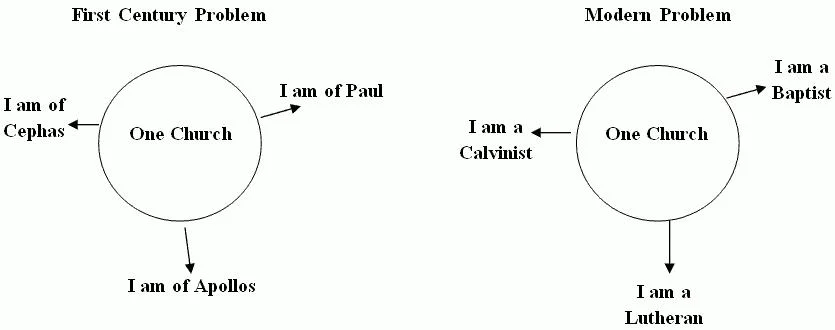
The word denomination has a rich history that dates all the way back to 1398. The Online Etymology Dictionary defines denomination as "a naming, from Latin denominationem, a calling by anything other than the proper name."2 This definition sheds light on one of the many problems of denominationalism. Denominationalism is sinful because it attempts to call the church by anything other than the proper name or description(s)! Biblically speaking, a denomination is a division resulting from the teaching and following of men. For example, Paul condemned Christians in Corinth for trying to be followers of Apollos, Cephas, or Paul. Paul plainly said, "let there be no divisions among you" (1 Corinthians 1:10-13). The proper ownership for the church is given to us by the Lord. Jesus said, "I will build My church" (Matthew 16:13-18). Jesus is the One who purchased the church (Acts 20:28). The Scriptures refer to the church as belonging to Christ and God (Romans 16:16; 1 Corinthians 1:2; Acts 20:28; Colossians 1:13; etc.).
How Do We Make a Distinction?
How can a person know which religious group is right? To many people, this seems like a monumental task that is almost unachievable, when in reality it is a very simple task. For example, imagine that you go into a grocery store to shop. When you come out of the store, you forget where you parked your vehicle. How will you be able to find it? You begin by identifying the make, model, and color of your vehicle. The only problem is there are four vehicles that are the same make, model, and color as your vehicle. What will you do now? You now begin to think about unique identifying characteristics that only your vehicle has. For example, your vehicle may have a unique scratch or a bumper sticker. With these unique characteristics and a little time, it will not be that hard to find your vehicle. This same process is used in finding the Lord’s church in the midst of denominational and community church chaos. The Lord’s church has certain unique identifying characteristics that separate it from denominations (2 Timothy 1:13).
Here Are Some of the Unique Identifying Characteristics of the Lord’s Church:
- Time of Origin: 50 days after Jesus was resurrected (Daniel 2:44; Acts 1:3; 2:1-5, 47)
- Place of Origin: Jerusalem (Isaiah 2:1-4; Acts 2)
- Founder: Jesus Christ (Matthew 16:13-18; 1 Corinthians 3:11)
- Descriptions: church of Christ, church of God, etc. (Romans 16:16; 1 Corinthians 1:2)
- Head of the church: Jesus Christ (Ephesians 1:21-23)
- Headquarters: Heaven (Psalm 119:89; Matthew 16:19)
- Final Authority: The New Testament (Matthew 28:18-20; John 12:48; 1 Corinthians 1:10; Colossians 3:17)
If a religious group does not meet these exterior identifying characteristics, there is no way they can be the church you read about in the Bible. But, what happens if they meet these exterior criteria and there is still religious division? We then must look beyond the surface to their interior characteristics. In 1 Corinthians 4:17, Paul said that he taught the same thing in every church. This teaches us that every true church will teach only what the Bible teaches (1 Corinthians 4:6). To determine if a religious group is the true body of Christ, we would need to examine their doctrine or teaching with that of Scripture (Acts 2:42; 17:11; Romans 6:17; 16:17). This is the only way you can know if a religious group is the true church that Jesus built.
Denominationalism Is Sinful Because…
- It creates unwarranted religious division (1 Corinthians 1:10). Jesus prayed, "I do not pray for these alone, but also for those who will believe in Me through their word; that they all may be one, as You, Father, are in Me, and I in You; that they also may be one in Us, that the world may believe that You sent Me" (John 17:20-21). Does the religious world today look like a fulfillment of Jesus’ prayer? Not at all! God also desires the same unity His Son does. God said, "Behold, how good and how pleasant it is for brethren to dwell together in unity" (Psalm 133:1). Christians are to "endeavor to keep the unity of the spirit in the bond of peace" (Ephesians 4:3). God wants His church to "all speak the same thing, and that there be no divisions among you, but that you be perfectly joined together in the same mind and in the same judgment" (1 Corinthians 1:10).
- It is explicitly forbidden in Scripture. Paul rebuked the church at Corinth for dividing in the names of different men and creating division. He said, "Now I plead with you, brethren, by the name of our Lord Jesus Christ, that you all speak the same thing, and that there be no divisions among you, but that you be perfectly joined together in the same mind and in the same judgment. For it has been declared to me concerning you, my brethren, by those of Chloe's household, that there are contentions among you. Now I say this, that each of you says, "I am of Paul," or "I am of Apollos," or "I am of Cephas," or "I am of Christ." Is Christ divided? Was Paul crucified for you? Or were you baptized in the name of Paul?" (1 Corinthians 1:10-13). This passage of Scripture stands as a perfect model for the current problem of denominationalism. In the first century, some were claiming to be a part of the one church and yet be followers of Paul, Cephas, or Apollos. God clearly said, "Let there be no divisions among you." The problem with denominationalism in the first century is the same problem that exists today. The following chart illustrates the problem then and the problem now:
(see image below)
- It follows the teachings of men – not God. Jesus condemned the hypocrites of His day for following men’s teachings when he said, "Hypocrites! Well did Isaiah prophesy about you, saying: "These people draw near to Me with their mouth and honor Me with their lips, but their heart is far from Me. And in vain they worship Me, teaching as doctrines the commandments of men"" (Matthew 15:7-9). Since there were no denominations that existed in the first century, men had to "go beyond what is written" (1 Corinthians 4:6) and add to God’s word in order to form them (Proverbs 30:6; Galatians 1:6-10). One does not have to look far to see that the origins of denominations have arisen from men putting trust in men and “their writings” rather than Jesus and His doctrine (2 John 9-11). For example, the Baptists have their Standard Baptist Manual. Methodists have their Book of Discipline. Martin Luther had his 95 Theses. Jehovah’s Witnesses and Mormons have their own “Bibles.” And, Catholics have their own Catechisms and Papal edicts.
- It creates confusion and doubt in the place of God’s simple plan (2 Corinthians 11:3). This confusion is created by men and their doctrines – not God (Proverbs 16:25). The Scripture says, "For God is not the author of confusion but of peace, as in all the churches of the saints" (1 Corinthians 14:33). Unscriptural division and denominationalism speak negatively against God’s plan and creates unnecessary confusion.
The Gospel of Christ
This material is copyrighted by The Gospel of Christ and its authors. This information is free to use in its entirety without further consent, however, modifications should not be made without contacting mail@thegospelofchrist.com for permission. Any and all images contained herein are believed to be free for all distribution and content.
Bible Curricula - General Letters & Revelation – 3rd Quarter (13 weeks/13 lessons)
Objective: To challenge teacher(s) and students to have a working knowledge of Hebrews - Revelation
CHOOSE 1 CURRICULUM idea (out of 3) on how to teach Heb. – Rev. in 13 weeks/13 lessons:
1st Curriculum:
Spend 13 weeks on summarizing and discussing one NT book each week (8 letters in 8 weeks, Heb. – Jude; then 5 weeks in Revelation). Goal: discuss author, date, theme, purpose, background, and characteristics of each letter and go into greater detail with Revelation.
1. Hebrews (possibly written between A.D. 64-68 before the destruction of Jerusalem in A.D. 70)
2. James (possibly written between A.D. 45-49 before the A.D. 49 meeting of Acts 15:1-9)
3. 1 Peter (possibly written between A.D. 63-64 before persecution by Nero in A.D. 64)
4. 2 Peter (possibly written between A.D. 64-66 before Peter’s estimated death in A.D. 64-66)
5. 1 John (possibly written between A.D. 80-95 before persecution by Domitian in A.D. 95)
6. 2 John (possibly written between A.D. 80-95 before persecution by Domitian in A.D. 95)
7. 3 John (possibly written between A.D. 80-95 before persecution by Domitian in A.D. 95)
8. Jude (possibly written between A.D. 66-80 after 2 Peter, before Jude’s death in A.D. 80)
9. Revelation 1 (possibly written between A.D. 95-96 during persecution by Domitian in A.D. 95-96)
10. Revelation Chapters 2-3
11. Revelation Chapters 4-11
12. Revelation Chapters 12:1-20:6
13. Revelation Chapters 20:7-22:21
2nd Curriculum:
Spend 13 weeks on VERSE-BY-VERSE (approx. 87 verses per week)
[Everyone read/study these verses a week prior to the following schedule]:
1. Hebrews Chapters 1-5
2. Hebrews Chapter 6-9
3. Hebrews Chapters 10-11
4. Hebrews Chapters 12-13 & James Chapter 1
5. James Chapters 2-5
6. 1 Peter Chapters 1-5
7. 2 Peter Chapters 1-3 & 1 John Chapter 1
8. 1 John Chapters 2-5
9. 2 John, 3 John, Jude, Revelation Chapters 1-3
10. Revelation Chapters 4-8
11. Revelation Chapters 9-13
12. Revelation Chapters 14-18
13. Revelation Chapters 19-22
3rd Curriculum:
Spend 13 weeks on 13 topics from the General Letters and Revelation
1. Hebrews (1:1-3; 2:2; 4:2, 6, 12; 5:8-14; 11:8; 13:17) God’s Word & Obedience
2. Hebrews (2:1-3; 3:12; 4:1, 11; 6:1-8; 10:24-31; 12:15) Drifting Christians
3. Hebrews (11:1-13) Faith that Pleases God
4. James (1:2-27) Trials & Temptations
5. James (2:14-26) Works that Justify
6. James (3:1-12) Controlling the Tongue
7. 1 Peter (1:13 – 2:12) Be Holy
8. 1 Peter (3:8 – 4:19) Christian Suffering
9. 2 Peter (1:1-21 ) Christian Growth
10. 2 Peter (3:1-18) The Day of the Lord
11. 1 John (2:5, 15; 3:1, 11, 14, 16-18, 23; 4:7-12, 16-21; 5:2-3) Christian Love
12. 2 John (7-11), 3 John (9-11), Jude (3-4, 8, 10-13, 16-23) False Teachers
13. Revelation (21:1 – 22:5) Heaven
MEMORY WORK
Memorizing VERSES of Paul’s Letters for the Quarter:
1. Hebrews 10:25, “not forsaking the assembling of ourselves together, as is the manner of some, but exhorting one another, and so much the more as you see the Day approaching.”
2. James 2:24, “You see then that a man is justified by works, and not by faith only.”
3. 1 Peter 5:7, “casting all your care upon Him, for He cares for you.”
4. 1 John 1:9, “If we confess our sins, He is faithful and just to forgive us our sins and to cleanse us from all unrighteousness.”
Optional Shortened Memory Verses for younger students:
1. Hebrews 13:8, “Jesus Christ is the same yesterday, today, and forever.”
2. 2 Peter 3:18, “grow in the grace and knowledge of our Lord”
3. 1 John 5:17, “All unrighteousness is sin”
4. Revelation 2:10, “Be faithful until death”
Memorizing the major themes of each of the General Letters and Revelation for the Quarter:
(On our website, go to “Study Aids” then “Study Guides” then “Theming the New Testament”)
1. Hebrews Better (is the New Testament than the Old)
2. James Be Doers of God’s Word
3. 1 Peter Rejoice in Suffering
4. 2 Peter Guard against False Teachers
5. 1 John Be Confident in the Son of God
6. 2 John Do not Support False Teachers
7. 3 John Be Hospitable (especially to Gospel Preachers)
8. Jude Contend for the Faith (against False Teachers)
9. Revelation Be Faithful (unto Death)
Memorizing all books of the Bible by the end of the Quarter (add about 5 books per week):
1. Genesis, Exodus, Leviticus, Numbers, Deuteronomy
2. Gen., Exod., Lev., Num., Deut., Joshua, Judges, Ruth, 1 & 2 Samuel
3. Gen., Exod., Lev., Num., Deut., Josh., Judg., Ruth, 1 & 2 Sam., 1 & 2 Kings, 1 & 2 Chronicles, Ezra
4. Gen., Exod., Lev., Num., Deut., Josh., Judg., Ruth, 1 & 2 Sam., 1 & 2 Kgs., 1 & 2 Chr., Ezra, Nehemiah, Esther, Job, Psalms
5. Gen., Exod., Lev., Num., Deut., Josh., Judg., Ruth, 1 & 2 Sam., 1 & 2 Kgs., 1 & 2 Chr., Ezra, Neh., Est., Job, Psa., Proverbs, Ecclesiastes, Song of Solomon, Isaiah, Jeremiah
6. Gen., Exod., Lev., Num., Deut., Josh., Judg., Ruth, 1 & 2 Sam., 1 & 2 Kgs., 1 & 2 Chr., Ezra, Neh., Est., Job, Psa., Prov., Eccl., Song, Isa., Jer., Lamentations, Ezekiel, Daniel, Hosea, Joel, Amos
7. Gen., Exod., Lev., Num., Deut., Josh., Judg., Ruth, 1 & 2 Sam., 1 & 2 Kgs., 1 & 2 Chr., Ezra, Neh., Est., Job, Psa., Prov., Eccl., Song, Isa., Jer., Lam., Ezek., Dan., Hos., Joel, Amos, Obadiah, Jonah, Micah, Nahum, Habakkuk
8. Gen., Exod., Lev., Num., Deut., Josh., Judg., Ruth, 1 & 2 Sam., 1 & 2 Kgs., 1 & 2 Chr., Ezra, Neh., Est., Job, Psa., Prov., Eccl., Song, Isa., Jer., Lam., Ezek., Dan., Hos., Joel, Amos, Obad., Jon., Mic., Nah., Hab., Zephaniah, Haggai, Zachariah, Malachi
9. Matthew, Mark, Luke, John, Acts
10. Matt., Mark, Luke, John, Ac., Romans, 1 & 2 Corinthians, Galatians, Ephesians
11. Matt., Mark, Luke, John, Ac., Rom., 1 & 2 Cor., Gal., Eph., Philippians, Colossians, 1 & 2 Thessalonians, 1 & 2 Timothy
12. Matt., Mark, Luke, John, Ac., Rom., 1 & 2 Cor., Gal., Eph., Phil., Col., 1 & 2 Th., 1 & 2 Tim., Titus, Philemon, Hebrews, James, 1 & 2 Peter
13. Matt., Mark, Luke, John, Ac., Rom., 1 & 2 Cor., Gal., Eph., Phil., Col., 1 & 2 Th., 1 & 2 Tim., Tit., Phm., Heb., Jam., 1 & 2 Pet., 1 & 2 & 3 John, Jude, Revelation
QUESTIONS on General Letters & Revelation for…
Week 1: Hebrews (Chapters 1, 4, 5, 8, 11)
1. In what days are we living?
2. Jesus was tempted in all points as we are, yet without what?
3. Jesus became the author of eternal life to all who do what?
4. Under the New Testament, what will God not remember?
5. It is impossible to please God without what?
Week 2: James (Chapters 1, 2, 3, 4, 5)
1. We should be swift/quick to hear and slow to do what?
2. When the body is without the spirit, what is it?
3. What is a fire, a world of iniquity/sin?
4. What is it to a person who knows to do good but does not do it?
5. What should we do when we are happy?
Week 3: 1 Peter (Chapters 1, 2, 3, 4, 5)
1. Christians purified their souls when they did what?
2. Whom are we commanded to love?
3. Noah and his family were saved by water. What is the antitype that now saves us?
4. The saved are called righteous. What are the lost called?
5. Elders are to be examples to the flock instead of what?
Week 4: 2 Peter (Chapters 1, 1, 2, 2, 3)
1. A Christian who fails to grow is short-sighted and has forgotten what?
2. No prophecy of Scripture is of what?
3. Why did God cast angels down to hell (Tartarus) to be reserved for judgment?
4. What will the latter end be for the child of God who becomes unfaithful and gets entangled again in the pollutions of this world?
5. Why has God been longsuffering all these years and has not yet sent His Son a second time?
Week 5: 1 John (Chapters 1, 2, 3, 4, 5)
1. A child of God who says he has not sinned is a what?
2. We know we know God if we do what?
3. What does the Bible call a child of God who hates his brother in Christ?
4. How can we determine whether someone is a false teacher or not?
5. God hears our prayers if we ask according to what?
Week 6: 2 John
1. What abides in us and will be with us forever?
2. To love is walk according to what?
3. The many deceivers who have gone out into the world have not confessed what?
4. If a person does not abide in the doctrine/teaching of Jesus, he does not have whom?
5. If we support a false teacher, we share in his what?
Week 7: 3 John
1. John prays that Christians prosper in all things including what?
2. John has no greater joy than to hear about what?
3. Who was known for taking care of brethren, strangers and especially gospel preachers?
4. Who loved to dominate the church, did not receive the apostles and put Christians out who wanted to receive brethren?
5. Who has a good testimony from all and from the truth itself?
Week 8: Jude
1. What has once and for all time been delivered to the Christians?
2. Some people try to turn the grace of God into what?
3. What did the angels who are now in everlasting chains leave that was their own?
4. Sodom and Gomorrah are suffering the vengeance of what?
5. Why do some people flatter others?
Week 9: Revelation (Chapter 1)
1. Who is the faithful witness, the firstborn from the dead and the ruler over the kings of the earth?
2. While John was persecuted on Patmos island, he considered himself a brother in tribulation, patience and what else?
3. Who walked in the middle of the seven lampstands?
4. What are the seven stars in Revelation?
5. What are the seven lampstands?
Week 10: Revelation (Chapters 2, 3)
1. Which church left their first love?
2. Which church was holding fast to the doctrine of Balaam and the Nicolaitans?
3. Which church was dead?
4. Which church was lukewarm?
5. How did the Holy Spirit speak to the churches of Asia Minor in Revelation?
Week 11: Revelation (Chapters 4, 5, 6, 10, 11)
1. All thing that God created exists by what?
2. No one in heaven or on earth was able to open up the scroll except whom?
3. Who said, “How long, O Lord, holy and true, until You judge and avenge our blood on those who dwell on the earth?”?
4. What was sweet as honey in John’s mouth but became bitter in his stomach?
5. When the temple of God was opened in heaven, what was seen in it?
Week 12: Revelation (Chapters 12, 13, 14, 16, 19)
1. Who was the great dragon?
2. The number of the beast (666) in the number of a what?
3. Those who die in the Lord are what?
4. Great Babylon was a great what?
5. What does the fine linen of the Lamb’s wife represent?
Week 13: Revelation (Chapters 20, 21, 22)
1. The dead will be judged according to their what?
2. Anyone not found in the Book of Life will be cast into what?
3. What is the second death?
4. What will be the light of the New Jerusalem?
5. If anyone takes away from the words of Revelation, God will do what to him?
An Introduction to the General Letter of the New Testament (Worksheet 1-9)
Hebrews - Jude
Fill in the blanks. Give chapter and verse to each answer. Write/type notes in your Bible.
[Make 9 copies per student/teacher.]
Name of Letter ____________________________________________________
Author ____________________________________________________
The writer of the above letter (if known)
Audience ____________________________________________________
To whom the letter was initially written
Place 1. _________________________ 2. _______________________
Where author is when he writes Where audience is
Time ____________________________________________________
When letter was written
Purpose ____________________________________________________
Why letter was written
Theme ____________________________________________________
The main idea(s) of the letter
Characteristics ____________________________________________________
Unique or emphasized ideas, features, etc. of the letter
______________________________________________________________________
______________________________________________________________________
An Introduction to Revelation (Worksheet 10)
Fill in the blanks. Give chapter and verse to each answer. Write/type notes in your Bible.
Author ____________________________________________________
The writer of Revelation
Audience ____________________________________________________
To whom the letter was initially written
Place 1. _________________________ 2. _______________________
Where author is when he writes Where audience is
Time ____________________________________________________
When letter was written
Purpose ____________________________________________________
Why letter was written
Theme ____________________________________________________
The main idea(s) of the letter
Characteristics ____________________________________________________
Unique or emphasized ideas, features, etc. of the letter
______________________________________________________________________
______________________________________________________________________
______________________________________________________________________
REVELATION: A BRIEF INTRODUCTION
by David Ray Fanning I
The word “Revelation” means “a revealing, unveiling or uncovering.” Therefore, the book of Revelation is meant to be understood by the common Christian - and not hidden from him (Revelation 1:1). It is a book of prophecy in which those who read and heed will be blessed (Revelation 1:3; 22:7). It is a revelation of Jesus Christ that concerns events which were to “shortly take place” (primarily in the first century A.D.). Hence, most of the prophecies of Revelation have already taken place (read Revelation 1:1, 3; 2:16; 3:11; 22:6, 7, 12, 20 and note that 20:7-22:5 is yet to take place). Revelation was written by John the apostle while he was exiled on the island of Patmos near the end of the reign of Roman emperor Domitian around A.D. 95 (Revelation 1:1, 4, 9; 22:8; Domitian was the first emperor to demand that the Roman people worship him while he was still alive; he was also the first emperor to lead an empire-wide persecution against Christians, described in Revelation 13).
The prophecy of Revelation was signified to John by an angel of God (Revelation 1:1). It was written to the seven churches which were located in the Roman province of Asia (Minor; read Revelation 1:9-11). The Christians of the seven churches, as well as John, were undergoing heavy persecution due to the anti-Christian policies of the Roman government (Revelation 1:9-11; 2:10, 13; note: “Babylon” is another name for Rome described in Revelation 14:8; 17:5; 18:2, 10, 21; 1 Peter 5:13). Therefore, John was inspired to write this last book of the New Testament to encourage the Christians to remain faithful (loyal) to Christ even if it meant that they must die for Him (Revelation 2:10). Furthermore, he wanted to assure the Christians that God was in ultimate control and that He would punish Rome and reward His faithful children. The book of Revelation completed the final, inspired revelations of God and is not to be added to nor subtracted from (Revelation 22:18-19). There are no more latter-day revelations (2 Timothy 3:16-17; Jude 1:3).
The word “signify” means “to set forth in signs or symbols” (Revelation 1:1). The following are some of the symbols and their usual meanings:
- Numbers (and their multiples):
- 2 = something strengthened
- 3 = the divine name
- 4 = the world men inhabit
- 6 = imperfection or evil (example: 666 = the imperfect, evil man Domitian)
- 7 = perfection (example: 7 Spirits = The perfect Holy Spirit)
- 10 = human completeness (example: 1000 years = the complete time Satan’s powers are limited, that is, the Period between the Apostolic Age and the Second Coming)
- 12 = organized religion (example: 144,000 – organized religion of the Old and New Testaments, namely, all of God’s faithful children of all the ages)
- Colors
- White = purity or victory
- Red = blood
- Black = death
For a brief commentary on “Revelation” go to our website under “Study Aids” then “Study Guides” then “Revelation: A Brief Introduction” (also in the same section see Ben’s outline of Revelation)
The Gospel of Christ
This material is copyrighted by The Gospel of Christ and its authors. This information is free to use in its entirety without further consent, however, modifications should not be made without contacting mail@thegospelofchrist.com for permission. Any and all images contained herein are believed to be free for all distribution and content.
Bible Class Curricula - First Principles - Lesson #3 - Bible Authority
Introduction
Bible authority and its understanding is crucial to proper Bible study and rightfully dividing the word of God (2 Timothy 2:15). Jesus has all authority, and we must submit to Him and His Word (Matthew 28:18; John 12:48; Luke 6:46). Everything we do in word or deed must be done in "the name" of Jesus (Colossians 3:17). In the name simply means “by the power or authority” (Acts 4:9-11). Thayer’s Bible dictionary defines authority as: "the power of rule or government (the power of him whose will and commands must be submitted to by others and obeyed)" (p. 225). Therefore, authority deals with submission to God and permission from God. Bible authority has lost its meaning in our society because the false, philosophical winds have carried many minds away from the truth (Colossians 2:8; Ephesians 4:14). Many today teach that there is no such concept as absolute truth – which in and of itself is a self-defeating view because it states its position as if it were an absolute truth. A person who does not believe in or accepts the concept of absolute truth will automatically reject the Bible because the Bible claims to be the religious authority and standard in faith and practice (John 17:17; 2 Timothy 3:16-17).
Because the vast majority has rejected Bible authority in our culture, many continue down a long, slippery slope of rejecting any true standard. The mental rejection of the principle of authority has certainly impacted Christianity and has done a great deal of spiritual damage to the souls of men and women who sadly have permitted unlawful practices to be brought into the worship and life of the church (2 Chron. 18:13). What is the solution to this great problem that has wreaked havoc in our society as well as the church? The answer has remained the same and has never changed since the creation: Listen attentively and only abide in what the word of God teaches and authorizes (Genesis 3:11; 2 Chron. 18:13; 1 Peter 4:11). Adam and Eve were the first human beings to reject the principle of authority because they listened, trusted, and obeyed the word of Satan rather than the word of God. Let us learn from their mistake and make sure we are abiding in God’s authority.
The Bible Is Our Standard
God has clearly demonstrated in His word that He is the sole authority for everything we must do in faith and practice (1 Thessalonians 5:21; Romans 12:2; Matthew 7:21; Ephesians 5:10). Since God is the Creator of this universe (Genesis 1:1) and man is the crown of His creation (Genesis 1:26-27), man must realize that God has the right to command and determine the standard. God created man as a free moral agent to choose whether or not to obey Him (Genesis 3:2-3; Josh. 24:15). From the beginning of time, humans have had the same two choices presented to them. They can either love and be loyal to God or hate and despise God (Matthew 6:24; John 14:15). He has established a written form of communication in which He reveals His authority (2 Peter 1:20-21; 2 Timothy 3:16-17; 1 Corinthians 2:6-16; Colossians 3:17). He reveals this in what we know as the Holy Bible.
There were four scientists who established a research station in Antarctica and stayed for a couple of weeks, learning the layout of the area. One day, two of the scientists decided to go on a short expedition to conduct scientific research. They gathered all the equipment they needed to get to their destination and back. Shortly after they started heading out, a huge blizzard came and caused them to turn in all sorts of directions so much so that they could not determine where they started. Fortunately, one of the scientists brought an orange flag, placed it on a small pole, and hammered it into the ground so that if they got turned around they could head back to the flagpole and then try another route. The Bible is our spiritual flagpole. The blizzards of change will keep sweeping over us, trying their best to get us to go in a wrong direction, but we must always depend on God’s word to be our guide, helping us to stay or return to the strait and narrow path (Matthew 7:13-14; Ephesians 4:14-15; James 1:21-25).
The Method of Communication
God has clearly revealed in His Word the method in which He chose to establish His communication to mankind throughout the ages (Hebrews 1:1-2). Under the Old Testament, God revealed to Israel what came to be known as the Old Law. He did this through inspired prophets such as Moses, Jeremiah, Daniel, David, Ezekiel, etc. This law was only given to Israel (Deuteronomy 5:1-3; Jeremiah 31:31-34). It came to be known as "the law of Moses and the prophets" (Acts 13:15; 24:14; 28:23; Romans 3:21; etc.). It is also described as "the Law of Moses and the Prophets and the Psalms" (Luke 24:44). Today, we are living under a greater and better covenant known as the New Testament or the New Covenant (Hebrews 8:1-13; 9:15-17; Colossians 2:14-17; Ephesians 2:14-18).
God sent Jesus in human flesh so that He could die for the sins of mankind (John 1:1, 14; Hebrews 10:1-10). When Jesus was buried, He rose again from the dead on the third day (1 Corinthians 15:1-4). He ascended back into heaven (Acts 1:9-11) to show that He completed the work that the heavenly Father had sent Him to do (Acts 1:9-11). He then sat down at the right hand of God the Father (Hebrews 1:1-4). Afterward, Jesus immersed the apostles with miraculous power when He baptized them in the Holy Spirit (John 14:16-18; 16:13-15; Luke 24:46-49; Acts 1:4-5; 2:1-4). One of the main purposes of miracles was to confirm the word of God that the inspired men were preaching and writing (Mark 16:16-20; Hebrews 2:1-3). Since Jesus promised that these inspired men would be led into all truth, all inspired writing was completed and delivered by the first century (John 16:13; Jude 3; 2 Peter 1:3). Therefore, in summarizing how we received the New Testament, the Father sent the Son who then sent the Holy Spirit to guide His apostles into all truth (John 12:48; 16:13; 2 Peter 1:19-21; Ephesians 3:1-7; Hebrews 1:1-2; 2 Corinthians 12:12). Through the inspired apostles, we have the completed New Testament (1 Thessalonians 2:13; 1 Corinthians 14:37; Jude 3).
Wrong Standards
We have established that there is one right standard of authority (the Bible). We have also established how God gave us the Bible. Now, we will look at several wrong standards of authority that individuals often use in determining what is right and wrong.
First, we cannot allow our feelings and emotions to be our guide (Proverbs 18:2; 3:5-6; Jeremiah 10:23). Have you ever heard someone say: "I feel that this passage is saying…" or "I just got this feeling deep down inside that this passage is stating…"? Some things may seem right to us, but really they are the ways of death (Proverbs 14:12; 16:2). We would become fools to trust our own hearts because our own hearts can deceive us (Proverbs 28:26; Jeremiah 17:9).
Second, we cannot allow our conscience to be our guide. Saul’s conscience did not bother him when he was killing Christians (Acts 23:1; 26:9). We can have a weak conscience (1 Corinthians 8:7). We can have a defiled conscience (Titus 1:15). We can sear our conscience (1 Timothy 4:2). We must not rely on our conscience because it is not the proper guide.
Third, we cannot allow the traditions of men to be our guide (Mark 7:6-7). There are many people who are not willing to become a Christian because they have held onto the doctrines that their preacher or other spiritual leader taught them. A false teaching is still a false teaching no matter how many years it has been taught and implemented. Many people in the religious world have been taught the false doctrine known as the “Sinner’s Prayer.” It is the idea that all a person has to do to be saved is to recognize himself as a sinner and ask God in prayer to come into his heart to forgive him of his sins. Read the New Testament and you will find that such a popular doctrine is not found anywhere. The Samaritan woman at the well had been following the Samaritan traditions for a long time. She was not right because she was the following the traditions of her ancestors (John 4:20-22). Paul the Apostle emphasized that we are only to follow the traditions inspired by God (1 Corinthians 11:2; 2 Thessalonians 2:15).
Fourth, we cannot allow human reasoning alone (rationalism) to be our guide. We as human beings do not know everything there is to know in the universe. We are finite. That is why we are not to direct ourselves (Jeremiah 10:23). The Gentiles trusted in their own wisdom and sinned as a result (Romans 1:22). The gospel was foolishness to the Greeks because it did not fit into their own reasoning (1 Corinthians 1:22-23). Solomon teaches us that we are not to lean on our own understanding (Proverbs 3:5-6). When we use our own reasoning, we are not wise because we are using self as our standard (2 Corinthians 10:12). Just because we may not completely understand the reason behind the way God wants it done does not mean we are to disregard it as a command of God and consider it irrelevant. For example, in 2 Kings 5, Naaman did not completely understand why he had to go to the river Jordan and dip seven times in order to have his leprosy cleansed. What does the river Jordan and baptizing oneself seven times have to do with cleansing leprosy? Yet, the power was not in human reasoning or science but in the divine power and will of God’s authoritative word or command. God has revealed to us what we need to know and do (2 Peter 1:3). We do not need to try to speculate the secret things of God (Deuteronomy 29:29).
Conclusion
We must follow God and allow His Word (the Bible) to be our only standard (1 Timothy 1:3). We cannot allow our emotions, traditions, or consciences to get in the way of doing that which we know is right. Jesus said in Matthew 7:21 that only those who do "the will" of God will go to heaven. God has revealed His will to us in the Bible (Ephesians 3:1-5). We must constantly study His will so that we will know how to rightfully divide and ascertain truth (Acts 17:11; 2 Timothy 2:15; Hebrews 5:14).
Study Questions
- What is Bible authority?
- Why is it important that we understand authority?
- Where must we go to determine the standard of living?
- Explain the method by which God has given us His Word.
- Why can’t we rely on our emotions or consciences to be our guide?
- Explain some other false ways people may try to justify sin.
The Gospel of Christ
This material is copyrighted by The Gospel of Christ and its authors. This information is free to use in its entirety without further consent, however, modifications should not be made without contacting mail@thegospelofchrist.com for permission. Any and all images contained herein are believed to be free for all distribution and content.
Bible Class Curricula - First Principles - Lesson #10 - Music In New Testament Worship
Introduction
The Holy Spirit taught the Christians at Ephesus to sing when He said, “speaking to one another in psalms and hymns and spiritual songs, singing and making melody in your heart to the Lord” (Ephesians 5:19). In view of the type of singing God commands in New Testament worship, even Baptist preacher Charles Spurgeon said, "I would as soon attempt to pray to God with machinery as to sing to Him with machinery." Spurgeon understood the New Testament
authorizes a person to pray using a mechanical instrument just as much as it authorizes a person to sing using an instrument. Neither is authorized by God. Why then is there so much confusion in the religious world over instrumental music? Just what does the New Testament say about singing? Let us see what the New Testament teaches on this very important subject.
A Matter of Bible Authority
As it relates to Bible authority the Scripture teaches we are only to do that which God has authorized. Paul said, “And whatever you do in word or deed, do all in the name of the Lord Jesus, giving thanks to God the Father through Him” (Colossians 3:17). Both in the Old and New Testament God’s people are taught not to add to, subtract from or make any changes to what God has specified in His Word (Revelation 22:18-19; Deuteronomy 4:2). One of the premiere passages relating to Bible authority is 1 Corinthians 4:6. In this passage, Paul told Christians not to go beyond what is written. When it comes to matters of faith (that is, spiritual matters that can affect our salvation, such as, acceptable worship to God, John 4:23-24), if God authorizes or specifies it, then we are to do it. If God does not authorize or specify it and it is not written, we need to avoid it. Man’s opinions, ideas and what makes him feel good are not the authority. Men’s traditions only get in the way of pleasing God. For example, Jesus said “Hypocrites! Well did Isaiah prophesy about you, saying: 'These people draw near to Me with their mouth And honor Me with their lips, But their heart is far from Me. And in vain they worship Me, Teaching as doctrines the commandments of men" (Matthew 15:7-9). Authority demands that we “speak as the oracles of God” (1 Peter 4:11) and that we not “go beyond the doctrine of Christ” (2 John 1:9). With these principles of Scripture in mind, let’s turn our attention to what God has authorized for singing in the New Testament.
God Has Specified Vocal Music
The primary passages in the New Testament on congregational singing are Ephesians 5:19 and Colossians 3:16. Paul commands the church to, “speak to one another in psalms and hymns and spiritual songs, singing and making melody in your heart to the Lord” (Ephesians 5:19). The emphasis in this verse is the speaking and singing to one another. Can an instrument speak? Absolutely not! Where is the mention of an instrument in this verse? There is none. In the letter to the Colossians Paul said, “Let the word of Christ dwell in you richly in all wisdom, teaching and admonishing one another in psalms and hymns and spiritual songs, singing with grace in your hearts to the Lord” (Colossians 3:16). From this passage, we learn that our singing is also an action involving teaching. Again, can an instrument teach anyone anything? Absolutely not! There is no mention in the New Testament of mechanical instruments of music. Christians are to make melody in their heart! We make melody in our heart when we “sing with the spirit and the understanding” (1 Corinthians 14:15). Every New Testament passage that relates directly or indirectly to the worship of the church or to individual Christians on earth teaches that it is accomplished with the voice and without the addition of instrumental music.
Take just a moment and look at all the passages on music:
- Matthew 26:30, “And when they had sung a hymn, they went out to the Mount of Olives.” (See also Mark 14:26)
- Acts 16:25, “But at midnight Paul and Silas were praying and singing hymns to God, and the prisoners were listening to them.”
- Romans 15:9, “and that the Gentiles might glorify God for His mercy, as it is written: For this reason, I will confess to You among the Gentiles, And sing to Your name.” (See Psalm 18:49)
- 1 Corinthians 14:15, “I will sing with the spirit, and I will also sing with the understanding.”
- Ephesians 5:19, “speaking to one another in psalms and hymns and spiritual songs, singing and making melody in your heart to the Lord.”
- Colossians 3:16, “Let the word of Christ dwell in you richly in all wisdom, teaching and admonishing one another in psalms and hymns and spiritual songs, singing with grace in your hearts to the Lord.”
- Hebrews 2:12, “saying: I will declare Your name to My brethren; In the midst of the assembly I will sing praise to You.” (See Psalms 22:22)
- Hebrews 13:15, “Therefore by Him let us continually offer the sacrifice of praise to God, that is, the fruit of our lips, giving thanks to His name.”
- James 5:13, “Is anyone cheerful? Let him sing psalms.”
Thus, in the New Testament God has specified vocal singing and there is no authority for the use of instrumental music.
While the New Testament does not authorize instrumental music in worship, there are many who still use it. Why is this? Many will say, “The New Testament doesn’t say we can’t use it.” This statement gets to the heart and core of the problem with modern religion. The Bible teaches we can only do that which we are authorized or told to do. Paul said, “Whatever you do in word or deed, do all in the name of the Lord Jesus…” (Colossians 3:17). To do something in the name of another means that we do it by their authority (Acts 4:7). As was previously noted, the Bible teaches that we must not go beyond what is written (1 Corinthians 4:6; Revelation 22:18-19). Too many people have their argument backward. Just imagine how big the Bible would be if God had to tell us not only what to do - but everything we are not to do. Biblically speaking, Christians only do what they are authorized to do (Proverbs 30:6).
Under What Law Are Christians Held Accountable?
In the Scriptures, there are two main laws or covenants we must understand to rightly divide the Word of God (2 Timothy 2:15). To the Israelites, at Mount Sinai, God gave the Old Covenant (Exodus 20:1-17; Deuteronomy 5:2-3). This covenant was never intended to be the permanent covenant binding on all men for all ages. In fact, Jeremiah prophesied under the Old Covenant that a “new” covenant was coming that promised greater blessings and benefits (Jeremiah 31:31-34). In view of that prophecy, the writer of Hebrews affirms, “In that, He says, ‘A new covenant,’ He has made the first obsolete. Now, what is becoming obsolete and growing old is ready to vanish away” (Hebrews 8:13). The Scripture teaches that the Old Covenant has been taken away and that we are accountable to the New Testament (Romans 3:19; Ephesians 2:14- 18; Colossians 2:14-16; Hebrews 7-10; etc.). Hebrews 10:9 says that Jesus “took away the first that He may establish the second.” If Jesus nailed the Old Testament to the cross and took it out of the way, then it is not the pattern for how we worship God today. There are many things the Israelites did under the Old Testament that are not acceptable today. The offerings of animal sacrifices, burning incense, going to the temple were all practices that have ceased for Christians. Just as these practices are not our pattern today, we cannot use the Old Testament to sanction mechanical instruments of music in worship today.
The Voice of History on Instrumental Music
Although these men do not serve as the authority, it is worth noting that many denominational founders and leaders have even affirmed that mechanical instruments of music are without Bible authority. Notice what some of these men say:
- The Voice of Catholicism: "... the first Christians were of too spiritual fiber to substitute lifeless instruments for or to use them to accompany the human voice." –CATHOLIC ENCYCLOPEDIA
- The Voice of Orthodox: "The execution of Byzantine church music by instruments, or even the accompaniment of sacred chanting by instruments was ruled out by the Eastern Fathers as being incompatible with the pure, solemn, spiritual character of the religion of Christ." -- Constantine Cavarnos, BYZANTINE SACRED MUSIC
- John Calvin: "Musical instruments in celebrating the praises of God would be no more suitable than the burning of incense, the lighting up of lamps, the restoration of the other shadows of the law. The Papists, therefore, have foolishly borrowed this, as well as many other things, from the Jews. Men who are fond of outward pomp may delight in that noise, but the simplicity which God recommends to us by the apostle is far more pleasing to Him." - Commentary on the Book of Psalms, Vol. I, p. 539 (Presbyterian, founder of Calvinism)
- John Wesley: "I have no objection to instruments of music, in our chapels, provided they are neither heard nor seen." - METHODIST (founder)
- Adam Clarke: "Music as a science, I esteem and admire: but instruments of music in the house of God I abominate and abhor. This is the abuse of music, and here I register my protest against all such corruptions in the worship of the Author of Christianity." - METHODIST (commentator)
- Martin Luther: - "Martin Luther called the organ an 'ensign of Baal'." – MCCLINTOCK & STRONG'S ENCYCLOPEDIA
- Charles H. Spurgeon: "I would as soon attempt to pray to God with machinery as to sing to Him with machinery." –Baptist Preacher
- J. H. Garrison: "There is no command in the New Testament, Greek or English, commanding the use of the instrument. Such a command would be entirely out of harmony with the New Testament." (Christian Church)
- Professor John Girardeau, Presbyterian Professor in the Columbia Theological Seminary in Music in the Church, page 179, makes the following statement: "The church, although lapsing more and more into defection from the truth and into a corruption of apostolic practice, had no instrumental music for 1200 years" (that is, it was not in general use until that time).
Study Questions
- Does Colossians 3:17 teach we are to have God’s authority for whatever we do in word or deed?Under which law are we accountable today?
- Why is it important to understand under what law we are accountable?
- Is the Old Testament a pattern of how we are to worship God today? If not, why not?What kind of music does God authorize in New Covenant worship?
- What do all the passages on music in the worship of the church have in common?
- Discuss the importance of 1 Corinthians 4:6. How does this apply to Christian worship in song?Must we prove all things we do?
- Although not the authority, what do we learn from the voice of history concerning mechanical instruments of music?
- Discuss this statement "There is no command in the New Testament, Greek or English, commanding the use of the instrument. Such a command would be entirely out of harmony with the New Testament." Why is this such a hard principle to understand for so many?
The Gospel of Christ
This material is copyrighted by The Gospel of Christ and its authors. This information is free to use in its entirety without further consent, however, modifications should not be made without contacting mail@thegospelofchrist.com for permission. Any and all images contained herein are believed to be free for all distribution and content.
Bible Class Curricula - First Principles - Lesson #7 - The Church That Jesus Built
Introduction
We live in a world where an individual can find a religious group or church that believes and practices almost anything. In the midst of this confusion, it has become increasingly difficult to identify the New Testament church. However, simple laws of logic and reasoning tell us that anything is made according to its kind. In Genesis chapter one, the phrase "according to its kind" or a similar statement occurs 18 times. By using this phrase, God is conveying to us that each creation follows and represents its Maker’s pattern. In this lesson, we will be studying the nature and pattern of the New Testament church. By using the Bible as our blueprint, we will be able to determine what “church” is the true church of the New Testament. In identifying the one true church in the midst of all the denominational and community church chaos, we must first identify what the church is not.
What the Church Is Not
Not A Building. The church of Christ is not composed of walls, ceilings, and pews. The bold martyr Stephen proclaimed, "God does not dwell in temples made with hands" (Acts 7:48-50). Even during the time of the Israelites, God did not want His people to trust in the temple. In Jeremiah, the people were crying out, "The temple of the Lord, The temple of the Lord, The temple of the Lord," (Jeremiah 7:4). Yet, their trust in the building did not save them from the impending Babylonian exile (Jeremiah 25:9-12). Buildings burn, temples fall, yet the church of the living God will stand forever because it is comprised of individuals (1 Timothy 3:15; 1 Corinthians 12). The church of Christ in the New Testament is made up of people, not pews, carpet, and a pulpit (Acts 8:3-4; 1 Corinthians 12:27). May we never let our meeting hall become our cemetery; may we never confuse merely attending a worship service to be the same as living faithfully to God. The church of Christ is not a building.
Not a Denomination. The word denomination by its very definition is in direct contradiction with the New Testament pattern. Denomination means “to call by or name something after another.” In the New Testament, the idea of naming the church is strongly condemned. There are many descriptions of the church, but not an official name. Paul said to the Corinthians, "Now I plead with you, brethren, by the name of our Lord Jesus Christ, that you all speak the same thing, and that there be no divisions among you, but that you be perfectly joined together in the same mind and in the same judgment" (1 Corinthians 1:10). In this context, Paul is dealing with the root problem of denominationalism. Some were saying, "I am of Paul, or I am Apollos, or I am of Cephas" (1 Corinthians 1:12). Paul’s inspired questions indicate that the very nature of a denomination is a division when he asks, "Is Christ divided? Was Paul crucified for you? Or, were you baptized in the name of Paul?" (1 Corinthians 1:13). For anyone who desires to have a church, Paul sets down two simple criteria. First, one must be crucified as a sinless sacrifice for his followers. No person on earth today can serve as a sinless sacrifice (Hebrews 10:12; Romans 3:23). Second, the leader of any group must have the God-given authority to command baptism in his name. In the New Testament, there is no authority for baptizing into any man’s name – except Christ’s (Matthew 28:18-20; Acts 19:1-5). Therefore, denominationalism violates the pattern of the New Testament church. The church of Christ is not a denomination.
Not a Social Club. To many people, the church is nothing more than a glorified social club. It is a place to dress exquisitely and to simply be seen (James 2:1-4). For some, “going to church” is nothing more than a good public relations move. The Jews had the mindset that their religion could be used for social purposes, but Jesus strongly rebuked them. Jesus condemned the Jews because they wore elaborate clothing, loved the best seats, and wore religious titles such as “rabbi” (Matthew 23:1-12). This same rebuke applies today to those who want to make the church into nothing more than a modern-day civic club. To understand that the church is not a social club, we need to realize that we are not the center of worship. God is the center of our worship, and we must make Him the focus of our worship services – not ourselves (John 4:24).
Not an Afterthought. With the recent rise of premillennial fiction books such as Left Behind and others, the church is being looked at more as an afterthought than an original plan. Many in the premillennial camp believe that God planned to set up a 1000-year reign on earth, but His plan was ruined, and the church was created as an afterthought until the original plan could be set up. While this may be an attractive view to many, the Bible teaches the church has always been God’s original plan. Paul said God was making his power known to princes and principalities through the church, which was "according to the eternal purpose" (Ephesians 3:10-11). This passage clearly teaches that the church has been in the mind and plan of God from all eternity. The church is much more than an afterthought. It is the forethought and divine plan of God that will last until Christ comes to receive it unto Himself (1 Corinthians 15:24, Matthew 16:18-19).
The Nature of the Church
If a group of people on an unknown island found a Bible, read it, and decided to do exactly what it said, what church would they set up? These people would not be able to set up any of the denominations we have today. Their only scriptural option would be to establish the church of the first century, and nothing more. Let us consider some characteristics needed to set up the New Testament church.
Only One Church. The Lord promised to Peter, "I will build My church" (Matthew 16:18). Notice Jesus said "church" singular. It was never a part of God’s plan to have a multitude of religious groups all claiming to be His church. One of the clearest and most repeated teachings about the church is its singular nature. The Holy Spirit uses the synonyms body and church interchangeably to represent the Lord’s people. For example, God said, "And He put all things under His feet, and gave Him to be head over all things to the church, which is His body, the fullness of Him who fills all in all" (Ephesians 1:22-23). Remembering that the body and the church are the same, Paul later says, "There is one body and one Spirit, just as you were called in one hope of your calling" (Ephesians 4:4). If the body is the church, and there is only one body, then how many churches are there? Only one! Paul said, "And let the peace of God rule in your hearts, to which also you were called in one body; and be thankful" (Colossians 3:15). Christians of Rome were told, "For as we have many members in one body, but all the members do not have the same function, so we, being many, are one body in Christ, and individually members of one another" (Romans 12:4-5). Paul wrote to the church at Corinth, "But now indeed there are many members, yet one body" (1 Corinthians 12:20). While every man may do that which is right in his own eyes today (Josh 21:25), let us remember that Jesus is only coming back to save His church (1 Corinthians 15:24) for all the saved and only the saved are in the church of Christ (Acts 2:47; 20:28; 1 Corinthians 12:13; 15:24; Ephesians 5:23; Colossians 1:13; Hebrews 12:25-29).
The Proper Founder. The church we read about in the Bible only has one founder – Jesus Christ. Jesus said, "I will build My church" (Matthew 16:18). Paul said, "No other foundation can any man lay except that which is laid, which is Jesus Christ" (1 Corinthians 3:11). Jesus Himself promised He would be the builder of the church. The New Testament teaches that Jesus is the owner of the church: "the church of God which He purchased with His own blood" (Acts 20:28). Today, Jesus is still the head of the New Testament church. "And He put all things under His feet and gave Him to be head over all things to the church" (Ephesians 1:21-23). In matters of doctrine, Jesus has all authority in His church: "All authority has been given to Me in heaven and on earth" (Matthew 28:18-20). Since the church is the bride of the Lord, it should wear the name of her husband – Jesus Christ (Ephesians 5:21-31). These passages teach us that the church belongs solely to Jesus and should follow His direction and wear His name. Therefore, it is sinful for men to come along hundreds of years later; name the church after some man, method, or doctrine; and make up creeds for it to follow. If we are going to be members of the Lord’s church, we must wear His name and follow His teaching (2 John 9-11). It is the Christian’s God-given responsibility to "prove all things" (1 Thessalonians 5:21, KJV). If Jesus is the legitimate founder of His church, then naturally one wonders who founded all the denominations that exist today. John Wesley founded the Methodists. John Smythe helped to start the Baptists. John Knox and John Calvin aided in conceiving the Presbyterians. Pope Boniface II was highly instrumental in bringing to full maturity the Catholics. Martin Luther founded the Lutherans. Joseph Smith originated the ideas of the Mormons. Etc. The one thing you will notice about denominations that exist today is that they all have the wrong founder. In view of this, Jesus said, "Every plant which My heavenly Father has not planted will be uprooted. Let them alone. They are blind leaders of the blind. And if the blind leads the blind, both will fall into a ditch" (Matthew 15:13-14).
The Established Period. The Bible is very specific as to when the Lord’s church/kingdom would be established. In Daniel 2:44, we are told that in the time of the fourth kingdom, God would set up a kingdom that would never be destroyed. Beginning with the time of Daniel who was under the rule of the first kingdom, Babylon, and going through the Medo-Persian (second) and Grecian (third) kingdoms, there was no new kingdom set up. God’s people were still under the rule of the Old Covenant kingdom. But, during the time of the fourth kingdom (the Roman Empire), God established the kingdom of His dear Son, namely, the church of Christ (Mark 9:1; Colossians 1:13). Jesus promised He would build His kingdom (Matthew 16:18-19). On the day of Pentecost after the resurrection of Jesus, the “new” kingdom was established, and the Bible says, "The Lord added to the church daily" (Acts 2:47). From this information, we learn that the church of the Bible was established on the day of Pentecost around A.D. 30. This is very important to note because most modern, man-made denominations began between A.D. 1500–1800. Most modern churches were established 1500 years too late. If the church of which you are a part was established some other time after approximately A. D. 30, it is not the true church of the New Testament.
The Established Place. The Bible also tells us where the church of the Lord would be established. In Isaiah 2:1-4, God promised that the "Lord’s house" would be established in Zion, the hill upon which Jerusalem sits. Isaiah cannot be talking about the Old Testament Temple because it was still in existence during the time of Isaiah’s writing. So then, what is this “house of the Lord” about which Isaiah is speaking? This phrase refers to the church of the Lord. In 1 Timothy 3:15, the Bible says that the house of the Lord is "the church of the living God, the pillar, and ground of truth." It was in Jerusalem on the day of Pentecost that the Lord’s church was established (Luke 24:44-53; Acts 1:4, 12; 2:5, 38-47). Did the church you of which you are a part begin in Jerusalem or somewhere else? Please remember that most denominations in existence today began either in the Americas or England.
Can a Person Be Saved Outside the Church of Christ?
Can a soul be saved outside the church of Christ? Absolutely not! Why not? The answer is simple: Jesus is the Savior of the body (Ephesians 5:23). Since the body is the church, then Jesus will only save those in His body (Ephesians 1:22-23). The Scriptures teach that grace and salvation is only found "in Christ" (2 Timothy 2:10). When one is baptized into Christ and, therefore, into His body (1 Corinthians 12:13), then salvation is only in the body of Christ (1 Corinthians 12:13; Galatians 3:27). The Scriptures teach that those who are a part of the Lord’s church are the ones who have their names registered in heaven (Hebrews 12:22-23). If you are not in the Lord’s church, then you are not on heaven’s registry. The Bible promises that at the second coming of Christ, Jesus will deliver His Kingdom to the Father (Hebrews 9:28; 1 Corinthians 15:24). Jesus is presently ruling His kingdom through His church because they are one and the same (Matthew 16:18-19; Acts 2:47; Colossians 1:13; Mark 9:1).
May each of us realize how important the church is to God! It was so important that our Lord purchased the church with His own precious blood (Acts 20:28). May we be motivated to seek first God’s church and live faithfully for Christ every day of our lives (Matthew 6:33; Revelation 2:10).
Study Questions
- Explain the principle behind making something "according to its kind."
- How does that relate to the Lord’s church?
- Do the Scriptures teach the church is or is not the building?
- What is a denomination?
- What two criteria does Paul give for having a church named after an individual?
- According to Ephesians 3:10-11, was the church an afterthought?
- How many churches did Jesus build?
- Why then do so many people miss this point?
- Who founded the New Testament church?
- Who founded all denominations that exist today?
- Explain when and where the Bible prophesied the church would be started.
- Must any church that claims to be a Bible church meet these requirements?
- Is the church necessary to salvation?
- Must I be a member of the Lord’s church to be saved? Why?
- Should Christians try to apologize for, or beat around the bush about, any of these truths concerning the Lord’s church? Why or why not?
The Gospel of Christ
This material is copyrighted by The Gospel of Christ and its authors. This information is free to use in its entirety without further consent, however, modifications should not be made without contacting mail@thegospelofchrist.com for permission. Any and all images contained herein are believed to be free for all distribution and content.
Bible Class Curricula - First Principles - Lesson #4 - Jesus of Nazareth
Introduction
Who is Jesus of Nazareth? Muslims would tell you He was a great prophet among prophets but not the Son of God. Mormons would tell you He was a god among many gods. People of the world would tell you He was just an ordinary man who made a big impact in world history. What does the word of God say? Who is Jesus?
The Historicity of Jesus
No other person has had more influence on the world in history than Jesus of Nazareth. Even the common dating system centers on Jesus (B.C.means “before Christ” and A.D. is a Latin phrase, anno domini, meaning “in the year of our Lord”).
Ancient Historical Writings
- Flavius Josephus (A.D. 37-100), Jewish historian, wrote in his Antiquities of the Jews: "Now there was about this time Jesus, a wise man, if it be lawful to call him a man; for he was a doer of wonderful works, a teacher of such men as receive the truth with pleasure. … He was Christ. And when Pilate, at the suggestion of the principal men amongst us, had condemned him to the cross, those that loved him at the first did not forsake him; for he appeared to them alive again the third day; as the divine prophets have foretold these and ten thousand other wonderful things concerning him. And the tribe of Christians, so named from him, are not extinct at this day." (18.3.3). Josephus also wrote: "he assembled the Sanhedrin of judges, and brought before them the brother of Jesus, who was called Christ, whose name was James." (20.9.1).
- Jewish Talmud (A.D. 200-500): these writings of Jewish traditions claim that Jesus was born out of wedlock after his mother was seduced by a Roman soldier named Pandera. They refer to Jesus’ miracles as “magic” and state that He claimed to be God. It also mentions Jesus’ execution on the eve of the Passover: "On the eve of the Passover they hanged Jesus," (Baraila, Babylonia Sanhedrin, 43a).
- Tertullian (A.D. 197), a theologian in defense of Christianity, wrote: "Tiberius accordingly, in those days the Christian name made its entry into the world, having himself received intelligence from the truth of Christ’s divinity, brought the matter before the senate, with his own decisions in favor of Christ. The senate, because it had not given the approval itself, rejected his proposal. Caesar held to his opinion, threatening wrath against all of the accusers of the Christians" (Apology, V. 2).
- Thallus (A.D. 52) was one of the first historical Gentile writers who mentioned Christ. Julius Africanus (A.D. 221), a Christian writer, comments about Thallus: "Thallus, in the third book of his histories, explains away this darkness as an eclipse of the sun – unreasonably, as it seems to me. Unreasonably, of course, because a solar eclipse could not take place at the time of the full moon, and it was the season of the Paschal full moon that Christ died." Julius is referring to the Gospel accounts of the darkness which fell upon the land during Christ’s crucifixion (Luke 23:44-45). Because this event was so well known, non-believers felt compelled to give a naturalistic explanation for it. However, even Thallus was not fully convinced of his own “natural” explanation. (1/113)
- Justin Martyr (A.D. 150), a Christian apologist and philosopher, wrote in his Defence of Christianity to the Emperor Antonius Pius and referred him to Pilate’s report. Justin supposed it was preserved in the imperial archives. But the words, "They pierced my hands and my feet," he says, "are a description of the nails that were fixed in His hands and His feet on the cross; and after He was crucified, those who crucified Him cast lots for His garments, and divided them among themselves; and that these things were so, you may learn from the ‘Acts’ which were recorded under Pontius Pilate." Later he says: "That He performed these miracles you may easily be satisfied from the ‘Acts’ of Pontius Pilate." (Apology I. 48)
- Mara Bar-Serapion, a non-Christian philosopher, wrote a letter sometime later than A.D. 73 to his son while he was in prison to encourage him to seek wisdom. He pointed out that those who persecuted wise men were overtaken by misfortune. He mentions the deaths of Socrates, Pythagoras, and Christ (1/114; see Robert E. Van Voorst, Jesus Outside the New Testament: An Introduction to the Ancient Evidence, Wm. B. Eerdmans Publishing, 2000. p 54).
- Clement of Rome, “Apostolic Church Father” of the 1st century A.D., wrote: "The Apostles received the Gospel for us from the Lord Jesus Christ; Jesus Christ was sent forth from God" (Corinthians 42)
- Ignatius of Antioch, “Apostolic Church Father” of the 1st century A.D., wrote: "Jesus Christ who was of the race of David, who was the Son of Mary, who was truly born and ate and drank, was truly persecuted under Pontius Pilate, was truly crucified and died,"
- Polycarp of Smyrna, “Apostolic Church Father” of the 2nd century A.D., spoke passionately of Christ and wrote against certain heretics of his day. Irenaeus, “Apostolic Church Father” of the 2nd century, said that Polycarp had a personal association with the Apostle John, and with others who "had seen the Lord" (Eusebius V. XX).
The Pre-Existence of Jesus
According to the Bible, Christ had a pre-existence before He became known as Jesus of Nazareth. His pre-existence was from eternity (Micah 5:2; Isaiah 9:6). This refutes a false doctrine that was taught during the early centuries of the church, namely that Jesus was created by God the Father. Even today, Jehovah’s Witnesses hold to this ancient heresy by stating that God the Father created Jesus who then created everything else. But John 1:1,2 states: "In the beginning was the Word, and the Word was with God, and the Word was God. He was in the beginning with God." John 1:14-17teaches us that Jesus is the One of Whom the context speaks. These verses prove that Jesus had a timeless existence. He was not at any time brought into existence. He always has been and always will be. He was not created; instead, He was the eternal Creator of all things and beings (Hebrews 1:10; Colossians 1:16-17). In fact, Jesus is indeed God (John 1:14-17). In Hebrews 1:7-9, the Bible calls Jesus Jehovah. Jesus was and is “Almighty God” (Isaiah 9:6).
The Virgin Birth, Childhood, and Adult Life of Jesus
About seven hundred years before Christ was born as the Son of Man, Isaiah the prophet predicted in Isaiah 7:14 that Jesus would be born of a virgin and Micah the prophet predicted in Micah 5:2 that Jesus would be born in Bethlehem. Matthew records the fulfillment of these divine prophecies in 1:22-23; 2:5-6. The gospel writers cover the life of Jesus from when He was an infant to when He was about two and then when He was twelve, but then skips about eighteen years of His life to when He reaches the age of about thirty and begins preaching (Matthew 2:11; Luke 2:41-50; 3:23). If Jesus was such an important individual, why skip all these years? Obviously, God’s emphasis was to be placed on His Son’s final years on this earth, including the death, burial, resurrection, and ascension.
The Miracles of Jesus
Some of the main purposes of God’s miracles were to confirm that the messenger(s) was from God and that the message was from God (Hebrews 2:1-4). By witnessing the miracles of Jesus, it was obvious to one of the Jewish leaders named Nicodemus that Jesus was from God because he states in John 3:2, "Rabbi, we know that You are a teacher come from God; for no one can do these signs that You do unless God is with him."
We do not know the exact number of miracles Jesus performed while on earth for it would have been impossible for the Gospel writers to record them all. But, the miracles which are recorded total about thirty-four or thirty-five (John 21:25). They were performed in three different realms: the human realm (the healings of the deaf, blind, dumb, etc.), the natural realm (walking on the water, turning water into wine, multiplying the loaves and fish, etc.), and the spiritual realm (demon exorcism, bringing the dead back to life, etc.). The enemies of Jesus recognized that He was performing genuine miracles, but they attributed His miracles as coming from Satan (Matthew 12:24-30). Jesus refuted their claim by revealing their irrational reasoning with powerful logic. If Jesus was performing miracles on behalf of Satan, why would He be speaking against Satan? Peter testifies to the miracles that Jesus performed. In his sermon to Cornelius, Peter states in Acts 10:38, "how God anointed Jesus of Nazareth with the Holy Spirit and with power, who went about doing good and healing all who were oppressed by the devil, for God was with Him."
John, the beloved disciple, shows why he wrote his inspired Gospel, revealing the main purpose of his Gospel in John 20:30-31, "And truly Jesus did many other signs in the presence of His disciples, which are not written in this book; but these are written that you may believe that Jesus is the Christ, the Son of God, and that believing you may have life in His name." Jesus did not perform these miracles to prove He was a powerful magician or to put on a show! The main purpose of Jesus’ miracles was to show people that He was Who He claimed to be – the Son of God. Peter states in Acts 2:22, "Men of Israel, hear these words: Jesus of Nazareth, a Man attested by God to you by miracles, wonders, and signs which God did through Him in your midst, as you yourselves also know[.]"
The True Messiah
The Old Testament foretells of an individual who would come and be known as the Messiah (Hebrew word meaning “Anointed One,” Daniel 9:26; Micah 5:2; John 4:25). In the New Testament, Jesus reveals Himself as the Messiah. For example, when a Samaritan woman who is drawing water from Jacob’s well meets Jesus, she says to Him, "I know that Messiah is coming" (who is called Christ). When He comes, He will tell us all things" (John 4:25-26). Jesus says to her in verse 27, "I who speak to you am He." Jesus claimed to be the Anointed One chosen by God. Jesus fulfilled the prophecies concerning the work of the Messiah. After Jesus rose from the dead, He appeared to two of His disciples on the road to Emmaus. They still did not understand the events that had previously taken place, so Jesus said to them, "O foolish ones and slow of heart to believe in all that the prophets have spoken! Ought not the Christ to have suffered these things and to enter into His glory?" And beginning at Moses and all the Prophets, He expounded to them in all the Scriptures the things concerning Himself" (Luke 24:25-27).
The Death, Burial, and Resurrection of Jesus
Crucifixion was one of the most dreadful, agonizing death punishments in ancient times. The location of Jesus’ crucifixion was Golgotha, the Place of the Skull. Though it was outside the wall of Jerusalem, it was in the immediate vicinity of the city. The crucifixion took place on Friday about 9 A.M. Isaiah 53:8 and Daniel 9:26 prophesied that Jesus would experience a violent death. Psalm 22:16 reveals that He was to die by crucifixion (even though crucifixion had not yet been invented). Psalm 22:11 states that Jesus’ death would be in the midst of His enemies, that His garments would be parted, and Psalm 22:18 reveals that the parting would be determined by casting lots. Why did Jesus have to die on the cross? Romans 3:24-26 states: "being justified freely by His grace through the redemption that is in Christ Jesus, whom God set forth as a propitiation by His blood, through faith, to demonstrate His righteousness, because in His forbearance God had passed over the sins that were previously committed, to demonstrate at the present time His righteousness, that He might be just and the justifier of the one who has faith in Jesus." Jesus had to become our substitute (Galatians 3:10-13). He took our sins and bore them on the cross (1 Peter 2:24; 2 Corinthians 5:21; Isaiah 53; Hebrews 9:26-28; 12:2).
After Jesus died on the cross, His body was taken and put in the new tomb that was owned by Joseph of Arimathea. The Roman guards stood watch to make sure that none of the disciples would come to steal the body, heeding a warning given to Pilate by the Jewish Sanhedrin (Matthew 27:62-66). The body was in the tomb for three days. Early Sunday morning, something spectacular happened. The power of death could not hold Jesus in its grasp (Mark 16:9; Acts 2:22-39). Jesus arose from the dead by the power of God (1 Corinthians 15:1-4)! He appeared to His disciples who became eyewitnesses of His resurrection (1 Corinthians 15:5-9).
Conclusion
Acts 1:9-11 states, "Now when He had spoken these things, while they watched, He was taken up, and a cloud received Him out of their sight. And while they looked steadfastly toward heaven as He went up, behold, two men stood by them in white apparel, who also said, "Men of Galilee, why do you stand gazing up into heaven? This same Jesus, who was taken up from you into heaven, will so come in like manner as you saw Him go into heaven." Jesus went back into heaven to show that He completed the sacrifice for sin by showing His blood that He had shed. Jesus then sat down at the right hand of God and began His reign over His kingdom, the church of Christ (Matthew 16:18-19; Acts 2:29-36; Colossians 1:13; Hebrews 1:1-4). Jesus is coming again at an hour we do not expect (Matthew 24:36; Hebrews 9:28). We need to make sure that we are obeying Him as our Lord and Master (Luke 6:46).
Study Questions
- Prove that Jesus of Nazareth existed.
- Was Jesus created or is He eternal? Explain.
- Give a few examples of the miracles of Jesus.
- Why are the miracles of Jesus significant? What do they prove?
- How can one know that Jesus was a prophet sent from God?
- What is the importance of Old Testament prophesy in relation to Jesus?
- Prove that Jesus was the Son of God.
The Gospel of Christ
This material is copyrighted by The Gospel of Christ and its authors. This information is free to use in its entirety without further consent, however, modifications should not be made without contacting mail@thegospelofchrist.com for permission. Any and all images contained herein are believed to be free for all distribution and content.
Bible Class Curricula - First Principles - Lesson #12 - The Lord's Supper
Introduction
God desires that the church respect His authority on what He demands in regards to how we ought to worship Him. When Jesus was in conversation with the Samaritan woman at the well, He said to her in John 4:23-24: “But the hour is coming, and now is, when the true worshipers will worship the Father in spirit and truth; for the Father is seeking such to worship Him. God is Spirit, and those who worship Him must worship in spirit and truth.” Jesus wants our spirit (attitude/heart) to be sincere, heartfelt and contrite so that we can worship Him acceptably “in spirit” (Josh. 24:14; Psalm 34:18; 51:17; 78:8; Ezek. 18:31; 36:26). Jesus also desires that we worship Him the way that God has prescribed it, that is, in accordance with His will (John 4:23; 9:31; 17:17). One of the worship actions that God has prescribed for us to observe in worship/service to Him as His assembled church is the partaking of the memorial meal known as the Lord's Supper (1 Corinthians 11:17-29; Matthew 28:18, 20). This lesson is designed to examine this very meaningful action of worship to God.
The Authority of the Lord's Supper
How do we know what pleases God? By hearing, believing and doing what His word authorizes (Heb. 11:6; Romans 10:17; James 1:21-22). God has revealed His mind to us on what He desires through His inspired word (1 Corinthians 2:10-12). We can know what is authorized by God because of this “chain” of authority linked in the Scriptures. The “chain” of authority begins with God the Father who permitted His Son to reign at His right hand after Jesus ascended into heaven (Ephesians 1:20-23), giving Jesus all authority in heaven and on earth (Matthew 28:18; Hebrews 1:1,2; Matthew 17:5; Acts 3:22,23). Jesus then “dispatches” the Holy Spirit to equip the apostles by endowing them with miraculous power (John 16:7-15; Ephesians 3:3-5). As the Spirit guides the apostles into all truth, they eventually record the written word which gives us all things that pertain to life, godliness and eternal salvation (John 16:13; Acts 2:42-43; 1 Corinthians 14:37; 2 Timothy 3:16,17; 2 Peter 1:3). Among the things the apostles reveal is Jesus’ desire/command for His children to assemble together to partake of His Supper, signifying His death on the cross (proving how much love He had for us as he suffered and agonized on the tree for six hours, as recorded in Matthew 26:26-28; Mark 14:22-24; Luke 22:17-20; Acts 2:42; 20:7; 1 Corinthians 10:16-21; 11:17-34).
The Beginning of the Lord's Supper
What is the origin of the Lord's Supper? The Bible reveals that on a Thursday night the Lord and His disciples assembled together in an upper room in Jerusalem and partook of the Jewish Passover meal. After the Passover meal, Jesus instituted the Lord's Supper. Luke 22:14-16 states: “When the hour had come, He sat down, and the twelve apostles with Him. Then He said to them, ‘With fervent desire I have desired to eat this Passover with you before I suffer; for I say to you, I will no longer eat of it until it is fulfilled in the kingdom of God.’ Then He took the cup, and gave thanks, and said, ‘Take this and divide it among yourselves; for I say to you, I will not drink of the fruit of the vine until the kingdom of God comes.’”
According to Luke's account, Jesus took a cup before giving the unleavened bread to the apostles. After breaking the unleavened bread He took that cup, the one for which Jesus gave thanks and said of that cup, “This cup which is poured out for you is the new covenant in My blood” (Luke 22:20).
Based on the facts of all the gospel accounts put together, we could assemble the complete picture this way:
- Jesus took a cup and gave thanks for it (Luke 22:17a).
- Jesus then told His disciples to “share” the contents of the cup among themselves (17b). They probably did this by pouring the contents of the container into their own containers.
- He did not tell them to drink it at that time.
- He stated that He would not drink of it until the kingdom of God came (Luke 22:18).
- After this saying, Jesus took the bread, blessed it, and gave it to the disciples, and they ate (Luke 22:19). Jesus stated that it symbolized His body, which would be given as a sacrifice.
- He then took “the cup” (the one previously referred to as “a cup”), for which He had given thanks and from which they had poured the fruit of the vine into their own cups (Luke 22:20a).
- Then He told them to drink and that it symbolized His blood of the new covenant that was shed for the remission of sins (Luke 22:20b; Matthew 26:28; Mark 14:24).
- Then the disciples who had already poured out the contents into their own containers to drink.
Through apostolic authority, practice and sanction, this memorial meal would be commemorated by the church of Christ beginning on the day Jesus’ kingdom/church was established (Matthew 16:18-19; 26:29; Mark 14:25; Luke 22:16, 18; Acts 2:42 “breaking of bread”; Acts 20:7 “break bread”; 1 Corinthians 11:23-25).
The Contents of the Lord's Supper
There are two elements of the Lord's Supper that our Lord took and signified as a memorial to His death on the cross.
1. The first element was the bread.
What kind of bread was it? Was it leavened or unleavened bread? Using the Scriptures and correct reasoning, we can deduce what bread they used in this meal.
What was leaven? It included yeast which caused dough or batter to rise through the process of fermentation. Leaven is used in a negative sense and a positive sense in the Scriptures.
Jesus' Parable of The Leaven
Most passages in the Old and New Testament deal with leaven in a negative sense. The only positive passage in the New Testament that deals with leaven is found in Matthew 13:33. In this parable Jesus focuses on the growth of the kingdom. The church’s growth will be like the hidden yet convincing effect that yeast has on flour: As stated by Jesus, “The kingdom of heaven is like leaven, which a woman took and hid in three measures of meal till it was all leavened.”
Sacrifices Under The Old Testament
There are instructions in the Law of Moses that outlawed using leaven with certain sacrifices (Ex. 34:25; Leviticus 2:11; 6:17) with a few exceptions such as: (1) the peace offering that used leavened bread (Leviticus 7:13) and (2) the offering of the first fruits of the grain harvest (Leviticus 23:17). Unleavened bread symbolized the requirement of purity for worship.
The Use of “Bread” In Matthew 14-16
Read through Matthew 14-16 and notice all the ways that “bread” is used throughout those chapters.
- In Matthew 14:13-20, Jesus had fed about 5,000 men (besides women and children) with five loaves and two fishes from a young boy's lunch.
- In Matthew 15:1-9, Jesus rebuked the Pharisees because they were upholding the man-made traditions of their forefathers rather than the word of God because the disciples were eating bread with unwashed hands.
- In Matthew 15:23-28, Jesus heals a Syro-Phoenician woman's daughter because the mother was able to pass the test of the Savior by upholding her faith in Him: Jesus told her, “It is not good to take the children’s bread and throw it to the little dogs.” And she said, “Yes, Lord, yet even the little dogs eat the crumbs which fall from their masters’ table.” Jesus had been sent to bring light to the dark nation of Israel, but along the way, we see examples of Him also being a light to the Gentiles.
- In Matthew 15:32-37, Jesus performs a second miracle that involved the multiplication of seven loaves of bread and a few fish to about 4000 men (besides women and children).
- In Matthew 16:1-8, Jesus saw that the “leaven” of the Pharisees and Sadducees were destructive to His disciples (Matthew 16:6; Mark 8:15). The disciples finally understood Him to be talking about the doctrine of the Pharisees and Sadducees (16:8).
The Illustration of Leaven In Church Discipline
Paul uses the idea of the negative influence of leaven on a batch of flour to warn the Christians about the potentially destructive effect of condoning sin within the congregation (1 Corinthians 5:1-8; Galatians 5:9).
Jesus Cleans Out His Father's House
Read John 2:13-17. Ask yourself these questions:
- 1. Was Jesus a Jew? Yes.
- 2. What Jewish feast was about to begin? The Passover.
- 3. What was Jesus doing at His Father's house (temple)? He was cleaning it out.
- 4. What were the Jews to do at Passover in their houses? They were to clean out the leaven from
- their houses. Jesus was cleaning out the “leaven” out of His Father's house.
When Jesus instituted the Lord's Supper, He and His apostles had just completed the Jewish, Passover meal. Therefore, we can deduce that they did not use leavened bread because (1) the Passover meal was to consist of unleavened bread only (Ezekiel 45:21) and (2) because all leaven was to be kept out of the house (Exodus 12:15, 19; 13:3). As obedient Jews, Jesus and His disciples were faithful in following the Law of Moses and did not have/use leavened bread in the upper room. At the same time, Jesus used the elements of the Passover and instituted the Lord’s Supper as an example of how His kingdom would commemorate His death under a new covenant with a new and better meaning and significance. Furthermore, the unleavened bread was a fitting element to represent the sinless, pure, undefiled body of Jesus on the cross (Hebrews 9:26) as well the unleavened nature of Jesus’ body, the church (1 Corinthians 5:7).
2. The second element was the fruit of the vine.
In Palestine the major fruit that grew on vines from which the juice could be extracted was grapes. All around Palestine there are ancient wine presses where people would stomp the grapes to extract the juice. Notice Jesus’ specific reference to “the fruit of the vine” in describing the second element of the Lord’s Supper (not the Greek word oinos, which is usually employed for wine, whether unfermented or fermented, depending on the context; Matthew 26:29; Mark 14:25; Luke 22:18).
Is alcoholic wine required? Is it acceptable? The answer to both questions is an emphatic “No”! No only is fermented wine not authorized by Jesus to be used in the Lord’s Supper, but using it would be a direct violation of Jesus’ nature and the nature of faithful Christians; for in some cases it would place a stumbling block especially in the way of Christians who once lived as alcoholics/drunkards (Rom. 14:21; 1 Corinthians 6:9-11; Galatians 5:19-21).
This “fruit of the vine” represents the blood of Jesus that was shed for (eis) the remission of sins (Matt. 26:28). It is interesting to note that the same Greek phrase “for the remission of sins” is also found in Acts 2:38 where we find that in order to be saved we must repent (for the remission of sins) and be immersed (for the remission of sins). Those who teach that immersion is not essential for salvation will tell you that “for the remission of sins” in Acts 2:38 means “because your sins have already been remitted/forgiven”. If that is the meaning in Acts 2:38, then Jesus’ statement in Matthew 26:28 would have to mean that Jesus shed His blood because our sins have already been remitted/forgiven. What an absurdity! Jesus shed His blood so that the remission of sins could be obtained by those who render faith and obedience to the gospel (2 Thessalonians 1:7-9). We are to have a change of heart and be immersed so that our sins will be washed away by the blood of the Lamb (Acts 22:16; Revelation 1:5).
The Day of Observing The Lord's Supper
During Jesus’ earthly ministry up to His ascension, did He specify what day His Supper was to be observed? We have no record of such. However, it is important to remember that while Jesus was on the earth, His intention was not to reveal every specific thing; instead Jesus would reveal His full and final truth to His apostles and prophets by way of the Holy Spirit after He ascended into heaven and received all authority to do so (Matthew 16:18-19; 28:18; John 16:13; Ephesians 2:19-20; 2 Peter 3:2; Jude 3).
An example of added clarification after Jesus’ ascension can be found in the Corinthian correspondence where Paul was asked whether or not it was authorized for a Christian to divorce his/her non-Christian spouse. Paul replies in 1 Corinthians 7:12: “But to the rest I, not the Lord, say: If any brother has a wife who does not believe, and she is willing to live with him, let him not divorce her. And a woman who has a husband who does not believe, if he is willing to live with her, let her not divorce him.”
Though the Lord’s statement in Matthew 19:6 addressed the lack of authorization for divorce in general, The Lord had never addressed the specific question of whether or not a believer was authorized to divorce his/her unbelieving spouse or what to do if the unbelieving spouse departs from/divorces the believer. Since Paul was authorized to bind what was already bound in heaven by the Lord Himself (1 Corinthians 14:37), he revealed as an inspired spokesman what God commanded. Similarly in regards to a day of observing the Lord’s Supper, is there added revelation that clarifies a specific time that the early church partook of the Lord's Supper by Apostolic sanction? After all, disciples of Christ were commanded to assemble together (Hebrews 10:24-26) and “do this” (eat of the Supper) in remembrance of Jesus’s death till He comes (1 Corinthians 11:20, 23-29). Through apostolic authority, practice and sanction, this memorial meal was first observed by the church of Christ beginning on the day Jesus’ kingdom/church was established, namely, the first day of the week (Sunday, Acts 2:1, 42; Leviticus 23:15-16). Such a practice continued on the first day of the week (1 Corinthians 11:20; 16:1-2; Acts 20:7).
The Lord had much to reveal that would ultimately be accomplished through the apostles themselves. Jesus' will would come into effect after He died on the cross. While the time to observe the Lord's Supper was not specified by our Lord during His earthly ministry, we can deduce from the Scriptures and correct reasoning that we ought to follow the approved accounts of action that were set by the apostles as they were guided by the Holy Spirit.
It makes perfect sense why we ought to observe the Lord's Supper on the first day of the week when we put together all the data from Scriptures:
- It was the day the Lord raised up from the dead (Mark 16:1,2).
- It was the day in which the church was established (Acts 2).
- It is also known as the Lord's day (Revelation 1:10).
The Examination At The Lord's Supper
Since God desires for us to worship Him “in spirit” (John 4:24), such applies when we come together as the church to observe the Lord's Supper. The Bible commands that we examine ourselves when partaking of this sacred supper.
- The Lord's Supper is to be eaten with a look backward to the death of Jesus. Jesus stated in 1 Corinthians 11:25,26: “Do this in remembrance of Me.” Paul's instructions make it clear that we are to discern (make a distinction) the Lord's precious body that was given on the cross. A memory device was shared with me many years ago that continues to help me to examine the Lord's death: ONE Lord, TWO robbers, THREE crosses, FOUR-parted garments, FIVE wounds, SIX hours, and the SEVEN sayings of Jesus on the cross.
- The Lord's Supper is to be eaten as we look within ourselves. 1 Corinthians 11:28 reads, “But let a man examine himself, and so let him eat of the bread and drink of the cup.” Such a person will be blessed in eating and drinking because an examined person will personally reflect on his or her life with Jesus. A search deep into our souls will be able to help us manifest greater service to our Lord rather than keep us away from the Supper.
- The Lord's Supper is to be eaten with a look forward to His second coming. 1 Corinthians 11:26 reads, “For as often as you eat this bread, and drink the cup, you proclaim the Lord's death till He comes.” This Supper is intended to be a perpetual proclamation until the end of time.
- The Lord's Supper is to be eaten in a worthy manner (1 Corinthians 11:27-29). It is eaten in a worthy manner when a Christian properly partakes of and discerns the Lord's body.
The Frequency of the Lord's Supper
There are many people today who believe it does not matter when we observe the Lord's Supper. There are various denominations who take it annually, semi-annually, quarterly, monthly, weekly, and daily. Some people will even take it at weddings. Where does the biblical evidence point? What has God authorized (Colossians 3:17)?
- Christians (who are mentally and physically capable) must come together in one place to worship God in spirit and in truth on at least a weekly basis (John 4:23-24; Acts 2:42 “continued steadfastly” is imperfect tense, indicating continuous action; 14:27; 20:7; 1 Corinthians 11:18-34; 14:23, 26; 16:1-2; Hebrews 10:24-26).
- In 1 Corinthians 16:1,2, Paul writes: “Now concerning the collection for the saints, as I have given orders to the churches of Galatia, so you must do also: On the first day of the week let each one of you lay something aside, storing up as he may prosper, that there be no collections when I come.” The Corinthian church met to eat the Lord’s Supper (even though they abused it: 1 Cor. 11:20). 1 Corinthians 16:1-2 implies that the Corinthian church was already meeting “every” Sunday (the Greek word “kata” means “every” even though it is not translated as such in the King James and New King James). Since they were already meeting every Sunday, Paul was ordering the Corinthian congregation to give as they had prospered every first day of the week (this was ultimately to be used for the needy saints in Jerusalem, Romans 15:25-28).
- In church history, we understand that the post apostolic churches continued to meet together on the first day of the week (Didache 14.1; Ignatius, Magnesians 9.1). This reinforces what was practiced by the early church in the first century under apostolic sanction.
- What was the primary purpose of the church assembling together on the first of the week? They came together to partake of the Lord's Supper (1 Corinthians 11:20; Acts 20:7; 2:42). The Corinthian congregation came together for the purpose of partaking of the Lord’s Supper, even though sadly they abused it (use of aorist infinitive active to denote purpose). The brethren at Troas came together for the same purpose. Acts 20:7 states: “Now on the first day of the week when the disciples came together to break bread” (use of aorist infinitive active to denote purpose). Therefore, the primary purpose of the “every first day of the week” church worship assembly was to partake of the Lord’s Supper (compare “remember the Sabbath” in Exodus 20:8).
- These official assemblies of the Lord's people were occurring at regular intervals according to Hebrews 10:25 because some Christians were abandoning coming together when they ought to have been.
- They were assembling together on the first day of the week because it was the Lord's Day (Rev. 1:10).
If we desire to go by Bible authority, then we will partake of the Lord's Supper only on the first day of the week and every first day of the week. There is no other day on which Jesus’ kingdom/the church is authorized to partake.
Major Premise: The partaking of the Lord's Supper upon the first day of the week is right only if its use is authorized by the New Testament (Colossians 3:17).
Minor Premise: The partaking of the Lord's Supper upon the first day of the week is authorized by the New Testament (Acts 20:7; 2:42; 1 Corinthians 11:17-34).
Conclusion: Therefore, the partaking of the Lord's Supper upon the first day of the week is right.
The Gist of the Lord's Supper
What is the meaning of the Lord's Supper? What ought we to cherish from it? There are various aspects that are pointed out in the Scriptures for us to remember:
- We ought to remember Jesus and His death.
- We ought to meditate on what Jesus means to us personally and as a corporate body.
- We ought to spiritually commune with our Savior.
- We ought to honor and respect Him as the Son of God.
- We ought to remember that the Supper equips us to better service and devotion.
Study Questions
- In the worship service, what are some ways in which one could prepare to partake and meditate
- upon the Lord's Supper?
- Why ought we to partake of the Lord's Supper on Sunday and only on Sunday?
- How did the Lord's Supper originate?
- Why should we use unleavened bread and the fruit of the vine?
- Research transubstantiation. Is it a biblical practice? Provide justification why or why not.
The Gospel of Christ
This material is copyrighted by The Gospel of Christ and its authors. This information is free to use in its entirety without further consent, however, modifications should not be made without contacting mail@thegospelofchrist.com for permission. Any and all images contained herein are believed to be free for all distribution and content.
Bible Class Curricula - First Principles - Lesson #1 - The Existence of God
Introduction
The question of God’s existence is extremely important (Josh. 24:15; 1 Kings 18:21; Hebrews 11:6). If God does not exist, then life has no meaning (Ecclesiastes 2:17), and, according to the evolutionary theory, we are here simply as the result of millions of years of chance and chemical processes. Our existence must be explained solely by physical means. We have no soul, no spirit, and no real purpose. But, if God does exist, then life has profound meaning. We do have a soul, a spirit, a meaningful purpose, and a responsibility to an All-Powerful, Supreme Being who has fashioned us in His image (Genesis 1:26). The purpose of this lesson is to answer the question of God’s existence and to show that, not only can we know that God exists, but we can also prove His existence beyond any shadow of a doubt.
I Can Know That God Exists
There are several ways of viewing God. The three most popular are atheism, agnosticism, and theism. The atheist says that he knows there is no God; the agnostic says that it is possible that God exists but there is no way to know for sure, and the theist believes in God and says that we can know that He exists. Let us briefly examine all three of these positions.
First, it is impossible to know that God does not exist, as the atheist claims. In order to establish the nonexistence of God as objective truth, you would have to know every fact in the Universe that there is to know, which would, in fact, make you God! Otherwise, the one fact that you do not know may be the fact of God’s existence. Second, it is contradictory to be an agnostic. The agnostic says that it is impossible to know facts, especially the fact of God’s existence. But, the claim that you cannot know the fact of God’s existence is itself a claim of fact! Therefore, the only rational and logical belief system in regard to God’s existence is theism (that is, to know that God does exist).
Scripture teaches that we can know that God exists because He has revealed Himself (Psalm 19; Romans 1:19-21; etc.). There are many different ways to prove that God exists. In this lesson, we will focus on three.
Number 1: The Law of Cause and Effect
The Law of Cause and Effect is one of the most basic scientific laws in existence. Simply stated, this law says that every material effect must have an adequate antecedent cause (Hebrews 3:4). The dump truck was not run off the road by a fly hitting the windshield, and the cookies did not end up in the cookie jar before Mom baked them. A fly is obviously not big enough to force a dump truck off the road, and the cookies cannot be put into the jar before they are made because they do not yet exist! This law is based on simple “common sense” (2 Corinthians 11:3) and is accepted by every individual who is rational and sane.
Concerning proving the existence of God, an argument based upon the Law of Cause and Effect (or, the Law of Causality), known as the Cosmological Argument, has been constructed. This argument demonstrates a sufficient reason, or first cause, of the existence of the Universe. The Universe is obviously here, and it is obviously an effect. The question is what is the cause? How did it get here?
The first thing that must be determined is why there is something rather than nothing. This question deals with dependency and necessary being. Everything that exists depends upon something else’s existence. That is to say, that if something now exists, something has always existed because something cannot come from nothing. If that were the case, the Law of Cause and Effect would be no Law at all. Therefore, it must be the case that a Being exists whose existence is not dependent upon any other being. In fact, it is impossible for this necessary “Being” not to exist! Otherwise, there would have been a time when nothing at all existed. That is absurd! If there were ever a time when nothing at all existed, then nothing could ever exist because nothing can ever begin to exist without the intervention of something that already does exist. There must a Sufficient Cause, a Supreme Being. There must be a God! What is more reasonable? To believe that something came from nothing or that something came from something?
Now that we have determined that a Sufficient Cause must exist, let us turn our attention to the universe individually. There are only three possibilities for the existence of the universe: it is eternal, it created itself, or the Necessary Being, God, created it. The first option is quickly put to rest by one of the highest authorities in science, astronomer Robert Jastrow. Jastrow states, "The lingering decline predicted by astronomers for the end of the world differs from the explosive conditions they have calculated for its birth, but the impact is the same: modern science denies an eternal existence to the universe, either in the past or in the future."1 Kitty Ferguson added, "It’s also common knowledge that the universe isn’t eternal but had a beginning … and that it is expanding."2 God’s word confirms this to be true in Hebrews 1:10-12.
The second option, that the universe created itself, is also put to rest by modern science. This option suggests that something came from nothing (a claim we have already defeated). Jonathan Sarfati summed up the impossibility of this absurd claim, "Quantum mechanics never produces something out of nothing."3 There is zero evidence to prove that something has ever come from nothing. In fact, this would be impossible to prove since any experiment trying to prove this would have to begin with something! This leaves us with the third and final option – the universe was created. This is the only option that is consistent with the Law of Cause and Effect.
Number 2: The Law of Biogenesis
Another fundamental scientific law is the Law of Biogenesis. The law states, "In this material universe, life comes only from previous life of its own kind."4 Obviously, there is life on our planet, but where did that life come from? There are only two options: one, life spontaneously generated out of nothing, or, two, life was created by the necessary, non-contingent Being (God) that was discussed earlier.
The atheist presupposes that God does not exist and therefore assumes something (i.e. life) came from nothing, life from non-life. He believes that at some time in the distant past, non-living chemicals gave rise to living organisms. In his famous book, The Implications of Evolution, G.A. Kerkut listed seven non-provable assumptions of evolution. At the top of the list was that abiogenesis, or spontaneous generation, occurred. George Wald of Harvard described the difficulty of this view when he wrote:
As for spontaneous generation, it continued to find acceptance until finally disposed of by the work of Louis Pasteur – it is a curious thing that until quite recently professors of biology habitually told this story as part of their introductions of students to biology. They would finish this account glowing with the conviction that they had given a telling demonstration of the overthrow of mystical notion by clean, scientific experimentation. Their students were ususally so bemused as to forget to ask the professor how he accounted for the origin of life. This would have been an embarrassing question, because there are only two possibilities: either life arose by spontaneous generation, which the professor had just refuted; or it arose by supernatural creation, which he probably regarded as anti-scientific.5
The truth is that evolutionists believe in spontaneous generation because supernatural creation is the only other alternative. As Wald later said:
Most modern biologists, having reviewed with satisfaction the downfall of the spontaneous generation hypothesis, yet unwilling to accept the alternative belief in special creation, are left with nothing. I think a scientist has no choice but to approach the origin of life through a hypothesis of spontaneous generation.6
Although the atheist believes in spontaneous generation, he does it in spite of his science. He chooses to blindly believe in an idea that true science has proven to be false for years! The Law of Biogenesis is called a law because it is just that – a law. It has never changed, nor will it ever change. In fact, thousands of scientists, beginning with Louis Pasteur, have documented the truthfulness of this law. Simpson and Beck note, "there is no serious doubt that biogenesis is the rule, that life comes only from other life, that a cell, the unit of life, is always and exclusively the product or offspring of another cell."7 Spontaneous generation is scientifically impossible.
The Law of Biogenesis is monumental in proving the Supernatural origin of life. "Biogenesis (the law of biogenesis) represents the complete undoing of evolutionary theory from the ground floor up."8 This is only one great example of science defeating the cause of evolution and proving that the origin of life is the guiding hand of a Supernatural Creator.
Number 3: The Argument from Design
Design demands a designer. To the unbiased eye, there is no doubt that our universe was intricately and beautifully designed. Noebel correctly observed, "Science is relearning an old lesson: the more we uncover details about the universe and living organisms, the more we discover design."9The scholarly William Lane Craig said, "But, we now know that our existence is balanced on a knife’s edge. … The existence of intelligent life depends upon a conspiracy of initial conditions that must be fine-tuned to a degree that is literally incomprehensible and incalculable."10 There is no doubt that our universe is remarkably fine-tuned. But, how can this fine-tuning be explained? There are really only two possibilities – chance or design.
What are the chances that our finely tuned universe could have been fine-tuned simply by chance? William Lane Craig explains:
The problem with this alternative is that the odds against it are so incomprehensibly great that they cannot be reasonably faced. Students or laymen who blithely assert that "it could have happened by chance" simply have no conception of the fantastic precision of the fine-tuning requisite for life.11
The fact is that our universe is so intricately put together that it is impossible for it to be the result of blind chance. After comparing the living system with a complex, highly ordered structure, Simpson, Pittendrigh, and Tiffany stated, "Chance of origin of the particular arrangement which is a particular kind of living cell is utterly negligible."12
This leaves only one remaining alternative – design. When one honestly considers everything in our universe, from the macrocosm to the microcosm, the evidence of design is overwhelming. Albert Einstein said, "The harmony of natural law … reveals an intelligence of such superiority that, compared with it, all the systematic thinking and acting of human beings is an utterly insignificant reflection."13 There was thought and planning that went into the design of our universe. That thought can only be the work of a Supreme Intellect. As Thompson said, "The evidence speaks clearly to the existence of a non-contingent, eternal, self-existent Mind that created this universe and everything within it."14
Scripture also points to the design in the Universe as an evidence for the existence of God. The psalmist David wrote, "The heavens declare the glory of God; And the firmament shows His handiwork," (Psalm 19:1). The Apostle Paul said, "For since the creation of the world His invisible attributes are clearly seen, being understood by the things that are made, even His eternal power and Godhead, so that they are without excuse," (Romans 1:20). There is no doubt that God’s fingerprints are all over. All we have to do is take the time to look.
Conclusion
To the unbiased mind, there is no question that God exists. His existence is provable, and it is knowable. What is most important, however, is that fact that God’s existence requires something of me. Isaiah said, "But now, O LORD, You are our Father; We are the clay, and You our potter; And all we are the work of Your hand," (Isaiah 64:8). God is our creator, and we are His creation. He possesses sovereign right to rule over us, and we have the responsibility to obey Him. "The fool has said in his heart, "There is no God,"" (Psalm 14:1).
Study Questions
- Is it possible to know that God exists?
- Why is it important to know whether or not God exists?
- Define the terms: atheist, agnostic, and theist.
- What is the Law of Cause and Effect?
- What is the Law of Biogenesis?
- What does the design of the Universe tell us?
- Is it possible for the Universe to be eternal?
- Is it possible for live to arise from non-life?
- Is it possible that the Universe could have happened by chance?
References
- 1Jastrow, Robert as quoted in The Scientific Case for Creation, by Bert Thompson, (Montgomery, AL: Apologetics Press, 2004), p. 24
- 2Ferguson, Kitty, The Fire in the Equations: Science, Religion, and the Search for God (Grand Rapids, MI: Eerdmans, 1994), p. 89
- 3Sarfati, Jonathan, as quoted in The Scientific Case for Creation, by Bert Thompson, (Montgomery, AL: Apologetics Press, 2004), p. 105
- 4Jackson, Wayne, Lyons, Eric, and Butt Kyle, Surveying the Evidence (Montgomery, AL: Apologetics Press, 2008), p. 47
- 5Wald, George, Theories of the Origin of Life, Frontiers of Modern Biology (Boston, MA: Houghton-Mifflin, 1962) as quoted in Thompson, Bert, The Scientific Case for Creation, (Montgomery, AL: Apologetics Press, 2004), p. 140
- 6Wald, George, The Origin of Life, Writing About Science, ed. Mary Elizabeth Bowen and Joseph A. Mazzeo (New York: Oxford University Press, 1979) as quoted in Thompson, Bert, The Scientific Case for Creation, (Montgomery, AL: Apologetics Press, 2004), p.141
- 7Simpson, George Gaylord, and Beck, W.S., Life: An introduction to Biology, as quoted in Thompson, Bert, and Harrub, Brad, 15 Answers to John Rennie and Scientific American’s Nonsense
- 8Thompson, Bert, and Harrub, Brad, 15 Answers to John Rennie and Scientific American’s Nonsense (Montgomery, AL: Apologetics Press, 2002)
- 9Noebel, David A., Christian Biology in Understanding the times (Manitou Springs, CO: Summit Press, 2006), p. 165
- 10Craig, William Lane, Why I Believe God Exists in Why I am a Christian by Hoffman, Paul K., and Geisler, Norman, (Grand Rapids, MI: Baker Books, 2005), p. 68
- 11Ibid, p. 70
- 12Simpson, George Gaylord, Pittendrigh, C.S., and Tiffany, L.H., Life: An Introduction to Biology as quoted in Jackson, Wayne, Lyons, Eric, and Butt Kyle, Surveying the Evidence (Montgomery, AL: Apologetics Press, 2008), p. 37
- 13Einstein, Albert, Ideas and Opinions as quoted in Noebel, David A., Christian Biology in Understanding the times (Manitou Springs, CO: Summit Press, 2006), p. 165
- 14Thompson, Bert, The Scientific Case for Creation (Montgomery, AL: Apologetics Press, 2004), p.129
The Gospel of Christ
This material is copyrighted by The Gospel of Christ and its authors. This information is free to use in its entirety without further consent, however, modifications should not be made without contacting mail@thegospelofchrist.com for permission. Any and all images contained herein are believed to be free for all distribution and content.
Abortion, Birth Control, and the Issue of Life
From the first book of the Bible to the last book, God’s Word is concerned about the lives of His creation - not only the spiritual life and one’s relationship to God, but also the physical life and one’s relation to his fellow man (Genesis 1:26,27). Moses wrote to the Israelites in Genesis 9:6: “Whoever sheds man’s blood, by man his blood shall be shed; for in the image of God He made man.” Again, in the law, God instructs man not to “shed innocent blood” (Deuteronomy 19:10). Jesus’ teachings and example stress the importance of life (Luke 9:56). When our Lord walked the streets of Palestine, He ministered to the lame, blind, downtrodden, and social outcasts, of whom the world thought it best if they had never been born. He showed that these individuals were human, created in His image. So it follows that Christ’s disciples, the people making up His church, would strive in all ways to live and teach as the Master does. Thus, on issues such as abortion, our hearts should break when we think of the millions of innocent lives that have been extinguished in the name of “choice” and “freedom”. Our stomachs should churn when we hear of programs such as Planned Parenthood cutting up and selling aborted baby parts (or even that such a foundation as Planned Parenthood exists). Many want to ride the fence of the abortion issue and appeal to the worst-case scenario (such as rape, incest, etc.) as a reason abortion should be acceptable. The facts are, however, that most cases of abortion are not the result of a woman who has been forced in some way. Most abortions occur from a woman who willingly had sex, but did not want the responsibility that comes with it ( https://www.guttmacher.org/pubs/journals/3711005.pdf ). The legalization of abortion has promoted more individuals to live promiscuous lives and think it is morally acceptable because it is legal. Therein lies the problem with such sinful activity (such as legalization of homosexual “marriage”) due to the lack of knowledge of God’s Word among the populous.
From the first book of the Bible to the last book, God’s Word is concerned about the lives of His creation - not only the spiritual life and one’s relationship to God, but also the physical life and one’s relation to his fellow man (Genesis 1:26,27). Moses wrote to the Israelites in Genesis 9:6: “Whoever sheds man’s blood, by man his blood shall be shed; for in the image of God He made man.” Again, in the law, God instructs man not to “shed innocent blood” (Deuteronomy 19:10). Jesus’ teachings and example stress the importance of life (Luke 9:56). When our Lord walked the streets of Palestine, He ministered to the lame, blind, downtrodden, and social outcasts, of whom the world thought it best if they had never been born. He showed that these individuals were human, created in His image. So it follows that Christ’s disciples, the people making up His church, would strive in all ways to live and teach as the Master does. Thus, on issues such as abortion, our hearts should break when we think of the millions of innocent lives that have been extinguished in the name of “choice” and “freedom”. Our stomachs should churn when we hear of programs such as Planned Parenthood cutting up and selling aborted baby parts (or even that such a foundation as Planned Parenthood exists). Many want to ride the fence of the abortion issue and appeal to the worst-case scenario (such as rape, incest, etc.) as a reason abortion should be acceptable. The facts are, however, that most cases of abortion are not the result of a woman who has been forced in some way. Most abortions occur from a woman who willingly had sex, but did not want the responsibility that comes with it ( https://www.guttmacher.org/pubs/journals/3711005.pdf ). The legalization of abortion has promoted more individuals to live promiscuous lives and think it is morally acceptable because it is legal. Therein lies the problem with such sinful activity (such as legalization of homosexual “marriage”) due to the lack of knowledge of God’s Word among the populous.
Concerning the issue of life, we as God’s people can be consistent; whereas those of the pro-choice view cannot. Do we call single-celled organisms “living”? Of course we do! If a single-celled organism was found on another planet, scientists would exclaim, “We’ve found life in outer space!” But when it comes to human cells in a womb - well, let’s not call it life (and never call it a baby)! The fact is that our Creator made humans in His image (Genesis 1:26,27). This means we have an eternal spirit placed within us by our Maker that sets us apart from all other creation. Human life is sacred. As God’s creation, who are we (even with all our technological advancements) to choose death over life for an innocent human baby developing in his mother’s womb? God will certainly bring judgment upon a nation who persists in such immoral atrocities.
When does life begin if not at conception? Two months? Nine? Do we somehow become a person when we pass through the birth canal? (Now there is post-birth abortion, so throw that idea out!) The debate is never ending unless we see by the light of God’s Word that life starts when all the parts come together, that is, when the sperm and egg join (conception, Job 3:3).
This brings us to the discussion of birth control. If we are consistent and logical in our reasoning on life beginning at conception, then any birth control that has the potential to destroy a fertilized egg is considered an abortifacient. As most individuals know, there are many different types of birth control. Some are referred to as “contraceptives” (condoms, diaphragms, anti-sperm creams, foams, etc.), while others can be termed “abortifacients” (the Pill, IUD, the “morning after pill”, etc.). The former work only to prevent fertilization, while the latter work not just to prevent sperm from reaching an egg but also to make the environment unfavorable for a fertilized egg to implant. The Pill is probably the most popular form of birth control along with the condom. For Christians, use of the Pill should be greatly weighed against the belief of when life begins. Many use the Pill without researching exactly how it works (this author was one until the fine print was read). Information pertaining to the Pill can be read on the website as well as the drug fact sheet that comes with the prescription. We read that one way it prevents pregnancy is by changing the lining of the uterus making it difficult for a fertilized egg to be implanted. This should raise our flags. That resulting life is unable to go on living in the place God created for it. Even if the Pill (or any other form of contraceptive) prevents sperm from reaching an egg 99% of the time, that 1% chance is too much for the conscious Christian who values God-given human life.
As it is true that God’s Word does not directly deal with abortion or forms of birth control, the principles are there, and the wise Bible student will study to come to the correct conclusion. It will benefit us to see a few examples in the Word pertaining to these issues. In Psalm 139:13-16, David wrote that God “formed my inward parts”, “covered me in my mother’s womb”, and “saw my substance” being made in secret. In that context, he writes, “How precious also are Your thoughts to me, O God! How great is the sum of them!” (Psalm 139:17) Indeed, our Creator is seeing and thinking about us as we are forming in the womb! If that is not enough, God tells Jeremiah that He knew him before he was even formed in the womb. Notice the wording, “Before I formed you” (Jeremiah 1:5). Who fashions babies in the womb? God! Who is man to stop God from forming life? In Luke 1:41, 44, John the Immerser was around six months old when he leaped in his mother’s womb with joy upon hearing the voice of the Savior’s mother. There is life in the womb! Concerning children, God’s Word states, “Children are a heritage from the Lord, the fruit of the womb is a reward” (Psalm127: 3). God’s plan for marriage and the family is a faithful Christian couple raising children “in the training and admonition of the Lord” (Ephesians 6:4). Would such a couple want to contribute to the number of abortions that occur in this world (even if it was a small chance of occurrence)?
What can Christians do about such moral issues? We can (and should) study God’s Word and be honest with it and ourselves. We can examine ourselves asking if we are following the easy, broad way the world is treading or striving to journey the difficult way with the few (Matthew 7:13,14). We can speak up. Talk to our neighbors (we should be talking to them about the gospel in the first place). Talk to our legislators. To change people’s minds on such issues, we first must show them the love of Christ. We must inform them that we all will give an account for our lives before the Maker of this universe one day. We must share the Truth with them and let God’s Word change their lives as it has changed our lives. Life is precious. It was given to us by our Creator, and may we in turn, live a life that is pleasing to Him.

The Gospel of Christ
This material is copyrighted by The Gospel of Christ and its authors. This information is free to use in its entirety without further consent, however, modifications should not be made without contacting mail@thegospelofchrist.com for permission. Any and all images contained herein are believed to be free for all distribution and content.
Attitude Of Thankfulness
A wise, older preacher once told me, “Your attitude determines your altitude.” The older I have gotten the more I understand this and the truer it has become. What we think in our minds and hearts affects our actions and lives. “Out of the abundance of the heart his mouth speaks” (Luke 6:45). Many days end (good or bad) depending on our mindset that day. Many situations could have turned out differently if an attitude check had preceded the event. The overall mindset we possess in life will ultimately determine where we end up. This applies in the physical realm with our careers and earthly endeavors, but also, more importantly, it applies in the spiritual realm – where we will be in eternity. So, what kind of attitude should a child of God exhibit? We should have an attitude of thankfulness. God’s Word stresses the importance of having a disposition of thanksgiving. Thankfulness is key to possessing and maintaining an overall attitude that is pleasing to God. Having gratitude as our foundation will help us to continue to appreciate the love God has shown toward us and not take His blessings for granted; it will helps us keep in remembrance the sacrifice Christ paid for us, thus “setting our minds on things above” (Colossians 3:2, 15; Ephesians 4:23-24). With thanksgiving at the center of our mind, we will have the attitude of the Psalmist (Psalms 100:4) and live a Spirit-filled life as commanded in the New Testament (Ephesians 5:15-21).
A wise, older preacher once told me, “Your attitude determines your altitude.” The older I have gotten the more I understand this and the truer it has become. What we think in our minds and hearts affects our actions and lives. “Out of the abundance of the heart his mouth speaks” (Luke 6:45). Many days end (good or bad) depending on our mindset that day. Many situations could have turned out differently if an attitude check had preceded the event. The overall mindset we possess in life will ultimately determine where we end up. This applies in the physical realm with our careers and earthly endeavors, but also, more importantly, it applies in the spiritual realm – where we will be in eternity. So, what kind of attitude should a child of God exhibit? We should have an attitude of thankfulness. God’s Word stresses the importance of having a disposition of thanksgiving. Thankfulness is key to possessing and maintaining an overall attitude that is pleasing to God. Having gratitude as our foundation will help us to continue to appreciate the love God has shown toward us and not take His blessings for granted; it will helps us keep in remembrance the sacrifice Christ paid for us, thus “setting our minds on things above” (Colossians 3:2, 15; Ephesians 4:23-24). With thanksgiving at the center of our mind, we will have the attitude of the Psalmist (Psalms 100:4) and live a Spirit-filled life as commanded in the New Testament (Ephesians 5:15-21).
Having an attitude of thanksgiving means we will think about and be thankful for Christ’s sacrifice everyday (not just on Sundays). Have you ever contemplated what it would be like in this world if Jesus had not made that sacrifice and fulfilled all righteousness? Without His death, burial, and resurrection, Christianity would be pointless and we would have no hope of eternal life (1 Corinthians 15:12-18). It is a terrible thought. The wonderful fact is, God came down and dwelt among His creation showing Himself to be the Way, the Truth, and the Life (John 14:6). He became fully human with all the weaknesses, desires, and temptations therein (Hebrews 2:18; 4:15). He did not sin because He always remembered His purpose, leaving for Christians an example to follow (Hebrews 4:15; 1 Peter 2:21). How thankful we should be (and encouraged too) that Jesus did not give in to the devil. He gave up full equality with the Father in order to accomplish His will and became our Passover Lamb, High Priest, and King (1 Corinthians 5:7; Hebrews 8:1-6; Revelation 1:5). Being the True Temple, Jesus makes it possible for man to approach and come to God (1 Timothy 2:1-7). Because of Jesus Christ, we can come to God’s grace through faithful obedience (Romans 5:1-2; 6:17; Ephesians 1:7; 2:8; Hebrews 5:8-9). Our Lord made the ultimate sacrifice. May we offer the sacrifice of our lives in service to Him being ever thankful for the God of salvation (Romans 12:1-2).
Christians should be thankful for the written Word that God has given us. Our Creator has not left us to wonder aimlessly in the dark concerning our salvation. He gave us His will by inspiring over forty men to write His Word over a period of several hundred years which contained a unified theme running from the first page to the last. Maybe, there are a number of ways that God could have revealed His will to man, but He, providentially, made the Scriptures available to all men. How thankful we should be that the Bible can (and should) be in every home in the world. There is a poster online that reads, “What if we treated our Bibles like we do our cell phones? We would take it everywhere with us. We would turn back to get it if we forgot it. We would check it throughout the day for messages. We would use it for an hour or more every day.” Indeed, how different the world would be if every Christian treated God’s Word in such a way. When people receive the Word as that which is from God and not from man, rejoicing and thanksgiving follows (1 Thessalonians 2:13). His Word is, “settled in heaven”, “pure and proven”, and “a light for our path” (Psalms 12:6; 18:30; 119:89, 105). No other book can give us a glimpse of our Almighty God, give us daily bread to chew on, and guide our way to heaven. It is God-breathed and it is the only way God is going to speak to us today (1 Peter 4:11; 2 Peter 1:3; 2 Timothy 3:16-17). Are you truly thankful for His Word?
When we spend time studying God’s Word, we will develop an attitude of thankfulness for the blessings our Lord has given us and others, with whom we can share those blessings. The Holy Spirit emphasizes the importance of giving thanks to God for life’s necessities and spiritual blessings. One does not have to read far in the New Testament (or Psalms) to come across the word or phrase, “thanks”, “be thankful”, “thanksgiving,” etc. A few examples are: 2 Corinthians 4:15; Ephesians 5:4, 20; Philippians 4:6; Colossians 2:7; 3:17; 4:2; 1 Thessalonians 5:18; Hebrews 13:15; and Revelation 7:12. We can see the example of a thankful attitude set forth by our Lord in Matthew 15:36, Luke 22:17-19, and John 11:41. When was the last time we thanked God that we had the courage to get out of our comfort zone and share the gospel with someone (Acts 8:3-4)? Or be persecuted for His name’s sake 1 Peter 4:16)? Or do some simple task behind the scenes that helped others Galatians 6:10)? How often (other than the prayer for giving during Sunday worship) do we give thanks to God for the means to work/make money so we may give back to Him and provide for our family (2 Corinthians 9:6-9)? There are so many blessings we take for granted and as the song says, we should “count our many blessings”. Instead of focusing on what we do not have or our own problems, let us start counting the blessings that God is giving us every day. Let us have an attitude of thanksgiving and exclaim, “Oh, give thanks to the Lord for His is good! For His mercy endures forever.” (Psalm 107:1)
The Gospel of Christ
This material is copyrighted by The Gospel of Christ and its authors. This information is free to use in its entirety without further consent, however, modifications should not be made without contacting mail@thegospelofchrist.com for permission. Any and all images contained herein are believed to be free for all distribution and content.
Children’s Church – Is It Authorized?
The practice of taking the young children out of the worship assembly has come to be called “children’s church” in many corners. The purpose of this is to train and teach the children in a less formal setting that encourages them to “enjoy” church while allowing their parents to worship without distraction. This may sound good on the surface. However, it is important to ask some questions before giving in to any practice that involves worship to our God. Firstly, and most importantly, what does God’s Word teach on the subject? Is it authorized in the Scriptures? Does the Bible give us examples or principles to draw from that may help us come to a conclusion as to whether this is acceptable in God’s sight? Why would we separate children from the worship assembly in order to teach them about worship?
The practice of taking the young children out of the worship assembly has come to be called “children’s church” in many corners. The purpose of this is to train and teach the children in a less formal setting that encourages them to “enjoy” church while allowing their parents to worship without distraction. This may sound good on the surface. However, it is important to ask some questions before giving in to any practice that involves worship to our God. Firstly, and most importantly, what does God’s Word teach on the subject? Is it authorized in the Scriptures? Does the Bible give us examples or principles to draw from that may help us come to a conclusion as to whether this is acceptable in God’s sight? Why would we separate children from the worship assembly in order to teach them about worship?
God’s Word is clear that parents have the primary responsibility of training, teaching, and molding their children in the way of the Lord (Ephesians 6:1-4; Proverbs 22:6, 15; 23:13). It is upon this foundation that we should honestly ask ourselves if it is beneficial for children to be trained in spiritual matters by adults (or teens) other than their parents each Sunday during a very teachable time period (worship assembly). Some may consider separating children from adults for worship no different than separating them for Bible classes. The biggest difference is that the Bible class is an expediency in helping fulfill the command to be diligent to rightly divide God’s Word (2 Timothy 2:15). It is a time that Christians (and children) can gather to study, discuss, and learn more of God’s Word and to learn from one another. Thus, it is understandable that we would want our children in Bible class learning at a level they can understand from a faithful teacher. (It might also be said here that it is wise for our teachers to rotate teaching, so the adult teachers may benefit from Bible study with other learned adults periodically.) Worship to our Maker, on the other hand, is commanded (John 4:21-24; Revelation 14:7, 22:9) and the Bible emphasizes the importance of worshipping God in spirit and in truth. Worship is purposeful and intentional. It is a time to give glory to our Creator in fellowship (oneness) with other Christians (1 Corinthians 11:17-34). It is sinful for Christians not to assemble with the designated gathering of the congregation (Hebrews 10:24-25). The practice of excluding certain individuals from the worship assembly is not authorized in God’s Word. Anytime young children leave the assembly, an adult must accompany them. Thus, congregations practicing children’s worship contribute to excluding people from the assembly on a regular basis. Paul wrote to Christians in 1 Corinthians 11:20 that “when you come together in one place” there should be no divisions. Since the Old Testament was written for our learning (Romans 15:4), then in Nehemiah chapter eight, the Holy Spirit says more than once that “all the people gathered together” to hear the reading of the law, emphasizing the oneness of the worship assembly. (Other aspects of worship could be pointed out here from this chapter and would be beneficial for all Christians to study – Nehemiah 8:5-6; 12:43; also study 2 Chronicles 20:13; Ezra 10:1) Therefore, the worship assembly should be a time in which the whole congregation comes together in one place to praise God in unison. The worship assembly can be a learning experience each Sunday for children. They see how adults behave and respond as everyone sings, prays, reads/listens to the Word, gives of their means, and partakes of the Lord’s Supper together (and sometimes they will witness a baptism or restoration). Surely, we can see how important this must be for future generations of the Lord’s church. It is also worthy to note that the children were such an integral part of the affairs of the church of the first century that they would even accompany the church in bidding farewell to faithful gospel preachers (Acts 21:4-5; also study Matthew 14:13, 19-21; 15:29-38).
Do we desire our children to learn how to worship our Almighty God from faithful, convicted saints? Then, they must see it in action. Yes, children can become distracted and inattentive at times (or distract their parents), but at a very young age, they can learn to sit still, be respectfully quiet, and enjoy participating in the singing and giving. Who better to learn spiritual essentials from than one’s parents who are obeying God by gathering with the saints?
The Gospel of Christ
This material is copyrighted by The Gospel of Christ and its authors. This information is free to use in its entirety without further consent, however, modifications should not be made without contacting mail@thegospelofchrist.com for permission. Any and all images contained herein are believed to be free for all distribution and content.
Gossip: Let Your Speech Always Be With Grace
Why do we as human beings feel the need to always be speaking about something new or interesting and have itching ears that long to hear some alluring piece of information? Maybe that is a question for psychology, but it certainly plays a part in our spiritual walk on this earth as God’s people. One cannot go through a checkout aisle without seeing the gossip magazines the media produces on a daily basis. Maybe as Christians we are not concerned with that type of gossip as much as the everyday hearsay of a coworker, neighbor, or brother/sister in Christ. Many times we can get caught up in what others are saying about someone or a particular situation involving another, and even if we do not have all the facts, we feel compelled to give “our two cents” worth. How often do we stop before we speak and think, “Will this help the person or hinder them?” “If the person in question were here would I say this to their face?” “Am I trying to be sincerely helpful or unfairly judgmental?” In other words, before we join in a conversation about another person who is not present we need to firstly examine our own motives. How we use our tongues everyday reflects upon the church of which we are a part and the God whom we serve.
Why do we as human beings feel the need to always be speaking about something new or interesting and have itching ears that long to hear some alluring piece of information? Maybe that is a question for psychology, but it certainly plays a part in our spiritual walk on this earth as God’s people. One cannot go through a checkout aisle without seeing the gossip magazines the media produces on a daily basis. Maybe as Christians we are not concerned with that type of gossip as much as the everyday hearsay of a coworker, neighbor, or brother/sister in Christ. Many times we can get caught up in what others are saying about someone or a particular situation involving another, and even if we do not have all the facts, we feel compelled to give “our two cents” worth. How often do we stop before we speak and think, “Will this help the person or hinder them?” “If the person in question were here would I say this to their face?” “Am I trying to be sincerely helpful or unfairly judgmental?” In other words, before we join in a conversation about another person who is not present we need to firstly examine our own motives. How we use our tongues everyday reflects upon the church of which we are a part and the God whom we serve.
First, it would be beneficial to discuss the meaning of gossip. The Dictionary of Bible Themes defines it as, “Idle talk, which foolishly or maliciously spreads rumors or facts” (“5000-HUMANITY,” Bible Themes Dictionary, n.p.). Webster’s Dictionary explains it as, “information about the behavior and personal lives of other people; a person who often talks about the private details of other people's lives”. Gossip is anything spoken of about another person’s life that is false or portrays them in a bad light. That brings up some areas of concern. If a person is publicly sinning and we are aware of it, should we keep quiet because we do not want to gossip about them. In that situation we should first speak with that person (no one else) and try to get them to turn back to God, and then, if they do not repent, we follow the Scriptures and inform others (Matthew 18:15-17; Luke 17:3). When people are openly and impenitently sinning, the Bible tells us to point them out so others will not be lead astray (2 Thessalonians 3:14, 15). This is not gossip because we would be obeying God’s Word and wanting the best for that person (their repentance). Gossip takes place when we want to tear down someone’s character or reputation (no matter how small of a matter it may be) either with falsehoods or truths.
God’s Word is not silent on how our Maker expects us to use our speech. In both the Old and New Testament, there are examples of gossip (Psalms 41:5-8; John 7:12-13; 3 John 1:9-10), and it is condemned throughout the Bible (Leviticus 19:16; Exodus 23:1; Psalms 101:5; Romans 1:29-30; 2 Corinthians 12:20). The inspired writers of the wisdom books include often the prudence of keeping one’s tongue in check (Proverbs 10:18-19, 18:6-7; 21:23; 29:11; Ecclesiastes 5:2-3). Christians are to follow after the example of the Lord, and He never falsely accused anyone or spent His time spreading rumors. Christ told His disciples that one day everyone will give an account for every word uttered (Matthew 12:36-37). This indeed is sobering and should motivate us to be all the more diligent in how we use our tongues. If we think that we can say anything that comes to mind we are deceiving ourselves (James 1:26). Christians are commanded to have “speech that is always with grace” (Colossians 4:6) and “sound speech” (Titus 2:8) so that no one can accuse Christ’s followers of evil. This leaves no room for gossip in the Christian’s life. See also 1 Timothy 5:13; Titus 2:3; 1 Peter 4:15.
Why is it so important to watch what we say? No one puts the answer to this more clearly and effectively than James does in his book (James 3:1-12). God has blessed each of us with means to communicate, and how we do that is of our own free will. It ought not to be the case that we speak forth “blessings and cursings” or “bless our God” only to turn around and “curse men” (James 3:9, 10). As Christians we must make a conscious effort to check our thoughts before they cross our lips. If we do not, the results can be disastrous (Proverbs 11:13; 16:28; 17:9; 25:9-10; 26:20). Our purpose on this earth is to serve God and help as many as we can in our short stay here do the same. In order to fulfill this, we must think on things that are true and virtuous (Philippians 4:8) and open our mouths with wisdom and kindness (Proverbs 31:26). Gossip is not to be found among the characteristics of a Christian. May each of us pray for strength to “set a guard over our mouths” and “keep watch over the door of our lips” (Psalms 141:3).
The Gospel of Christ
This material is copyrighted by The Gospel of Christ and its authors. This information is free to use in its entirety without further consent, however, modifications should not be made without contacting mail@thegospelofchrist.com for permission. Any and all images contained herein are believed to be free for all distribution and content.
The Question Of Head Coverings: A Study Of 1 Corinthians 11:2-16
This passage is one of the most difficult passages in Scripture. For many, its difficulty has caused them to gloss over it or accept what others say about it without studying for themselves. As Christians we must study and teach the whole counsel of God (2 Timothy 2:15; Acts 20:27), and should therefore, make our best effort to understand God's Word. This writer does not claim to know all there is to know about these verses. Only through much studying and handling the Scriptures correctly can we glean from all of God's revelation, and especially from such hard passages (2 Peter 3:14-18).
This passage is one of the most difficult passages in Scripture. For many, its difficulty has caused them to gloss over it or accept what others say about it without studying for themselves. As Christians we must study and teach the whole counsel of God (2 Timothy 2:15; Acts 20:27), and should therefore, make our best effort to understand God's Word. This writer does not claim to know all there is to know about these verses. Only through much studying and handling the Scriptures correctly can we glean from all of God's revelation, and especially from such hard passages (2 Peter 3:14-18).
When studying a particular passage it is beneficial to remember the overall theme or point of the book to which it belongs. The book of 1 Corinthians was written by the apostle Paul to strengthen the church at Corinth and correct some major problems the congregation was having, such as, divisions (1 Corinthians 1:10), fornication (1 Corinthians 5:1), abuse of the Lord's Supper (1 Corinthians 11:20), abuse of miraculous gifts (1 Corinthians 14:1), and other problems. He also addressed some questions they had written to him (1 Corinthians 7:1). One of the main themes in 1 Corinthians is Christian liberty (1 Corinthians 10:23, 24), and how there are things that are lawful but under some circumstances would be sinful (one example was a stronger brother causing a weaker brother to stumble by eating meats offered to idols – 1 Corinthians 8:1-13). Some of these are based upon cultural settings and some are based upon timeless principles of God's Word. To determine which is the case in a given passage we must consider the context and the Scriptures in their totality.
Concerning the text at hand, the apostle begins by praising the church at Corinth for following God-approved traditions (Paul often gave praise before reproving – compare 1 Corinthians 11:17). These are traditions given by the apostle himself, therefore, not mere traditions of men but of God (2 Thessalonians 2:15; 3:6 versus Mark 7:1-13; Galatians 1:14; Colossians 2:8). Next, in 1 Corinthians 11:3 Paul states a well-known fact, namely, the order of headship taught in the Scriptures: God, Christ, man, and woman. This verse is key to the whole passage, and as we try to understand the other verses, the principle of headship should be in the front of our minds. It is a timeless principle because, as we will see, Paul refers to Genesis to make his point. Headship is the underlying principle of the text and whatever is believed about the following verses - this truth cannot be compromised.
In 1 Corinthians 11:4 the apostle writes that a man praying or prophesying with his head covered is dishonoring his head. Do not miss this point. Paul begins by addressing the men first. It seems the case that some at Corinth were trying to make men wear head coverings (1 Corinthians 11:7 supports this). Historical documents show that the Romans and the Greeks had different practices when it came to men (and women) wearing head coverings (The city of Corinth in the 1st century was a Roman colony inhabited mostly by Greeks. Thus, conflicts between the two cultures could arise). Paul goes on to say, on the other hand, that a woman who prays or prophesies with her head uncovered dishonors her head (1 Corinthians 11:5). On a side note, we see that women had miraculous ability to prophesy, of which Joel and Peter had spoken (Joel 2:28; Acts 2:17). This is not contrary to other Scriptures. What is contrary to the Scriptures is when one attempts to pull out of this verse the idea that women can lead prayer and prophesy in a mixed assembly or other spiritual activity that involves a mixed audience. Claiming this is saying the exact opposite of Paul's point here and elsewhere (1 Corinthians 14:34, 35; 1 Timothy 2:12). In the text, he goes on to say that if a woman is not covered then she might as well be shaven. Clearly, it was a shame for women to have their hair cut short in the 1st century. Probably, the reason was that temple prostitutes shaved their heads, kept short hair, and went without veils (as opposed to respectable women). A Christian woman would not want to even appear to be associated with prostitution. The reader might benefit from studying further these cultural aspects of the Greco-Roman world (Adam Clarke, Clarke's Commentary on the Whole Bible. Accordance electronic ed. 6 vols.; Altamonte Springs: OakTree Software, 2004, n.p.).
As mentioned before, it is possible that some in Corinth were saying that men and women needed to have their heads covered. In 1 Corinthians 11:7, Paul is saying that man is under no such obligation. Man was created first, and woman was created from his side as a helper. This appeal to creation makes the headship of mankind a principle that transcends time or dispensations. For this reason (woman was created for man) the woman is to have "authority on her head" (1 Corinthians 11:10). Women should comply with all things that show their subjection, including God's law as well as essential, societal customs (that are not contrary to the Word). By wearing a covering, the 1st century Christian women were showing their submission to their head – man (and Christ), and making a distinction between themselves and the local prostitutes. The reason: "because of the angels" (the exact meaning in uncertain). Angels ("messenger") are submissive creatures to God. They are concerned to some degree with the redemption of mankind (1 Peter 1:12) since no salvation is offered them if they rebel against God (2 Peter 2:4; Jude 1:6).
In 1 Corinthians 11:11, 12, Paul returns to his underlying point as he elaborates in case anyone attempts to take what he writes to the opposite extreme. Just because the woman is in subjection to man does not mean she is any less valuable. Man and woman are equally valuable in their service to God. They have different roles and the woman is to be submissive to man in the church and in the home. Both men and women are responsible for knowing and understanding God's Word (Galatians 3:28; Ephesians 5:22).
Paul tells the Corinthians to "judge among yourselves" whether it is "proper for a woman to pray to God with her head uncovered" (1 Corinthians 11:13). He appeals to nature (the collective practice of a society as in Romans 2:14; Ephesians 2:3). The natural practice of that culture taught that men have short hair and women long. Woman's hair is "given to her for a covering" (1 Corinthians 11:15). The apostle's reference to nature is further evidence that the requirement of a head covering is based on a cultural setting. Furthermore, does Paul's use of the word "dishonor" (1 Corinthians 11:14) mean that it is a sin for a man to have long hair? It cannot be the case that long hair on men is always sinful (consider the Nazirite - Numbers 6:5). Therefore, concerning hair length and head coverings, Paul is speaking of a social custom during that time. He concludes by saying that neither he nor the church practices such (referring to 1 Corinthians 11:14-15 – that is, men having long hair and women wearing short). Clearly, someone was being contentious about the matter. As seen in 1 Corinthians 11:7, it seems that some were trying to claim that this was a practice of the church and not a social custom. Paul is saying that the church has no practice of men wearing a head covering.
In conclusion, the principle set forth in 1 Corinthians 11:2-16 is timeless (since Paul refers back to Genesis 2), namely, the headship of man and woman (1 Corinthians 11:3). Women of all cultures and all times are commanded to be submissive to their husband, father, and men in the church since this was established at the beginning (1 Timothy 2:13, 14). The application that Paul makes in answering a problem the 1st century church faced (men and women wearing head coverings) is not universal. If wearing a head covering is a timeless practice of how women show their submission to their head then women would need to do so everywhere since women are to be in submissive at all times and in all places (Ephesians 5:22; Titus 2:5; 1 Timothy 2:11). It is noteworthy to mention there is no Old Testament commandment for women to wear head coverings. Would this be the case if this were a timeless practice? How might we apply this issue today with our different cultural customs? Christian women (and men) should not want to dress, act, or say anything that would associate themselves with the evil of this world, and therefore, cause a brother or sister to stumble. Specific examples would be different depending on the culture, and one would not be bound on another (unless firstly God's Word binds it). How we present ourselves (in knowledge of His Word, dress, and action) tells the world if we are being the submissive women that God seeks (1 Peter 3:1-6).
Questions to Study:
Could it be that Paul is writing with the understanding that the women would be praying or prophesying before other women only (that is, not in a mixed assembly)?
For most cultures today, is short hair on a woman looked down upon or associated with something improper?
An American tradition has been that men take their caps (or hats) off when they come into a building or pray. This may or may not come from this passage, and it may be changing to some degree. Is it a sin if a man keeps his hat on?
In our culture today, does wearing a veil (or a hat of some kind) symbolize anything on a woman?
The Gospel of Christ
This material is copyrighted by The Gospel of Christ and its authors. This information is free to use in its entirety without further consent, however, modifications should not be made without contacting mail@thegospelofchrist.com for permission. Any and all images contained herein are believed to be free for all distribution and content.
Pornography and Purity
We all know there is a sexual revolution occurring in our world. One cannot go out in public or even watch television without seeing some product being sold in the name of sex. Sexual images, sensual movements, and poorly-clade individuals are literally everywhere. The Internet is no exception. One may be looking at totally innocent information on a site and suddenly an illicit picture pops up. Young children receive cell phones (most of which have the Internet) at very early ages and they learn how to use them sometimes better than their parents! This means that children are going to be exposed to pornographic images increasingly at earlier ages. In fact, the average age that boys first encounter pornography on the Internet is 11 years old - and that number is falling ( http://national.deseretnews.com ). Boys are not the only ones affected. The same source reported that more and more girls are increasingly viewing pornography. Some psychologists have suggested that children need to explore their sexuality and that viewing “soft porn” is not harmful to individuals. Unfortunately, many people have this mindset today. In this independent and subjective-truth-believing society, many will argue pornography can help in some situations (such as bring the passion back into a marriage); but God’s Word (objective truth) has something else to say on this topic (John 17:17). Let us explore some scriptural principles on this difficult-to-discuss subject and be honest with ourselves and with our God. The destiny of our souls depends on it!
We all know there is a sexual revolution occurring in our world. One cannot go out in public or even watch television without seeing some product being sold in the name of sex. Sexual images, sensual movements, and poorly-clade individuals are literally everywhere. The Internet is no exception. One may be looking at totally innocent information on a site and suddenly an illicit picture pops up. Young children receive cell phones (most of which have the Internet) at very early ages and they learn how to use them sometimes better than their parents! This means that children are going to be exposed to pornographic images increasingly at earlier ages. In fact, the average age that boys first encounter pornography on the Internet is 11 years old - and that number is falling ( http://national.deseretnews.com ). Boys are not the only ones affected. The same source reported that more and more girls are increasingly viewing pornography. Some psychologists have suggested that children need to explore their sexuality and that viewing “soft porn” is not harmful to individuals. Unfortunately, many people have this mindset today. In this independent and subjective-truth-believing society, many will argue pornography can help in some situations (such as bring the passion back into a marriage); but God’s Word (objective truth) has something else to say on this topic (John 17:17). Let us explore some scriptural principles on this difficult-to-discuss subject and be honest with ourselves and with our God. The destiny of our souls depends on it!
It might be beneficial to discuss what is meant by pornography, since many today cannot agree upon a definition. The word “pornography” is from two Greek words, “porne” which means “harlot” (where we get our English word “fornication”) and “graphos” meaning “writing”. Webster defines it as, “the depiction of erotic behavior (as in pictures or writing) intended to cause sexual excitement.” It is “obscene writings, drawings, photographs, or the like” ( http://dictionary.reference.com ). “The like” would include anything that promotes or encourages the lustful actions of individuals. Immodestly and provocatively dressed people (including but not limited to magazines, city billboards, TV, or the Internet) are all forms of pornography. Many will call an ad selling jeans with a man and a woman pictured on a bed in the process of undressing each other “soft porn”, but porn is porn. It is sin and God considers all sin to be just that, sin.
The physical and emotional effects of pornography involve not only the user but others as well. Just because this sin can be done in the privacy of one’s home does not mean the only person affected is the one looking at pornography. Involving ourselves in this sin affects our families. Wives, husbands, and children most likely will see the evidence left on the computer or magazines lying around (or hidden). A husband is telling his wife “I’m not satisfied with you,” and a father is teaching his children, “do as I say, not as I do” when he partakes in this sin. A person who has let this sin in their life will have relationship problems. They will struggle with accepting reality when it comes to a real relationship. Our spouses sometimes say negative things or their appearance is lacking, and it is during these times the woman on the screen/magazine (who always looks her best and says sweet things) may allure that person farther from reality and farther from developing a real, God-given relationship with their spouse (or future spouse). An individual may live alone and think, “Who am I hurting if I look at some pictures ever so often?” Besides hurting ourselves (mentally and in our spiritual relationship with God), we are also harming the person we are looking at in a lustful manner. Think about the emphasis God’s Word places on covering up our nakedness and not looking upon other’s nakedness (Genesis 9:22-23; Exodus 28:42; Leviticus 18; Isaiah 47:3; Revelation 3:18). It is shaming that person when we look upon their nakedness. That person was created in the image of God (Genesis 1:27) and as such, deserves respect. We should be turning our eyes away and encouraging people to cover up (by not buying/downloading/viewing pornography and by teaching modesty).
Studies have shown that a person’s mind is altered when taken in by this sin. Viewing pornography affects the brain like a narcotic. The more we see those images, the more we want. Thus, begins the addiction (the opposite of the fruit of the Spirit called “self-control” in Galatians 5:16-25). Even if one turns away from this sin, those images will still be in their minds and they will struggle to forget them for a long time. Furthermore, seeing those images influence the user in his/her real sexual life. Researchers in one study concluded: “The more a user watches a particular media script, the more embedded those codes of behavior become in their worldview and the more likely they are to use those scripts to act upon real life experiences. We argue pornography creates a sexual script that then guides sexual experiences.” ( http://illinoisfamily.org/pornography/research-confirms-pornography-harms )
The more one becomes enamored by the sin of pornography the harder it will be to turn and live a life of purity. Only the pure in heart will see God (Matthew 5:8).
God’s Word is clear where the Christian’s mind should be – “Whatever things are true, whatever things are noble, whatever things are just, whatever things are pure, whatever things are lovely, whatever things are of good report, if there is any virtue and if there is anything praiseworthy, meditate on these things” (Philippians 4:8). Does it sound like pornography of any kind could be among this list? Over and over again the writers of God’s inspired word record the kind of mind believers are to possess and the kind of information we choose to allow into our life. Job stated, “I have made a covenant with my eyes; why then should I look upon a young woman” (Job 31:1). David’s problems began when he “saw a woman bathing” and “inquired about the woman” (2 Samuel 11:2-3). Paul, as the greatest contributor to the New Testament, writes continually about the spiritual mindset for which Christians should strive and cultivate (Romans 8:6-7; 13: 13, 14; 2 Corinthians 13:11; Philippians 2:1-5; Colossians 3:2; 2 Timothy 1:7). Other inspired writers also stress the necessity to withstand our fleshly desires (James 1:14, 15; 1 Peter 1:13; 2:11; 1 John 2:16, 17). Lustful thoughts, selfish-gratification, and pornography (in any form or fashion) has no place in the Christian’s life.
Our Lord, by His example and His teachings promotes purity in the hearts of believers. “I say to you that whoever looks at a woman to lust for her has already committed adultery with her in his heart” (Matthew 5:28). The context within which this is found is in the Sermon on the Mount, which discusses our relationship with God and our fellowman. In verses 21 – 30, Jesus speaks of specific heart matters: murder begins in the heart (Matthew 5:21-26) and adultery begins in the heart (Matthew 5:27-30). Lusting for the bodies of others indicates a heart problem. Jesus emphasizes that Christians should do all they possibly can to get sin out of their lives. It is better to suffer temporarily in this life than for eternity in hell. (Matthew 5:29-30) Oftentimes, we forget that our Lord was fully human. He was a man when He walked on this earth and as such, He was tempted just as men (and women) are today (Hebrews 4:15). He must have seen what the world of His day defined as “beautiful women” while He was on this earth in human flesh. He must have had situations that could have potentially “caught Him off guard” so-to-speak, but He made sure He was always “on guard”. He knew His purpose -and sin had no part in it (John 5:30). As Christians today, we can also remember our purpose (Romans 6:1-7; Colossians 3:17) – No longer to live in sin but to bring glory to our Lord. Jesus wants our hearts, minds, and souls to love Him (Mark 12:30).
What can be done to put a stop to pornography? How can we help ourselves or others who may struggle with this sin? Because this world “lies under the sway of the wicked one”, the battle is going to be a hard one and every Christian is needed to fight (1 John 5:19). Some Biblical truths must be remembered. One of the well-known characteristics of God is His omnipresence (Proverbs 15:3). He sees everything and He is in that dark bedroom/living room/computer room when pornographic images are on display. This should be motivation enough to stop. He wants us to remember our sanctification (set apart) in Him as Christians, and to recall His will for us, “that you should abstain from sexual immorality; that each of you should know how to possess his own vessel in sanctification and honor, not in passion of lust” (1 Thessalonians 4:1-4). God designed sex to be in a scriptural marriage (Hebrews 13:4), and when we look to outside stimuli for sexual pleasure, we are going against God’s Word. It is in the union and commitment of marriage that we can receive sexual pleasure with our spouse, which is a small, though important part of building a healthy, life-long relationship that brings glory to God.
If you or someone you know struggles with pornography, the first step towards healing is the desire to stop. You must want to come out of that sin and be pleasing to God (2 Corinthians 6:17; James 4:8). Next, you need to choose someone who will hold you accountable. If you are married to a faithful Christian, your spouse is the best person to whom you can confess your sins (James 5:16). Otherwise, talk to someone you know who wants the best for you and will do their best to help you. Parents must love and lead their children by monitoring what their children are viewing online. God did not say, “trust your kids” – He said, “bring them up in the training and admonition of the Lord” (Ephesians 6:4). Furthermore, there are many Internet website services that are devoted to helping you filter or stop pornography. Most importantly, you need to pray about this plague in our world and seek God’s help when temptation arises. We all need to remember what kind of God we serve. He is a loving God, who desires our love, but He is also a jealous God, who does not tolerate His children serving others. He is a merciful God, who forgives the penitent sinner, but He is a holy God, who cannot look upon sin and one day will judge this sinful world. May we fight against this evil and remember His words to us in Romans 13:10-14: “Love does no harm to a neighbor; therefore love is the fulfillment of the law. And do this, knowing the time that now it is high time to awake out of sleep; for now our salvation is nearer than when we first believed. The night is far spent, the day is at hand. Therefore let us cast off the works of darkness, and let us put on the armor of light. Let us walk properly, as in the day, not in revelry and drunkenness, not in lewdness and lust, not in strife and envy. But put on the Lord Jesus Christ, and make no provision for the flesh, to fulfill its lusts.”
The Gospel of Christ
This material is copyrighted by The Gospel of Christ and its authors. This information is free to use in its entirety without further consent, however, modifications should not be made without contacting mail@thegospelofchrist.com for permission. Any and all images contained herein are believed to be free for all distribution and content.
Which Lady of Proverbs Are You?
The book of Proverbs is full of wise sayings on many respects. The difference between the foolish and the wise, the peril of trusting in riches, and how to use one’s tongue for good are just a few of the topics covered in the book. The overall theme of Proverbs is of course, wisdom. Not wisdom of the world but wisdom according to God’s Word as is mentioned throughout the book (“the fear of the Lord…” – Proverbs 1:7; 9:10; 14:27; 19:23; 23:17). Proverbs 8 portrays wisdom crying out, “Listen, for I will speak of excellent things, and from the opening of my lips will come right things; for my mouth will speak truth” (Proverbs 8:6-7). The book implies that there are two “ladies” calling out to us throughout our lives. One is from God, lady wisdom whose words are righteousness (Proverbs 8:35). The other is from the evil one, the immoral woman whose words cast one down to hell (literally, Sheol, where the wicked dead await, Proverbs 7:27). All women will give ear to one of these “ladies”; the decision made will determine their fate. One will lead us down the path to true life, while the other leads us down the path to death. The question every Christian woman must ask herself is which type of woman portrayed in the book of Proverbs is she – the sinful woman (Proverbs 7) or the virtuous woman (Proverbs 31)?
The book of Proverbs is full of wise sayings on many respects. The difference between the foolish and the wise, the peril of trusting in riches, and how to use one’s tongue for good are just a few of the topics covered in the book. The overall theme of Proverbs is of course, wisdom. Not wisdom of the world but wisdom according to God’s Word as is mentioned throughout the book (“the fear of the Lord…” – Proverbs 1:7; 9:10; 14:27; 19:23; 23:17). Proverbs 8 portrays wisdom crying out, “Listen, for I will speak of excellent things, and from the opening of my lips will come right things; for my mouth will speak truth” (Proverbs 8:6-7). The book implies that there are two “ladies” calling out to us throughout our lives. One is from God, lady wisdom whose words are righteousness (Proverbs 8:35). The other is from the evil one, the immoral woman whose words cast one down to hell (literally, Sheol, where the wicked dead await, Proverbs 7:27). All women will give ear to one of these “ladies”; the decision made will determine their fate. One will lead us down the path to true life, while the other leads us down the path to death. The question every Christian woman must ask herself is which type of woman portrayed in the book of Proverbs is she – the sinful woman (Proverbs 7) or the virtuous woman (Proverbs 31)?
“With her enticing speech she caused him to yield, with her flattering lips she seduced him” (Proverbs 7:21). The immoral woman of chapter 7 is described in such terms as “loud”, “rebellious”, and “crafty”. She is devoid of understanding and draws simple men down her path. Her clothing is that of a harlot (Proverbs 7:10). She is not concerned about being modest with a “gentle and quiet spirit” (1 Peter 3:4). She would rather draw ungodly attention to herself and look enticing to men than pleasing to her Maker (1 Timothy 2:9-10). She has a crafty heart and feet that “would not stay at home” (Proverbs 7:11). This woman does not spend precious time studying God’s Word, but spends her days out and about concerned with materialistic fineries, like “tapestries, fine linens, perfume, and ointments” (Proverbs 7:16-17). For her, the home is not a sanctuary shared by her husband and herself where each shows love and respect to the other, but a place where she may hide her sins and even invite strangers to her bed when her husband is away (Proverbs 7:19; Titus 2:4-5; Ephesians 5:22-33). She uses her “impudent” (shameless) face to seduce others with “flattering lips” (Proverbs 7:13, 21). She is not a shamefaced woman, nor one who uses her mouth for kindness and truth. She flirts with men to build up her self-confidence rather than putting her confidence in the Lord as a person created in His image (Proverbs 3:26; Genesis 1:27). She “pays her vows” and “peace offerings” (Proverbs 7:14; Leviticus 3). To others she may seem religious as she always attends the worship assemblies and gives lip service to God, but her “heart is far from Him” (Isaiah 29:13). She looks righteous on the outside, but inside she is “full of dead men’s bones” (Matthew 23:27). This woman offers sacrifices to please men than give God the sacrifices of a “broken and contrite heart” (Psalms 51:17), faith (Philippians 2:17), praise (Hebrews 13:15), and her body as a living sacrifice (Romans 12:1). This woman seems like she has it all with the world at her fingertips, but she has forgotten the most important thing in this life: “Fear God and keep His commandments, for this is man’s all; for God will bring every work into judgment, including every secret thing, whether good or evil” (Ecclesiastes 12:13-14).
In stark contrast to the former, the book of Proverbs paints a picture of the virtuous woman in its last chapter. This wise lady is chaste and upright in character. Her husband has no reason to doubt her or suspect her of any sinful activity (Proverbs 31:11). She makes sure to have the proper clothing for herself as well as her household (Proverbs 31:21, 22). Wisdom is exhibited by this woman as she shows concern for others and upholding honor rather than her own appearance or pleasures (Proverbs 31:25). This lady is attractive, not necessarily for her physical appearance, but more importantly for her “strength”, “honor”, “wisdom”, and “kindness” (Proverbs 31:25-26). She remembers that “beauty is passing” and God cherishes the “incorruptible beauty of the heart” (Proverbs 31:30; 1 Peter 3:4). Being a homemaker is her first priority (Titus 2:5). She does not feel unfulfilled by her domestic responsibilities, nor does she regret having children. This wise woman knows that one’s house must be built upon God’s foundation and children are a blessing to that home (Psalms 127:1, 3-5). She submits to her husband as the Lord commands and others see them as “heirs together of the grace of life” (1 Peter 3:1, 7; Proverbs 31:23). This woman “seeks”, “works”, “considers”, and “provides” the physical necessities of life so that the spiritual necessities can be number one in her family’s life (Proverbs 31:13-16). She is a doer of good and not evil to her whole family (Proverbs 31:12, 27). Her kindness does not stop with her household but extends to neighbors and people in need (Proverbs 31:15, 20). This lady is the essence of “good works” (Titus 2:14, 3:8). She does not spend countless hours or idle time on Facebook, Twitter, etc., taking selfies, or playing Internet games because she is busy “watching over the ways of her household” and doing the work of the Lord (Proverbs 31:27; 1 Corinthians 15:58). The virtuous woman has true wisdom because she “fears the Lord” (Proverbs 31:30; 23:17; 16:6). She is not a “Sunday-only Christian”. Her Christianity is a way of life, a life that was changed by the grace of God when she submitted to Christ in faithful obedience (Ephesians 2:1-10; Titus 2:11-13; Galatians 3:26-28). She is the same every day of the week as she strives to live according to God’s Word both in public and private life (1 John 1:7-2:5; 1 Peter 2:12). This woman may not be wealthy or popular according to the world and she may suffer persecution for her stand for what is right. But she really does have it all, for she has remembered the most important things in life and her Maker will not fail to remember “the fruit of her hands” (Proverbs 31:31).
Many women throughout the ages have succumbed to the foolish woman’s voice, but at the same time, there have been countless others who heeded wisdom’s precepts. Among the foolish women who stand out in God’s Word: Athaliah (2 Chronicles 24:7), Jezebel (1 Kings 18:13; 19:2), and Sapphira (Acts 5:1-10). Little is known about these women except for their wickedness. They may have been hard workers, eloquent with words, or successful in secular endeavors, but God records their true character. Thus, we remember them as fools who in the end destroyed themselves (Proverbs 1:25-32). The wise women who feared the Lord include Sarah (1 Peter 3:5-6), Ruth (Ruth 1:16-17), Phoebe (Romans 16:1-2), Priscilla (Acts 18:26). These are remembered for their submission, virtue, service, and teaching. Like the former women, these women were not sinlessly perfect, but they knew there was a God bigger than themselves and they wisely trusted/obeyed Him. One day we will pass from this life, and we will be remembered for our foolishness or for our wisdom. As virtuous women, may our lives reflect that we are Christ’s followers.